Heat transfer and thermal equilibrium | Thermodynamics | AP Chemistry | Khan Academy
TL;DR
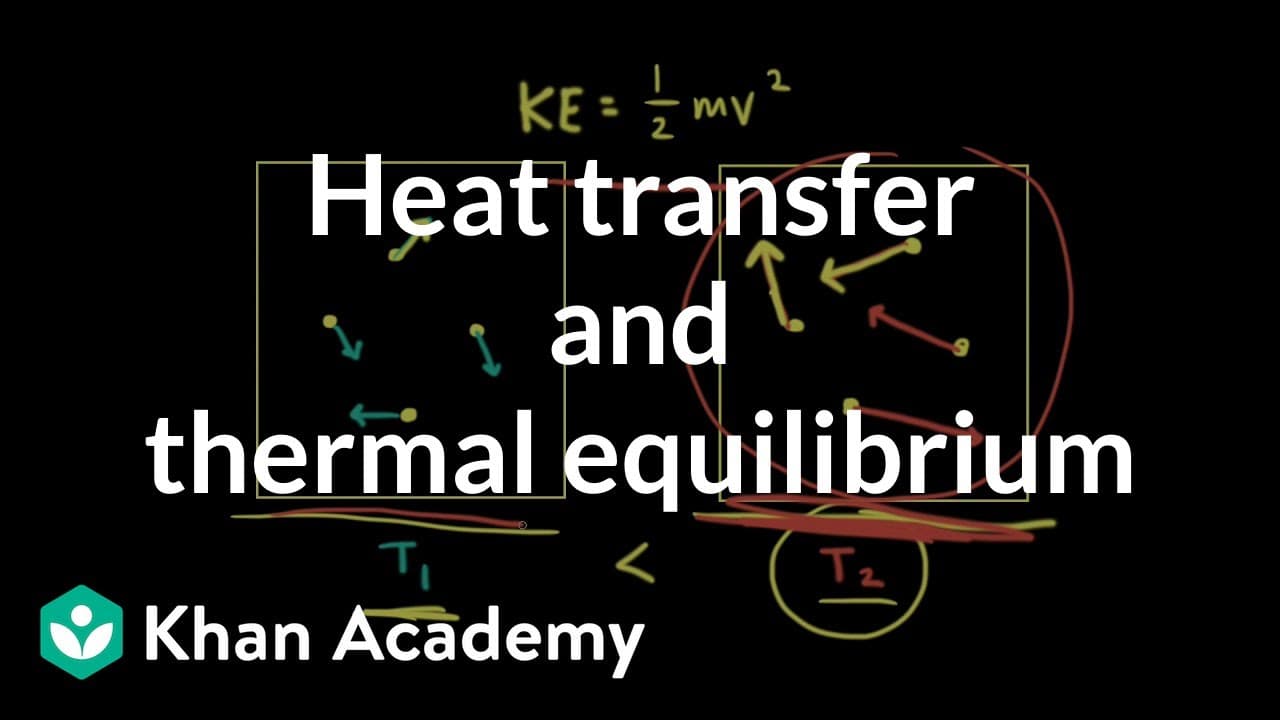
Temperature is a measure of the average kinetic energy of particles in a substance, with higher temperatures indicating faster motion. Heat flows from higher temperature objects to lower temperature objects until thermal equilibrium is reached.
Transcript
- [Instructor] Let's say we have two samples of helium gas. One sample of helium gas is at temperature T1 and the other sample of helium gas is at temperature T2. If T2 is greater than T1, that means on average, the particles of helium gas in the second box are moving faster than the particles of helium gas in the first box. We can tell the particl... Read More
Key Insights
- ❓ Temperature is a measure of the average kinetic energy of particles in a substance.
- ✋ Higher temperatures indicate faster particle motion and higher kinetic energy.
- 💐 Heat flows from objects at higher temperatures to objects at lower temperatures.
- 🥵 When two objects at different temperatures come into contact, heat is transferred between them until thermal equilibrium is reached.
- ❓ Thermal equilibrium occurs when objects in contact reach the same final temperature.
- 🥵 At thermal equilibrium, there is no more flow of heat between the objects.
- ❓ The average kinetic energy of particles in a substance is proportional to its temperature.
Install to Summarize YouTube Videos and Get Transcripts
Explore YouTube Video Summarizer or Get YouTube Transcript Extractor
Questions & Answers
Q: How does temperature relate to the average kinetic energy of particles?
Temperature is a measure of the average kinetic energy of particles in a substance. Higher temperatures indicate that particles are moving faster and have more kinetic energy.
Q: What happens when two objects at different temperatures come into contact?
When two objects at different temperatures come into contact, heat flows from the object at the higher temperature to the object at the lower temperature. This results in the particles in the hotter object slowing down and the particles in the colder object speeding up until thermal equilibrium is reached.
Q: What determines the average kinetic energy of particles in a substance?
The average kinetic energy of particles in a substance is determined by the temperature of the substance. Higher temperatures correspond to higher average kinetic energy.
Q: What is thermal equilibrium?
Thermal equilibrium is reached when two objects in contact reach the same final temperature. At this point, there is no more flow of heat between the objects, and the average kinetic energy of the particles in both objects is the same.
Summary & Key Takeaways
-
Temperature is a measure of the average kinetic energy of particles in a substance.
-
Higher temperatures indicate that particles are moving faster and have higher kinetic energy.
-
Heat flows from objects at higher temperatures to objects at lower temperatures until thermal equilibrium is reached.
Read in Other Languages (beta)
Share This Summary 📚
Summarize YouTube Videos and Get Video Transcripts with 1-Click
Try YouTube Summary with ChatGPT & Claude or YouTube Transcript Generator
Explore More Summaries from Khan Academy 📚



Summarize YouTube Videos and Get Video Transcripts with 1-Click
Try YouTube Summary with ChatGPT & Claude or YouTube Transcript Generator