Hypothesis test for difference in proportions | AP Statistics | Khan Academy
TL;DR
This content explains how to conduct a hypothesis test to determine if there is a significant difference in proportions between two populations.
Transcript
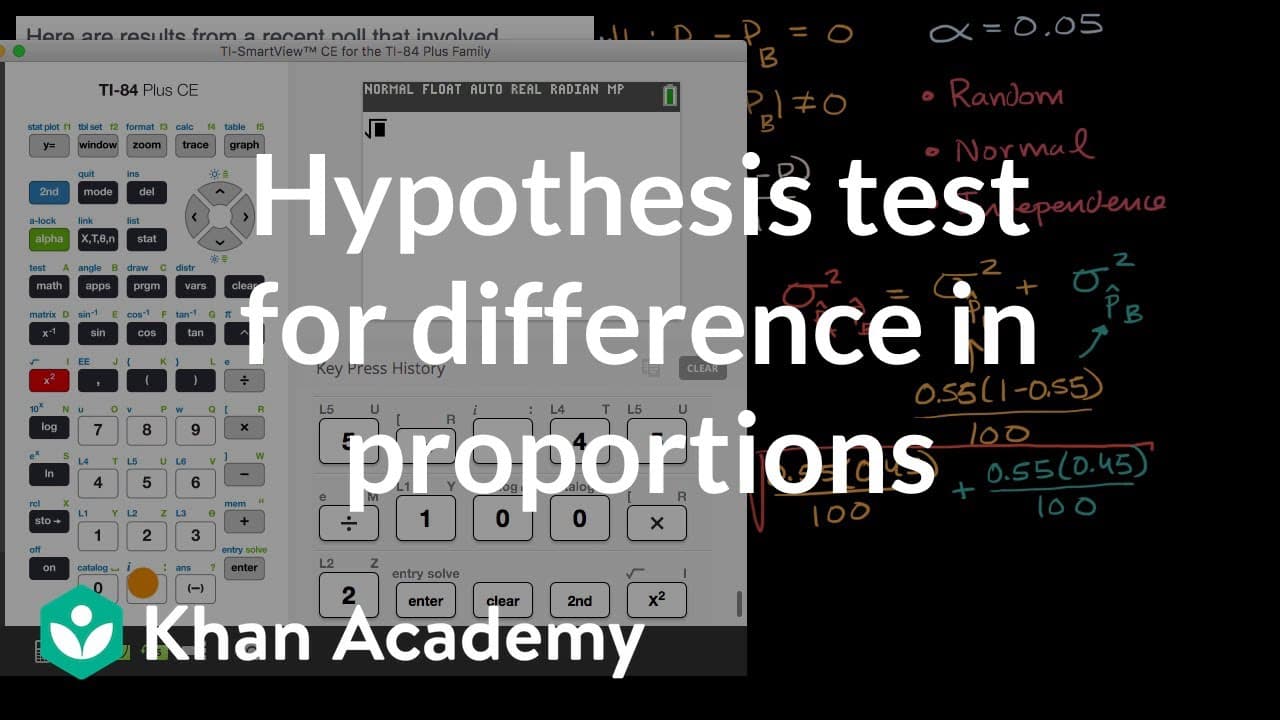
- [Instructor] We're now going to explore hypothesis testing where we're thinking about the difference between proportions of two different populations. So here it says, here are the results from a recent poll that involved sampling voters from each of two neighboring districts, District A and District B, and folks were asked whether they supported... Read More
Key Insights
- 🏆 Hypothesis tests are used to determine if there is significant evidence to support a claim about a population.
- ❓ The null hypothesis assumes no difference, while the alternative hypothesis suggests a significant difference.
- 🪡 Conditions for inference, such as random sampling and normal distribution, need to be met for accurate results.
- ❓ The standard deviation of the sampling distribution is estimated using the combined sample proportion.
- 🤪 By calculating a z-score, the probability of obtaining a result as extreme or more extreme than the observed difference can be determined.
- ✋ If the probability is higher than the significance level, the null hypothesis cannot be rejected.
Install to Summarize YouTube Videos and Get Transcripts
Explore YouTube Video Summarizer or Get YouTube Transcript Extractor
Questions & Answers
Q: What is the purpose of a hypothesis test?
A hypothesis test is used to determine if there is enough evidence to support or reject a claim about a population based on sample data.
Q: How is the null hypothesis defined in this scenario?
The null hypothesis assumes that the proportion of voters supporting the law in District A is equal to the proportion in District B, or that the difference between the proportions is zero.
Q: What are the conditions for inference in this analysis?
The conditions include random sampling, normal distribution (at least 10 successes and failures in each sample), and independence (sample sizes should be no more than 10% of the entire population).
Q: How is the standard deviation of the sampling distribution calculated?
The standard deviation is estimated using the combined sample proportion, which is the best estimate for the true proportion in District A and District B assuming no difference.
Summary & Key Takeaways
-
A recent poll sampled voters from two neighboring districts, District A and District B, to determine their support for a new law.
-
The null hypothesis assumes that there is no difference in proportions between the two districts, while the alternative hypothesis suggests there is a significant difference.
-
To conduct the hypothesis test, the conditions for inference need to be met, including random sampling, normal distribution, and independence.
Read in Other Languages (beta)
Share This Summary 📚
Summarize YouTube Videos and Get Video Transcripts with 1-Click
Try YouTube Summary with ChatGPT & Claude or YouTube Transcript Generator
Explore More Summaries from Khan Academy 📚



Summarize YouTube Videos and Get Video Transcripts with 1-Click
Try YouTube Summary with ChatGPT & Claude or YouTube Transcript Generator