Basic Operations on Discrete Time Signals Problem 3
TL;DR
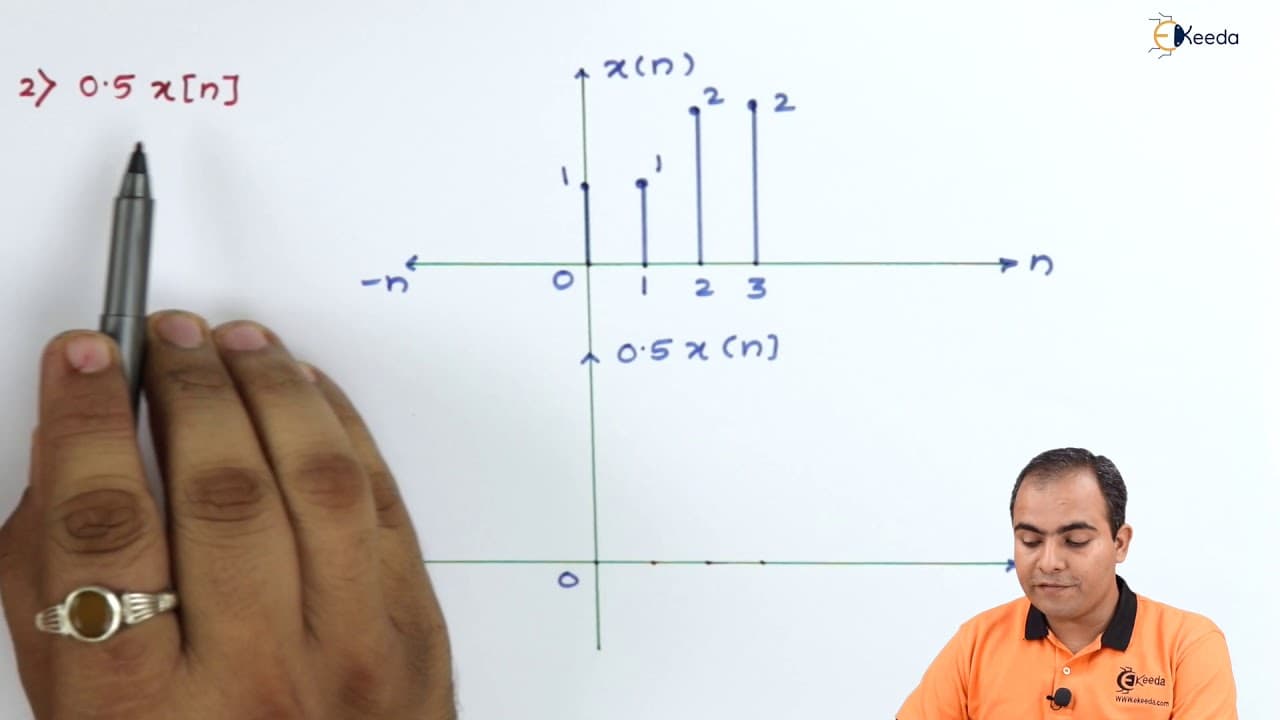
This video explains how to perform basic operations such as time reversal, amplitude scaling, and time scaling on discrete-time signals.
Transcript
click the bell icon to get latest videos from equator hello friends and today we are going to study a basic operations on this script M signal of problem number three so let's see what is given in this question now look at this question what is mentioned a problem or three for the given descriptive signal op in these things we are going to find out... Read More
Key Insights
- ⌛ Time reversal or mirror image involves multiplying each sample of a discrete-time signal by -1.
- 🧑🏭 Amplitude scaling involves multiplying the amplitudes of a discrete-time signal by a given factor.
- ⌛ Time scaling involves multiplying the time index of a discrete-time signal by a given factor.
- ⌛ Adding a discrete-time signal to its time-reversed version results in canceling out opposite amplitudes and obtaining a graph with zero amplitude at those instants.
- ⌛ Amplitude scaling affects the amplitude of a discrete-time signal, while time reversal and time scaling affect the position of the samples.
- 🧑🏭 Amplitude scaling can compress or expand a graph based on the factor used.
- 🧑🏭 Time scaling can compress or expand a graph based on the factor used and affects the position of the samples.
Install to Summarize YouTube Videos and Get Transcripts
Explore YouTube Video Summarizer or Get YouTube Transcript Extractor
Questions & Answers
Q: What are the properties used to solve the given problem on the discrete-time signal?
The properties used are time reversal or mirror image, amplitude scaling, and time scaling. Time reversal involves multiplying each sample by -1, amplitude scaling involves multiplying the amplitudes by a given factor, and time scaling involves multiplying the time index by a given factor.
Q: How do we find the amplitude at a particular instant in a discrete-time signal?
In a discrete-time signal, the amplitude is only present at a specific instant of time. In between two instants, the amplitude is always 0. By reading the values of the amplitude at the given instants, we can determine the amplitude at any particular instant.
Q: What happens when we add a discrete-time signal to its time-reversed version?
When we add a discrete-time signal to its time-reversed version, we simply add the amplitudes at each corresponding instant. If the amplitudes at a particular instant in both signals are X and -X, they will cancel each other out and result in an amplitude of 0 at that instant.
Q: How does amplitude scaling affect a discrete-time signal?
Amplitude scaling involves multiplying the amplitudes of a discrete-time signal by a given factor. If the factor is greater than 1, the amplitudes will increase, resulting in a compressed graph. If the factor is between 0 and 1, the amplitudes will decrease, resulting in an expanded graph.
Summary & Key Takeaways
-
The video discusses how to solve a problem involving a given discrete-time signal and finding different parts of it.
-
It explains the concepts of time reversal, amplitude scaling, and time scaling and how to apply them to the given signal.
-
The video provides step-by-step solutions for each part of the problem.
Read in Other Languages (beta)
Share This Summary 📚
Summarize YouTube Videos and Get Video Transcripts with 1-Click
Try YouTube Summary with ChatGPT & Claude or YouTube Transcript Generator
Explore More Summaries from Ekeeda 📚




Summarize YouTube Videos and Get Video Transcripts with 1-Click
Try YouTube Summary with ChatGPT & Claude or YouTube Transcript Generator