U-substitution with definite integral
TL;DR
U-Substitution simplifies the process of evaluating definite integrals by changing the variable and boundaries, resulting in a final value of 1.
Transcript
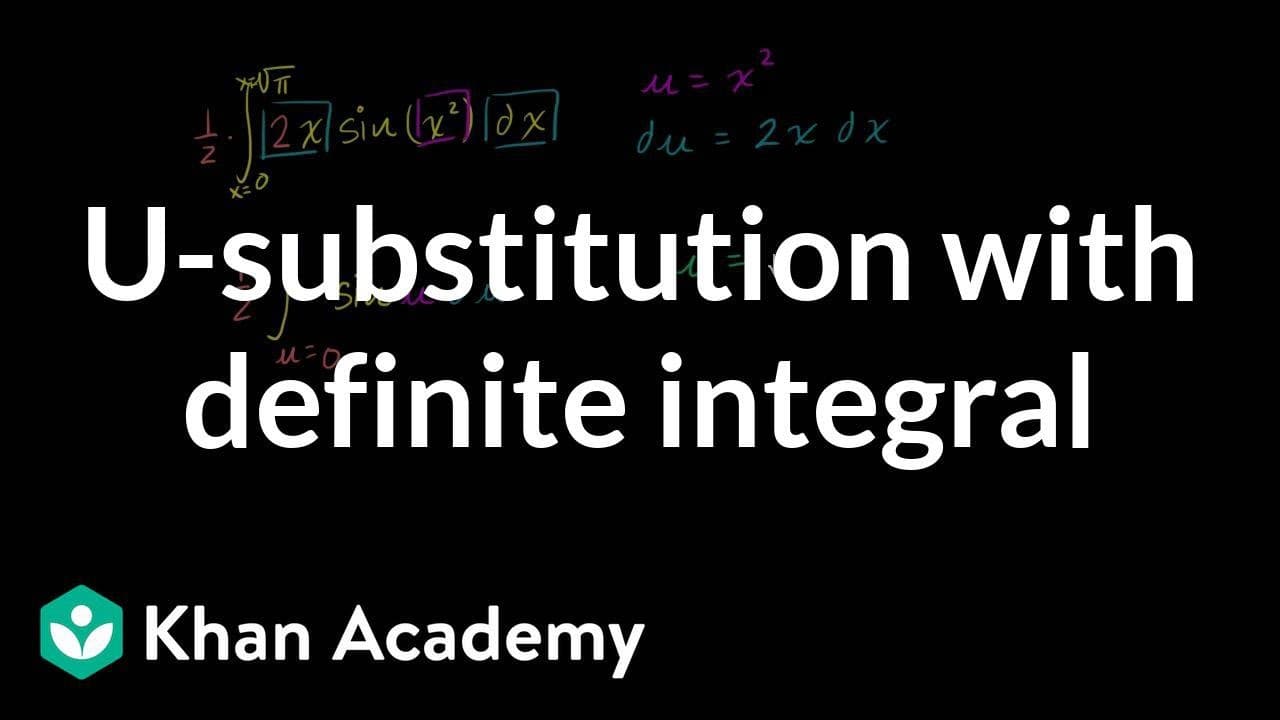
We now have a definite integral going from x equals 0 to x equals square root of pi, of x sine of x squared dx. So the first thing that you might want to ask yourself is whether u substitution is appropriate here. And if it is, what would you set u to be equal to? I'll let you think about that for a second. Well, we see here this expression, x squa... Read More
Key Insights
- 🗞️ U-substitution can significantly simplify the evaluation of definite integrals by changing the variable and rewriting the integral in terms of the new variable.
- 😫 By setting u=x^2 and finding du=2xdx, the integrand x*sin(x^2) can be rewritten as sin(u)du.
- 🤨 The boundaries of integration must be changed to match the new variable, resulting in u=0 to u=pi for this specific example.
- 😄 After evaluating the simplified integral in terms of u, the final value is obtained as 1.
- 🥘 U-substitution allows for a more efficient and straightforward approach to solving definite integrals, eliminating the need for complex manipulation and conversion back to the original variable.
- 🈸 Understanding the concept and application of u-substitution is crucial for effectively solving integral problems.
- 🚞 U-substitution is a powerful tool in mathematics, particularly in integral calculus, providing a way to simplify and evaluate integrals that would otherwise be challenging.
Install to Summarize YouTube Videos and Get Transcripts
Explore YouTube Video Summarizer or Get YouTube Transcript Extractor
Questions & Answers
Q: How can u-substitution be applied to evaluate the definite integral?
U-substitution involves choosing a new variable, setting u equal to a function of x, and finding the derivative du. The integral is then rewritten in terms of u and du, making it easier to evaluate.
Q: Why do we need to change the boundaries of integration?
When performing u-substitution, the boundaries of integration should also be expressed in terms of the new variable u. This ensures that the integral is evaluated correctly in the new variable.
Q: How does u-substitution make the evaluation of definite integrals easier?
U-substitution simplifies the integrand and allows us to apply known integration techniques. It eliminates the need for complex manipulations and makes the evaluation process more straightforward.
Q: What is the final value of the definite integral after applying u-substitution?
The definite integral of x*sin(x^2) from x=0 to x=sqrt(pi) evaluates to 1 after performing u-substitution.
Summary & Key Takeaways
-
U-Substitution is appropriate for evaluating the definite integral of x*sin(x^2) from x=0 to x=sqrt(pi).
-
By setting u=x^2 and du=2xdx, the integral can be rewritten as sin(u)du.
-
The boundaries of integration can be rewritten in terms of u, from u=0 to u=pi.
Read in Other Languages (beta)
Share This Summary 📚
Summarize YouTube Videos and Get Video Transcripts with 1-Click
Try YouTube Summary with ChatGPT & Claude or YouTube Transcript Generator
Explore More Summaries from Khan Academy 📚



Summarize YouTube Videos and Get Video Transcripts with 1-Click
Try YouTube Summary with ChatGPT & Claude or YouTube Transcript Generator