Security - Hegemonic Stability Theory
TL;DR
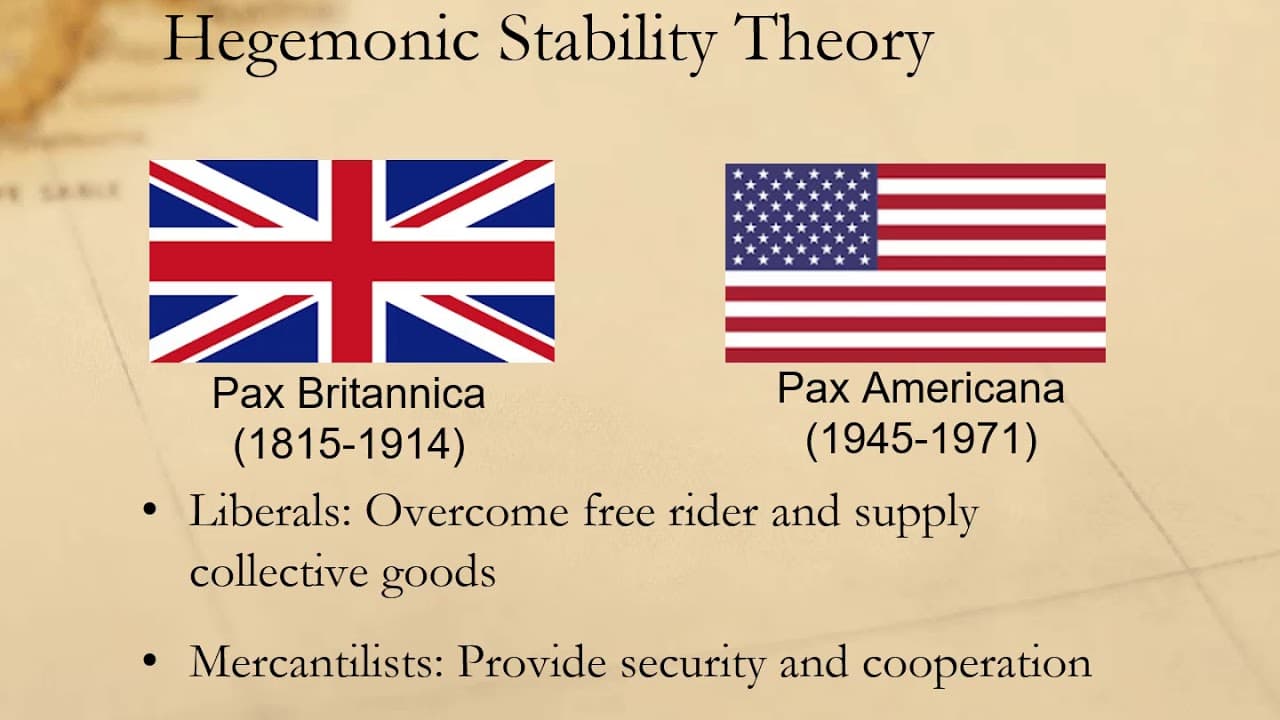
Hegemonic stability theory explains the implications of a unipolar system, where one dominant actor, or hegemon, enforces and maintains the rules of the international system for greater stability and collective goods.
Transcript
Hey everyone. Noah Zerbe here. Welcome back! In our last video, we looked at the concept of polarity and international relations. In this video, we're going to look at the concept of hegemonic stability theory, which deals with the international system under conditions of unipolarity. Remember that a unipolar system is an international system in wh... Read More
Key Insights
- 👋 Hegemonic stability theory explains the role of a dominant actor, or hegemon, in maintaining stability and addressing collective goods problems in the international system.
- 🌐 Historical examples, such as Britain during the Industrial Revolution and the United States post-World War Two, demonstrate the impact of hegemonic stability theory in promoting global norms and institutions.
- ❓ Different theoretical approaches offer varying perspectives on the motivations and actions of a hegemon.
- 🇸🇦 Saudi Arabia's role in OPEC exemplifies how a hegemon sacrifices its own interests for the functioning of the group and the stability of the international regime.
Install to Summarize YouTube Videos and Get Transcripts
Explore YouTube Video Summarizer or Get YouTube Transcript Extractor
Questions & Answers
Q: What is a unipolar system, and how does it relate to hegemonic stability theory?
A unipolar system refers to an international system in which there is one dominant actor, known as a hegemon. Hegemonic stability theory focuses on this system and analyzes the implications of having a single powerful actor influencing and enforcing international rules.
Q: What are the key characteristics of a hegemon?
A hegemon typically possesses a large and growing economy, dominates leading technological and economic sectors, and has political power backed up by military capabilities. These attributes allow the hegemon to enforce and maintain the rules of the international system.
Q: What is the role of a hegemon in maintaining international institutions?
The hegemon plays a crucial role in inducing, incentivizing, coercing, or threatening other states to behave in ways that maintain the international system. This may involve promoting dominant norms, such as capitalism and democracy, and bearing a disproportionate share of the costs of maintaining international institutions.
Q: How do different theoretical approaches understand the motivations of a hegemon?
Liberals emphasize the ability of a hegemon to provide collective goods and overcome the free rider dilemma. Mercantilists focus on the security benefits and economic gains a hegemon enjoys through its central position in the global economy. Marxists and critical IR scholars highlight the hegemon's imperial ambitions and exploitation of other states.
Summary & Key Takeaways
-
Hegemonic stability theory examines the international system under conditions of unipolarity, where a single dominant actor, known as a hegemon, enforces its will on other actors.
-
A hegemon must have the capability, willingness, and commitment to enforce the rules of the international system, often backed by a strong economy, technological dominance, and military power.
-
Historical examples include Britain during the Industrial Revolution and the United States after World War Two, where hegemonic stability theory played a role in maintaining global norms and institutions.
Read in Other Languages (beta)
Share This Summary 📚
Summarize YouTube Videos and Get Video Transcripts with 1-Click
Try YouTube Summary with ChatGPT & Claude or YouTube Transcript Generator
Explore More Summaries from Noah Zerbe 📚



Summarize YouTube Videos and Get Video Transcripts with 1-Click
Try YouTube Summary with ChatGPT & Claude or YouTube Transcript Generator