Basic Operations on Continuous Time Signal (Problem 3) | Representation of Signal | Signals & System
TL;DR
This content discusses problem number three related to emptiness time signals and basic operations on continuous-time signals, covering the concepts of time scaling, time shifting, and amplitude scaling.
Transcript
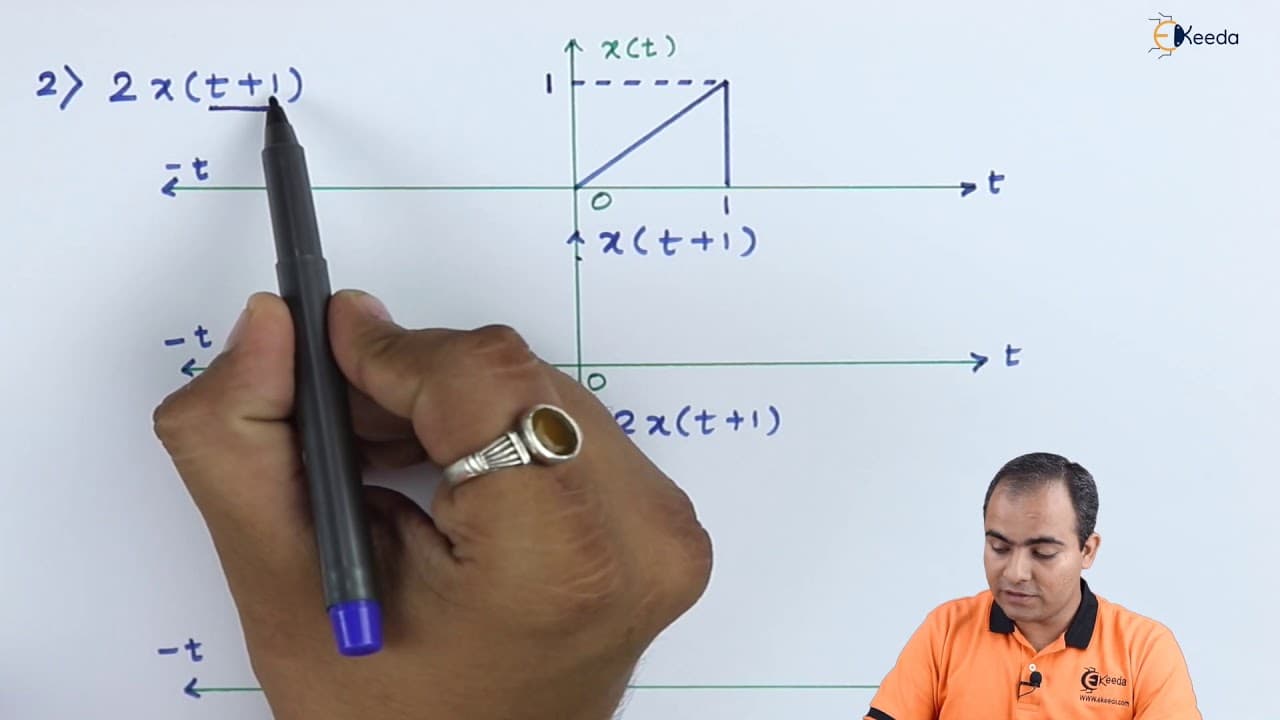
click the bell icon to get latest videos from akira hello friends and today we're going to study a problem number three which is based on emptiness time signals or you can say basic operations on continuous-time signals so let's see what is the question in problem number three a simple oven Ramsay of is given and it is available between 0 to 1 and ... Read More
Key Insights
- ⌛ The properties of time scaling, time shifting, and amplitude scaling are commonly used to manipulate continuous-time signals.
- ⌛ Time scaling involves multiplying each time instance by a scaling factor, which can expand or compress the graph.
- ↔️ Time shifting involves moving the graph to the left or right by a certain number of units.
- 📈 Amplitude scaling involves multiplying the function by a scalar value, which changes the amplitude of the graph.
- 🪈 The order of applying these properties can affect the final result of the signal manipulation.
- ⌛ The amplitude of the graph remains unchanged when applying time scaling or time shifting.
- 📈 When multiplying the function by -1, the graph's amplitude becomes negative.
Install to Summarize YouTube Videos and Get Transcripts
Explore YouTube Video Summarizer or Get YouTube Transcript Extractor
Questions & Answers
Q: What is the first property applied to find X of minus T by 2, and how does it affect the graph?
The first property applied is time scaling, which multiplies each time instance by 2. This results in the graph starting from 0 and terminating at -2.
Q: How is the function advanced in the second part of the question, and what is the effect on the graph?
The function is advanced by 1 unit using the time shifting property. The graph is shifted to the left by 1 unit, starting from -1 and terminating at 0. The amplitude is scaled by 2.
Q: How is the last part of the question solved, involving minus X of 2T?
The time scaling property is used to compress the graph by dividing all time instances by 2. The amplitude scaling property is applied to multiply the function by -1, resulting in the graph having a negative amplitude of -1.
Q: What are the changes in amplitude and time for the different parts of the question?
In the first part, the amplitude remains the same, while the time is scaled by 2. In the second part, the amplitude is doubled, while the time is shifted to the left by 1 unit. In the third part, the amplitude is -1, and the time is compressed by dividing by 2.
Summary & Key Takeaways
-
The content explains how to find X of minus T by 2 by applying the time scaling property, resulting in a graph starting from 0 and terminating at -2.
-
It discusses advancing the function by 1 using time shifting property, shifting the graph to the left by 1 unit and terminating at 0.
-
The content explains the use of amplitude scaling property to multiply the function by 2, changing the amplitude from 1 to 2.
-
It demonstrates the application of time scaling and amplitude scaling properties to compress the graph and change the amplitude to -1.
Read in Other Languages (beta)
Share This Summary 📚
Summarize YouTube Videos and Get Video Transcripts with 1-Click
Try YouTube Summary with ChatGPT & Claude or YouTube Transcript Generator
Explore More Summaries from Ekeeda 📚




Summarize YouTube Videos and Get Video Transcripts with 1-Click
Try YouTube Summary with ChatGPT & Claude or YouTube Transcript Generator