Products
Features
YouTube Video Summarizer
Summarize YouTube videos
Web & PDF Highlighter
Highlight web pages & PDFs
Chat with PDF
Ask any PDF questions with AI
Ask AI Clone
Chat with your highlights & memories
Audio Transcriber
Transcribe audio files to text
Glasp Reader
Read and highlight articles
Kindle Highlight Export
Export your Kindle highlights
Idea Hatch
Hatch ideas from your highlights
Integrations
Obsidian Plugin
Notion Integration
Pocket Integration
Instapaper Integration
Medium Integration
Readwise Integration
Snipd Integration
Hypothesis Integration
Apps & Extensions
Chrome Extension
Safari Extension
Edge Add-ons
Firefox Add-ons
iOS App
Android App
Discover
Discover
Ideas
Discover new ideas and insights
Articles
Curated articles and insights
Books
Book recommendations by great minds
Posts
Essays and notes from readers
Quotes
Inspiring quotes collection
Videos
Curated videos and summaries
Explore Glasp
Glasp Newsletter
Weekly insights and updates
Glasp Talk
Interview series with great minds
Glasp Blog
Latest news and articles
Glasp Use Cases
Learn how others use Glasp
Build & Support
Glasp API
Access Glasp's API for developers
MCP Connector
Connect Glasp to Claude & ChatGPT
Community
Glasp Reddit Community
Students
Student discount and benefits
FAQs
Frequently Asked Questions
AboutPricing
DashboardLog inSign up

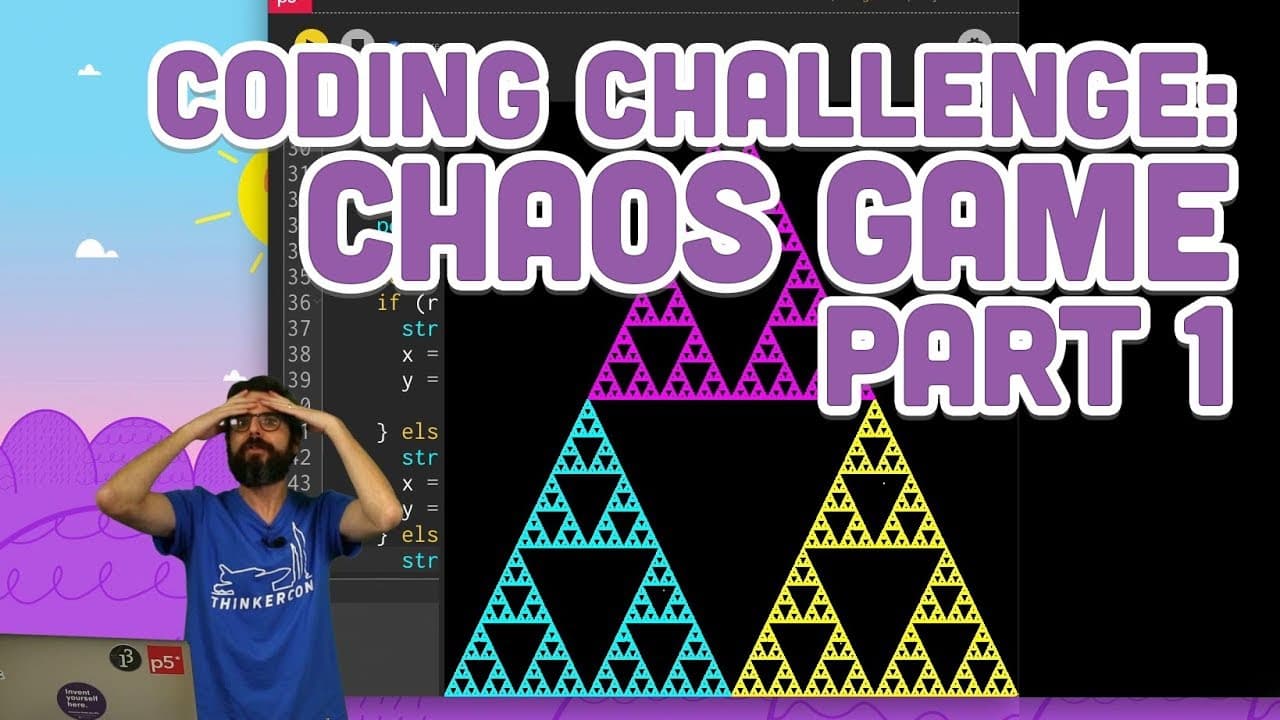
Coding Challenge #123: Chaos Game Part 1
67.9K views
•
November 28, 2018
by
The Coding Train
YouTube video player
Coding Challenge #123: Chaos Game Part 1

TL;DR

The Chaos Game involves picking random points and using math to create fractal patterns.

Transcript

(train whistle toots) - Hello, welcome to A Coding Challenge, The Chaos Game! So this is the Chaos Game playing out right behind me. This is actually code that I wrote at this wonderful event that I recently got the chance to attend, called ThinkerCon. Thank you to the organizers of ThinkerCon: Destin Sandlin, Henry Reich, Emily Graslie, Sabrina Cr... Read More

Key Insights

  • ❓ The Chaos Game is a simple algorithm that can create complex and beautiful fractal patterns.
  • 😥 The process involves selecting random points and making calculations to determine the next point.
  • ❓ The Sierpinski Triangle is a well-known fractal that can be created using the Chaos Game.

Install to Summarize YouTube Videos and Get Transcripts

Explore YouTube Video Summarizer or Get YouTube Transcript Extractor

Questions & Answers

Q: How does the Chaos Game work?

The Chaos Game involves starting with a set of seed points and selecting a random point on the plane. Based on a random number, the algorithm moves halfway towards a specific seed point and repeats the process for the newly generated point.

Q: What is the significance of the Sierpinski Triangle?

The Sierpinski Triangle is a well-known fractal pattern that can be created using the Chaos Game. It demonstrates the complexity that can emerge from simple rules and can be seen as a visual representation of chaos theory.

Q: How can the Chaos Game be customized?

The Chaos Game can be customized by varying the number of seed points, the distance to move towards each point, and the probabilities of selecting each point. Additionally, different rendering techniques, such as connecting the points or using different colors and shapes, can be implemented.

Q: What are some potential extensions to the Chaos Game?

Some potential extensions to explore include using an array of seed points, experimenting with different distance values and probability distributions, and adding additional visual elements such as erasing the background or using different shapes for rendering the points.

Summary & Key Takeaways

  • The Chaos Game involves picking random points on a two-dimensional plane and performing calculations to determine the next point.

  • The algorithm can create fractal patterns, such as the Sierpinski Triangle.

  • The process can be programmed using p5.js web editor, allowing for experimentation with different parameters and rendering techniques.


Read in Other Languages (beta)

English

Share This Summary 📚

Summarize YouTube Videos and Get Video Transcripts with 1-Click

Download browser extensions on:

Try YouTube Summary with ChatGPT & Claude or YouTube Transcript Generator

Explore More Summaries from The Coding Train 📚
9.4: Genetic Algorithm: Looking at Code - The Nature of Code thumbnail
9.4: Genetic Algorithm: Looking at Code - The Nature of Code
The Coding Train
Coding Challenge #116: Lissajous Curve Table thumbnail
Coding Challenge #116: Lissajous Curve Table
The Coding Train
Text Generation using Spell with Nabil Hassein thumbnail
Text Generation using Spell with Nabil Hassein
The Coding Train
8.1: Fractals - The Nature of Code thumbnail
8.1: Fractals - The Nature of Code
The Coding Train
Computer Mouse Conference Demos! (node.js + tensorflow.js) thumbnail
Computer Mouse Conference Demos! (node.js + tensorflow.js)
The Coding Train
ITP/IMA Winter Show 2019 thumbnail
ITP/IMA Winter Show 2019
The Coding Train

Summarize YouTube Videos and Get Video Transcripts with 1-Click

Download browser extensions on:

Try YouTube Summary with ChatGPT & Claude or YouTube Transcript Generator

Apps & Extensions

  • Chrome Extension
  • Safari Extension
  • Edge Add-ons
  • Firefox Add-ons
  • iOS App
  • Android App

Key Features

  • YouTube Video Summarizer
  • Web & PDF Summarizer
  • Web & PDF Highlighter
  • Chat with PDF
  • Ask AI Clone
  • Audio Transcriber
  • Glasp Reader
  • Kindle Highlight Export
  • Idea Hatch

Integrations

  • Obsidian Plugin
  • Notion Integration
  • Pocket Integration
  • Instapaper Integration
  • Medium Integration
  • Readwise Integration
  • Snipd Integration
  • Hypothesis Integration

More Features

  • APIs
  • MCP Connector
  • Blog & Post
  • Embed Links
  • Image Highlight
  • Personality Test
  • Quote Shots

Company

  • About us
  • Blog
  • Community
  • FAQs
  • Job Board
  • Newsletter
  • Pricing
Terms

•

Privacy

•

Guidelines

© 2026 Glasp Inc. All rights reserved.