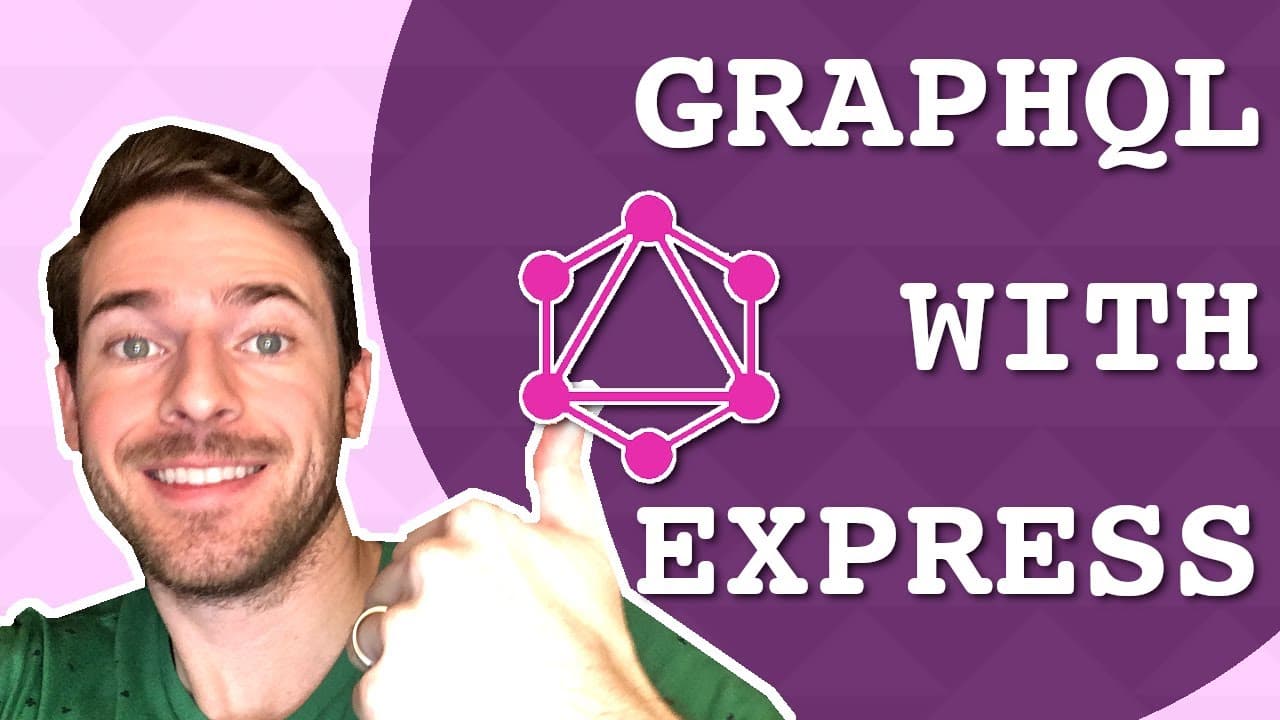
How to code a GraphQL server with Express
TL;DR
Learn to use GraphQL with Express and create a simple API.
Transcript
how is it going everyone welcome back to web dev junkie I'm Cody Seibert and in this video I'm gonna be talking about how to use graph QL more specifically how to use the library called Express - graph QL - spin up a graph QL service and then I'm also gonna use their graphical UI to kind of explain how graph QL works and if you're not a subscriber ... Read More
Key Insights
- 👻 GraphQL simplifies data fetching by allowing clients to specify exactly what data they need, resulting in efficient network usage.
- 🧑🏭 The GraphQL schema acts as a contract between the server and client, defining types, queries, and mutations for data management.
- 💯 Resolvers form the core of data handling in GraphQL, processing queries and returning the appropriate data types defined in the schema.
- ❓ Mutations extend the capabilities of GraphQL, enabling clients to update or create data effectively through specific defined queries.
- 🍵 Understanding how to handle asynchronous operations in GraphQL is essential for building robust applications that interact with external data sources.
- 😫 Setting up an Express server with GraphQL requires careful management of package installations and service configurations to ensure smooth operation.
- 🦻 The graphical interface provided by GraphQL facilitates testing and exploring the API, aiding developers in understanding their data structure while building queries.
Install to Summarize YouTube Videos and Get Transcripts
Explore YouTube Video Summarizer or Get YouTube Transcript Extractor
Questions & Answers
Q: What are the main packages required to set up a GraphQL API with Express?
To set up a GraphQL API using Express, you need to install Express, GraphQL, and Express-GraphQL. These allow you to create a server and define your GraphQL schema and resolvers. Using node-mon is also recommended during development for automatic server restarts.
Q: How do queries differ in GraphQL compared to REST APIs?
In GraphQL, instead of multiple endpoints as in REST APIs, you work with a single endpoint that serves different queries based on the structure of the request. Queries can request specific fields of data, allowing for more flexibility and reducing the number of network requests.
Q: What is the purpose of resolvers in GraphQL?
Resolvers are functions that are responsible for returning data for a specific field in your schema. They are analogous to controllers in a REST API, where you perform logic to gather data from a database based on incoming requests and return the appropriate results.
Q: How can mutations be utilized in GraphQL?
Mutations in GraphQL allow clients to modify data on the server. They enable you to perform actions like creating, updating, or deleting data, similar to POST, PUT, and DELETE methods in REST. A mutation defines the types of changes allowed, along with the parameters required to execute them.
Q: Why is it important to have a type query in the GraphQL schema?
The type query serves as the root of your GraphQL API, defining the entry points for data retrieval. Without at least one type query in your schema, the API cannot function as there would be no defined routes for client queries to access data effectively.
Q: How can asynchronous data fetching be handled in GraphQL?
Asynchronous data fetching can be managed in GraphQL by defining resolvers that return promises. These resolvers can fetch data from databases or external APIs and then return the data when it becomes available, allowing for efficient processing of requests without blocking the main execution thread.
Summary & Key Takeaways
-
The video covers setting up a GraphQL API using Express, installing necessary packages, and creating a basic server configuration.
-
It emphasizes understanding the schema definition and resolvers, explaining how data is queried and returned through a structured format.
-
The tutorial includes creating mutations for data manipulation and demonstrates how to handle asynchronous data fetching with nested structures.
Read in Other Languages (beta)
Share This Summary 📚
Summarize YouTube Videos and Get Video Transcripts with 1-Click
Try YouTube Summary with ChatGPT & Claude or YouTube Transcript Generator
Explore More Summaries from Web Dev Cody 📚
Summarize YouTube Videos and Get Video Transcripts with 1-Click
Try YouTube Summary with ChatGPT & Claude or YouTube Transcript Generator