More rigorous Gibbs free energy / spontaneity relationship | Chemistry | Khan Academy
TL;DR
This video explains the derivation of the Gibbs Free Energy formula, which relates to reversible and irreversible processes and their impact on entropy and heat exchange.
Transcript
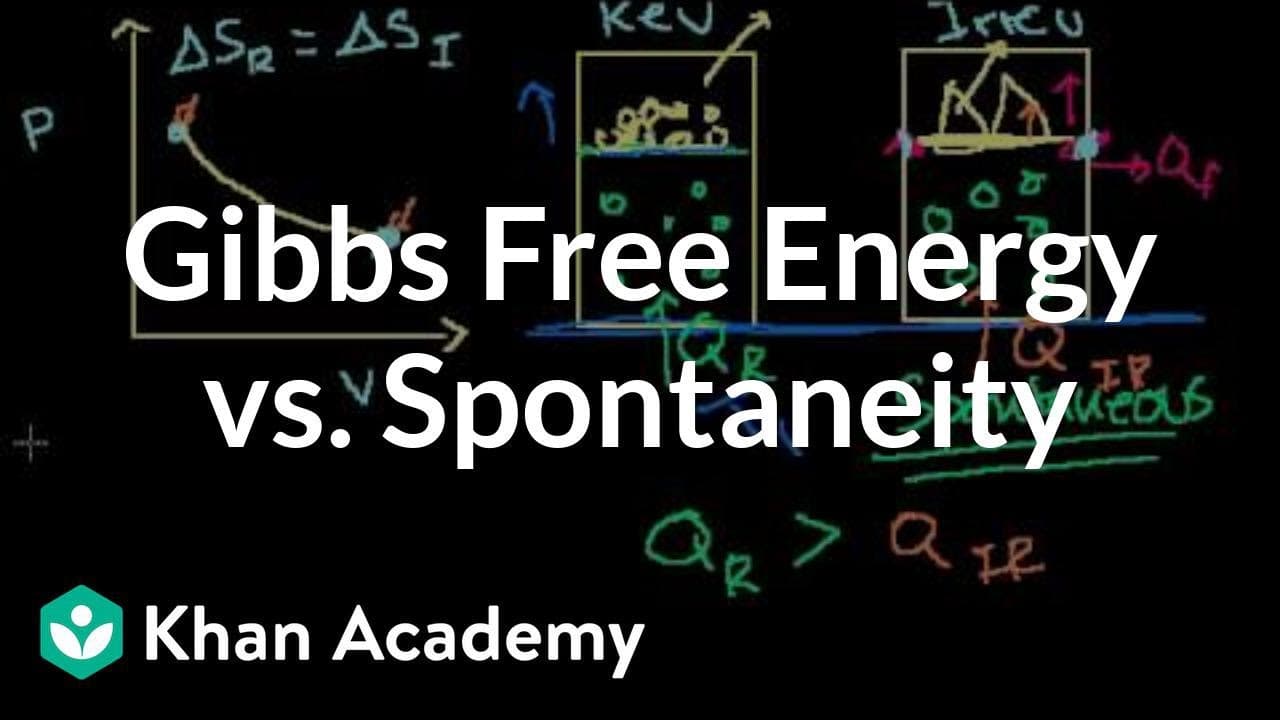
I've hopefully given you a bit of a gut feeling behind where the formula of Gibbs Free Energy comes from. In this video I want to do something a little bit more rigorous and actually, I guess you could say derive the formula. So to do that, let's just study two systems that have the exact same change in entropy. To depict that, I'll get out our han... Read More
Key Insights
- 🥵 Reversible processes maintain equilibrium and can move in any direction without generating heat or friction.
- 🥵 Irreversible processes, which are spontaneous, involve friction and generate their own heat.
- 💱 The change in entropy of the universe is zero for a reversible process.
Install to Summarize YouTube Videos and Get Transcripts
Explore YouTube Video Summarizer or Get YouTube Transcript Extractor
Questions & Answers
Q: What is the difference between reversible and irreversible processes?
Reversible processes are theoretical and maintain equilibrium, with no friction and the ability to move in any direction. Irreversible processes are spontaneous and generate friction, making them move away from equilibrium.
Q: How does heat exchange differ in reversible and irreversible processes?
In a reversible process, the system absorbs more heat from the reservoir to maintain its temperature compared to an irreversible process, which generates its own heat through friction.
Q: What is the change in entropy of the universe for a reversible process?
The change in entropy of the universe for a reversible process is zero because reversible processes can move in either direction and remain infinitely close to equilibrium.
Q: How does the Gibbs Free Energy formula relate to irreversible, spontaneous processes?
The Gibbs Free Energy formula, which considers enthalpy and temperature, shows that for an irreversible, spontaneous process, the value of heat added to the system minus the temperature times the change in entropy will be less than zero.
Summary & Key Takeaways
-
The video explores two systems with the same change in entropy and compares a reversible and irreversible process.
-
In a reversible process, pebbles are slowly removed, creating infinitesimally small changes that maintain equilibrium.
-
In an irreversible process, large blocks are removed, generating friction and additional heat.
Read in Other Languages (beta)
Share This Summary 📚
Summarize YouTube Videos and Get Video Transcripts with 1-Click
Try YouTube Summary with ChatGPT & Claude or YouTube Transcript Generator
Explore More Summaries from Khan Academy 📚



Summarize YouTube Videos and Get Video Transcripts with 1-Click
Try YouTube Summary with ChatGPT & Claude or YouTube Transcript Generator