Challenging similarity problem | Similarity | Geometry | Khan Academy
TL;DR
Two sets of similar triangles are analyzed to find the length of a segment using ratios and substitutions.
Transcript
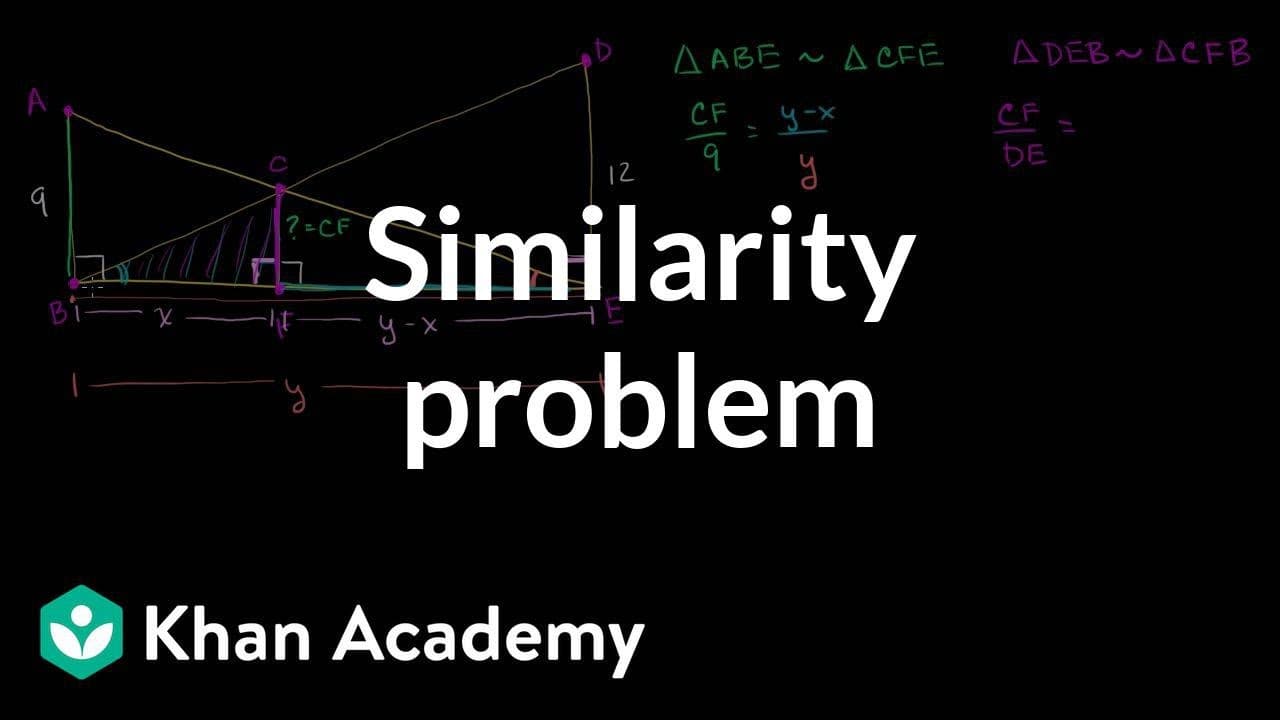
So given this diagram, we need to figure out what the length of CF right over here is. And you might already guess that this will have to do something with similar triangles, because at least it looks that triangle CFE is similar to ABE. And the intuition there is it's kind of embedded inside of it, and we're going to prove that to ourselves. And i... Read More
Key Insights
- 🔺 Triangle similarity can be proven by showing congruent corresponding angles.
- 🙃 Ratios of corresponding sides in similar triangles are constant.
- 🆘 The assumption of values for shared segments and substitution can help solve equations involving similar triangles.
Install to Summarize YouTube Videos and Get Transcripts
Explore YouTube Video Summarizer or Get YouTube Transcript Extractor
Questions & Answers
Q: How do you prove that two triangles are similar?
To prove that two triangles are similar, you need to show that their corresponding angles are congruent. In the given diagram, the angle CEF is congruent to the angle AEB, and the angle DBE is congruent to the angle CBF, proving the similarity of the triangles.
Q: How can you find the length of CF?
By using the ratios of corresponding sides in the similar triangles, we can set up the equation CF/9 = (y - x)/y, where y represents the length of the whole segment and x is the length of BF. This equation can be further simplified to find the value of CF.
Q: What strategy is used to solve the equation for CF?
The strategy involves assuming values for other segments shared by the triangles, such as BE and BF, and expressing CF in terms of these values. By substituting the value of CF from one equation into the other, we can solve for CF by combining like terms and multiplying.
Q: What does the solution for CF reveal about the relationship between the two given segments?
The solution, CF = 36/7, shows that regardless of the distance between the two given segments, the intersection point of two strings from the top of each segment will always be at a height of 36/7, or approximately 5 and 1/7 units, above the base of the other segment.
Summary & Key Takeaways
-
The content discusses the concept of similar triangles and how to prove their similarity by showing congruent corresponding angles.
-
The relationship between the ratios of corresponding sides in similar triangles is highlighted as a way to find unknown lengths.
-
The problem presented involves finding the length of a segment, CF, by assuming values for other segments and using substitution to solve the equation.
Read in Other Languages (beta)
Share This Summary 📚
Summarize YouTube Videos and Get Video Transcripts with 1-Click
Try YouTube Summary with ChatGPT & Claude or YouTube Transcript Generator
Explore More Summaries from Khan Academy 📚



Summarize YouTube Videos and Get Video Transcripts with 1-Click
Try YouTube Summary with ChatGPT & Claude or YouTube Transcript Generator