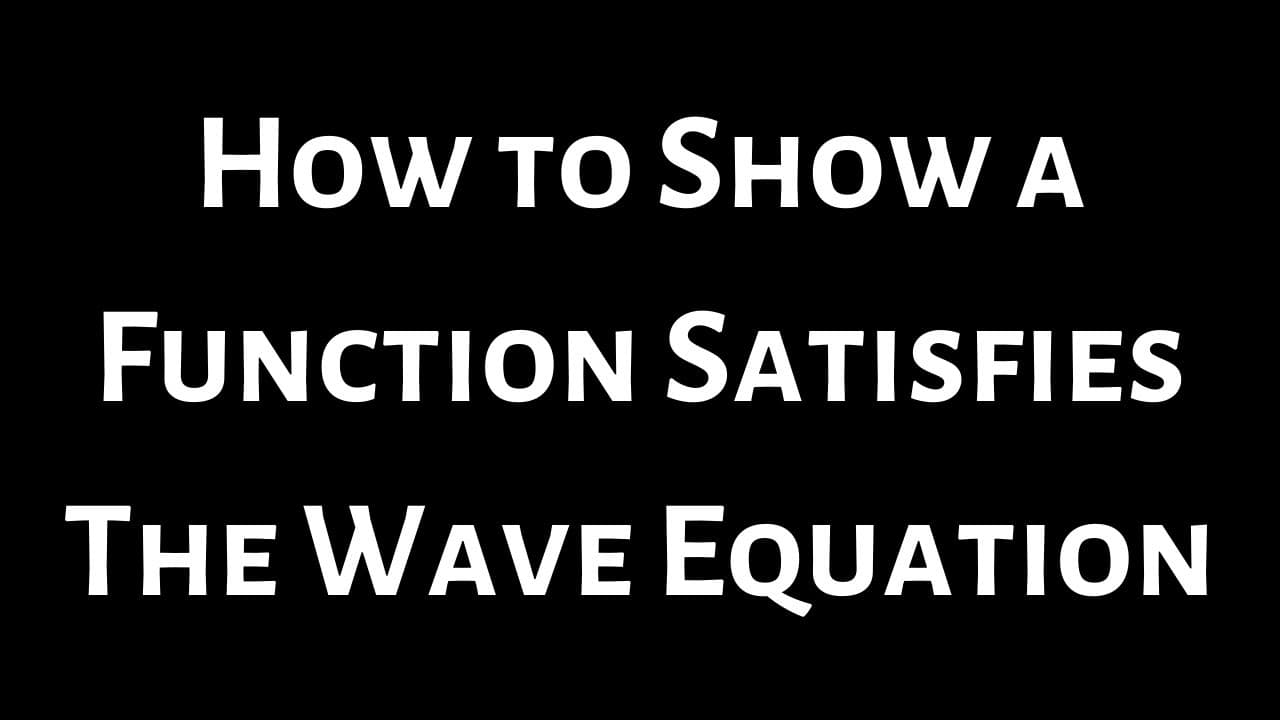
Show that z = cos(4x + 4ct) satisfies The Wave Equation
TL;DR
The video demonstrates the verification of the wave equation for the function Z, which equals the cosine of 4x plus 4CT.
Transcript
show that the function Z equals the cosine of 4x plus 4 C T satisfies the wave equation so this here is the wave equation so to do this problem all we have to do is take the partial derivatives and plug it in and verify that the equation is true let's start with the left-hand side taking the partials of Z with respect to T so I'm going to go ahead ... Read More
Key Insights
- 😑 The wave equation is satisfied when the partial derivatives of the function Z with respect to T and X match certain expressions.
- 🫡 The partial derivative of Z with respect to T involves applying the chain rule and differentiating the cosine function.
- 🤪 The partial derivative of Z with respect to X is obtained by differentiating the cosine function and leaving the inside function unchanged.
- 👋 The wave equation can be verified by comparing the left-hand side and right-hand side equations.
- 😆 By rearranging the equation, we can see that the function Z satisfies the wave equation.
- 👋 The wave equation is essential in the study of physics and engineering, particularly in the field of wave behavior and propagation.
- 👋 Verifying the wave equation for a given function is a fundamental mathematical process.
Install to Summarize YouTube Videos and Get Transcripts
Explore YouTube Video Summarizer or Get YouTube Transcript Extractor
Questions & Answers
Q: What is the function Z in the wave equation and how is it defined?
The function Z is equal to the cosine of 4x plus 4CT. It represents the wave equation in this context.
Q: How do you take the partial derivative of Z with respect to T?
To take the partial derivative of Z with respect to T, we apply the chain rule. We differentiate the outer function (cosine) with respect to T, leaving the inside function (4x + 4CT) untouched. Then, we multiply it by the derivative of the inside function, which is 4C.
Q: What is the partial derivative of Z with respect to X?
The partial derivative of Z with respect to X is obtained by differentiating the cosine function with respect to X, leaving the inside function (4x + 4CT) unchanged. The derivative of cosine is -sine, so we get -4 sine(4x + 4CT).
Q: How do you verify the wave equation using the derivative results?
To verify the wave equation, we compare the derivative results to the right-hand side of the equation. The left-hand side is -16C^2 cosine(4x + 4CT), while the right-hand side is -16 cosine(4x + 4CT). By putting the negative constant in front of the right-hand side, we can confirm that both sides are equal.
Summary & Key Takeaways
-
The video shows how to take partial derivatives of Z with respect to T and X to verify the wave equation.
-
The partial derivative of Z with respect to T is -4C sine(4x + 4CT).
-
The partial derivative of Z with respect to X is -4 sine(4x + 4CT).
Read in Other Languages (beta)
Share This Summary 📚
Summarize YouTube Videos and Get Video Transcripts with 1-Click
Try YouTube Summary with ChatGPT & Claude or YouTube Transcript Generator
Explore More Summaries from The Math Sorcerer 📚


Summarize YouTube Videos and Get Video Transcripts with 1-Click
Try YouTube Summary with ChatGPT & Claude or YouTube Transcript Generator