Statistical Learning: 11.1 Introduction to Survival Data and Censoring
TL;DR
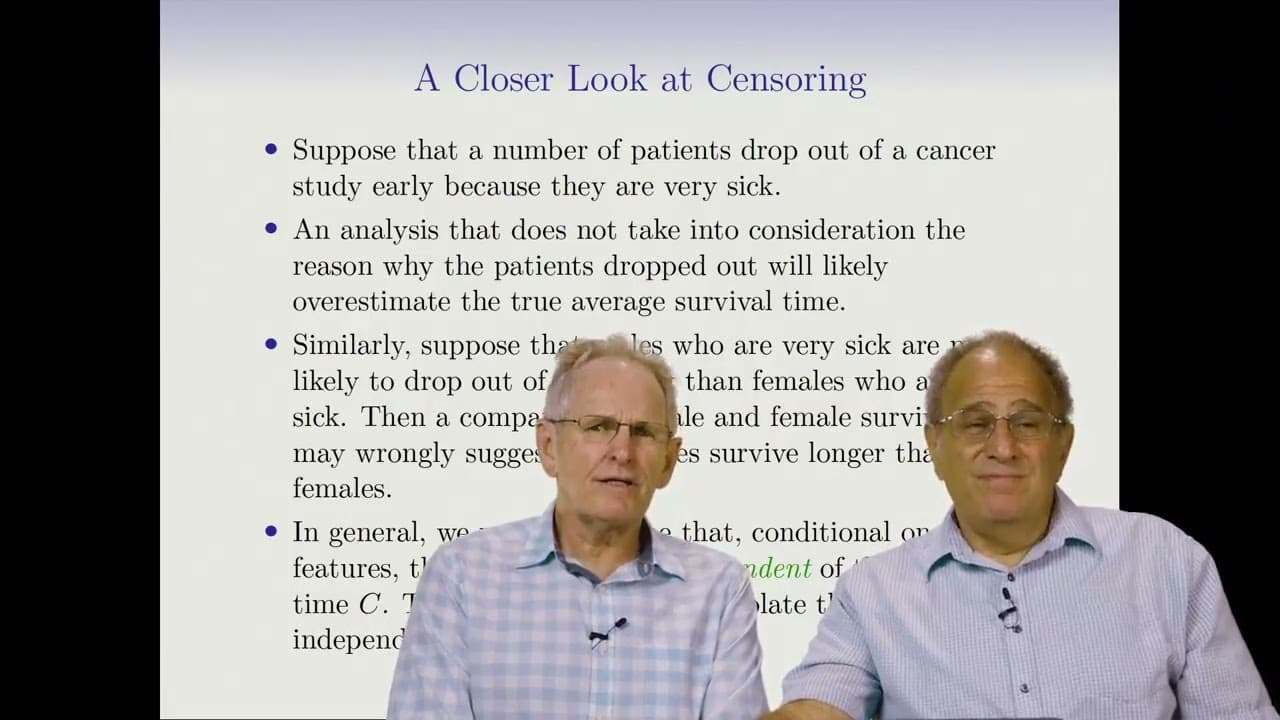
Survival analysis is a statistical method used to analyze data where the outcome variable is the time until an event occurs, such as patient survival. It deals with censoring, where some observations are incomplete, and is becoming more popular in statistical machine learning.
Transcript
welcome everyone uh this lecture is about survival analysis uh this is a shop we've added to the second edition of our book uh it's chapter 11 of the book this is kind of a special topic but a topic that's more and more interest in statistical machine learning so i think i think you'll enjoy it so what is survival analysis it concerns a special kin... Read More
Key Insights
- ⌛ Survival analysis is a statistical method used to analyze time-to-event data, such as patient survival or customer churn.
- 🍵 Censoring, where some observations are incomplete, is an important concept in survival analysis that needs to be properly handled.
- 😥 The Kaplan-Meier curve is a fundamental tool in survival analysis that estimates survival probabilities by considering the proportion of survivors at each time point.
- 👨💼 Survival analysis has applications beyond medicine, such as modeling customer churn in businesses.
- 🙈 The field of survival analysis has seen contributions from various notable statisticians and researchers, including Kaplan, Mantel, Hansel, Cox, and Thurnow.
- ⌛ Understanding the relationship between censoring and survival time is crucial for avoiding bias in survival analysis.
- ⌛ Checking the assumption of independence between event time and censoring time is important, and investigators should be consulted to gather information on reasons for censoring.
Install to Summarize YouTube Videos and Get Transcripts
Explore YouTube Video Summarizer or Get YouTube Transcript Extractor
Questions & Answers
Q: What is survival analysis and what kind of outcomes does it focus on?
Survival analysis is a statistical method that deals with predicting the time until an event occurs. It primarily focuses on outcomes such as patient survival or customer churn.
Q: Why is censoring important in survival analysis?
Censoring refers to incomplete observations where the event of interest has not occurred. It is important to consider censoring because it provides partial information about the outcome and can impact the estimation of survival probabilities.
Q: How can survival analysis be applied outside of medical research?
Survival analysis has applications beyond medicine. For example, it can be used to model customer churn in businesses, allowing companies to identify customers at risk and take proactive measures to retain them.
Q: What is the Kaplan-Meier curve and how does it estimate survival probabilities?
The Kaplan-Meier curve is a graphical representation of the probability of surviving past different time points. It estimates survival probabilities by considering the proportion of individuals who survive at each time point, taking censoring into account.
Summary & Key Takeaways
-
Survival analysis is used to predict the time until an event occurs, such as patient survival or customer churn.
-
Censoring, where some observations are incomplete, is a challenge in survival analysis.
-
The Kaplan-Meier curve is a fundamental tool in survival analysis that estimates the probability of surviving past different time points.
Read in Other Languages (beta)
Share This Summary 📚
Summarize YouTube Videos and Get Video Transcripts with 1-Click
Try YouTube Summary with ChatGPT & Claude or YouTube Transcript Generator
Explore More Summaries from Stanford Online 📚

Summarize YouTube Videos and Get Video Transcripts with 1-Click
Try YouTube Summary with ChatGPT & Claude or YouTube Transcript Generator