How to Compute a Limit Using Delta x and a Fraction
TL;DR
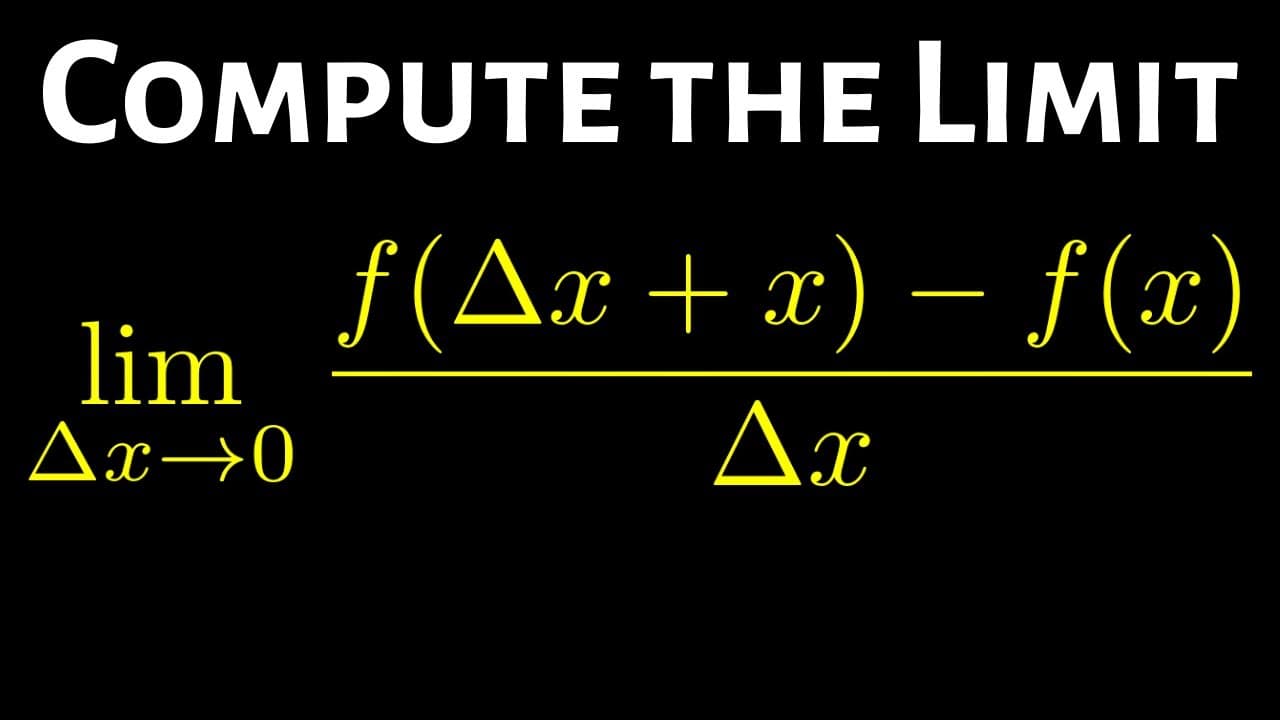
To compute a limit using Delta x, start by substituting X with X plus Delta x in the function. Next, simplify the expression by finding the least common denominator and manipulating the numerator. Finally, divide by Delta x and replace it with zero to determine the limit, yielding the result of negative 1 over (X plus 3) squared.
Transcript
hi everyone in this video we're going to evaluate this limit so we're given this function f of X equals 1 over X plus 3 and we have to evaluate this limit that involves Delta X you may not already know this but you may know it also this is actually something called the derivative of the function so we're assuming when we do this problem that we don... Read More
Key Insights
- 🙂 Evaluating a limit involves replacing variables in a function with a slightly different value and simplifying the expression.
- 🤩 Manipulating the numerator and finding the least common denominator are key steps in simplifying the expression.
- 🗂️ Dividing by the variable used for substitution and replacing it with zero helps find the limit.
- 🛀 The method shown in the video assumes the derivative is unknown, but if it is known, it can be used to evaluate the limit.
- ⛔ Understanding how to evaluate limits is important in calculus and can be applied in various mathematical problems.
- 🎮 The process described in the video can be used for evaluating limits of other functions as well.
- 👻 Substituting variables with a different value allows for a more precise evaluation of the limit.
Install to Summarize YouTube Videos and Get Transcripts
Explore YouTube Video Summarizer or Get YouTube Transcript Extractor
Questions & Answers
Q: How do you start evaluating a limit using the derivative of a function?
To start, evaluate the function at the given value by substituting the variable with the given value.
Q: What is the next step after evaluating the function at the specified value?
The next step is to simplify the expression by finding the least common denominator and manipulating the numerator.
Q: What do you do with the variable used for substitution in the final step?
In the final step, divide the expression by the variable used for substitution, and then replace it with zero to find the limit.
Q: Can this method be used if the derivative of the function is already known?
Yes, the method shown in the video assumes the derivative is unknown, but if it is known, you can also use it to evaluate the limit.
Summary & Key Takeaways
-
The video explains how to evaluate a limit by replacing variables in a function with a slightly different value and simplifying the resulting expression.
-
The first step is to evaluate the function at the specified value by substituting the variable with the given value.
-
Next, simplify the resulting expression by finding the least common denominator and manipulating the numerator.
-
Finally, divide by the variable used for substitution and replace it with zero to find the limit.
Read in Other Languages (beta)
Share This Summary 📚
Summarize YouTube Videos and Get Video Transcripts with 1-Click
Try YouTube Summary with ChatGPT & Claude or YouTube Transcript Generator
Explore More Summaries from The Math Sorcerer 📚

Summarize YouTube Videos and Get Video Transcripts with 1-Click
Try YouTube Summary with ChatGPT & Claude or YouTube Transcript Generator