How to Prove that the Natural Logarithm is an Onto Function
TL;DR
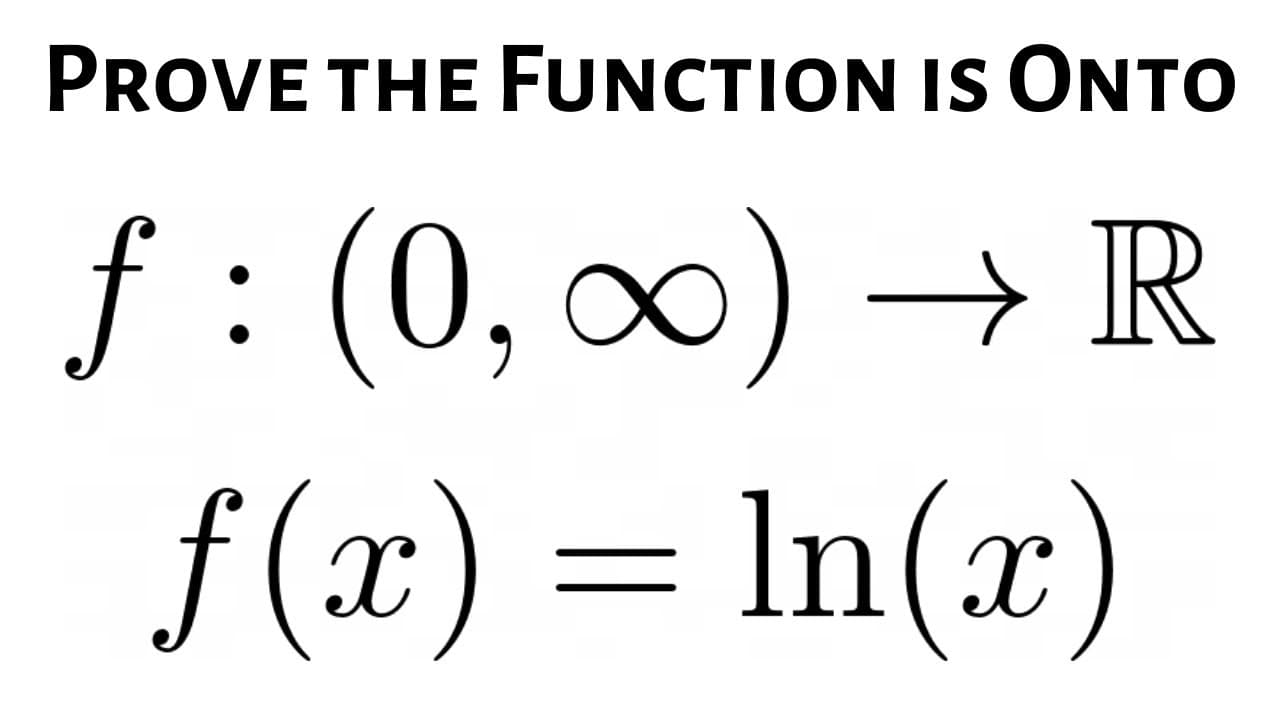
The video explains how to prove that the function f(x) = ln(x) is onto or subjective.
Transcript
so the function defined from the set of positive numbers into the real numbers by f of x equals ln x and we're going to prove that this function is on to so another word for onto is uh subjective so we need the definition of onto recall a function f from a to b where a is the domain and b is the codomain is onto if if and then for all little b and ... Read More
Key Insights
- 👍 The function f(x) = ln(x) can be proven to be onto by finding a suitable value for a in terms of b, such as a = e^b.
- ❓ The definition of onto or subjective function states that every element in the codomain has a corresponding element in the domain.
- 💦 Working backward in the proof helps in determining the necessary conditions for the function to be onto.
- ❓ The positive nature of the exponential function e^x ensures the existence of a suitable element a.
Install to Summarize YouTube Videos and Get Transcripts
Explore YouTube Video Summarizer or Get YouTube Transcript Extractor
Questions & Answers
Q: What is the definition of onto or subjective function?
An onto or subjective function is one where every element in the codomain has a corresponding element in the domain. In other words, for all elements b in the codomain, there exists an element a in the domain such that f(a) = b.
Q: How can we determine if the function f(x) = ln(x) is onto?
To show that the function f(x) = ln(x) is onto, we need to prove that for any given element b in the set of real numbers, there exists an element a in the set of positive numbers such that ln(a) = b. This can be done by finding a suitable value for a, such as a = e^b.
Q: How does the proof of onto property for f(x) = ln(x) work?
The proof starts by taking an arbitrary element b from the set of real numbers. Then, we find an element a in the set of positive numbers such that ln(a) = b by exponentiating both sides of the equation ln(a) = b, which gives a = e^b. This shows that for any b, there exists an a such that f(a) = b, proving the onto property.
Q: Why is it important to prove that a function is onto?
Proving that a function is onto establishes that the function covers or maps every element in the codomain. It guarantees that there are no "gaps" or missing elements in the function's range, allowing for a comprehensive understanding of the mapping between the domain and codomain.
Summary & Key Takeaways
-
The video aims to prove that the function f(x) = ln(x) is onto or subjective.
-
The concept of onto is defined as every element in the codomain having a corresponding element in the domain.
-
The proof is done by working backward and showing that for any given element b in the codomain, there exists an element a in the domain such that f(a) = b.
Read in Other Languages (beta)
Share This Summary 📚
Summarize YouTube Videos and Get Video Transcripts with 1-Click
Try YouTube Summary with ChatGPT & Claude or YouTube Transcript Generator
Explore More Summaries from The Math Sorcerer 📚


Summarize YouTube Videos and Get Video Transcripts with 1-Click
Try YouTube Summary with ChatGPT & Claude or YouTube Transcript Generator