How to Understand Team Coordination in Sports
TL;DR
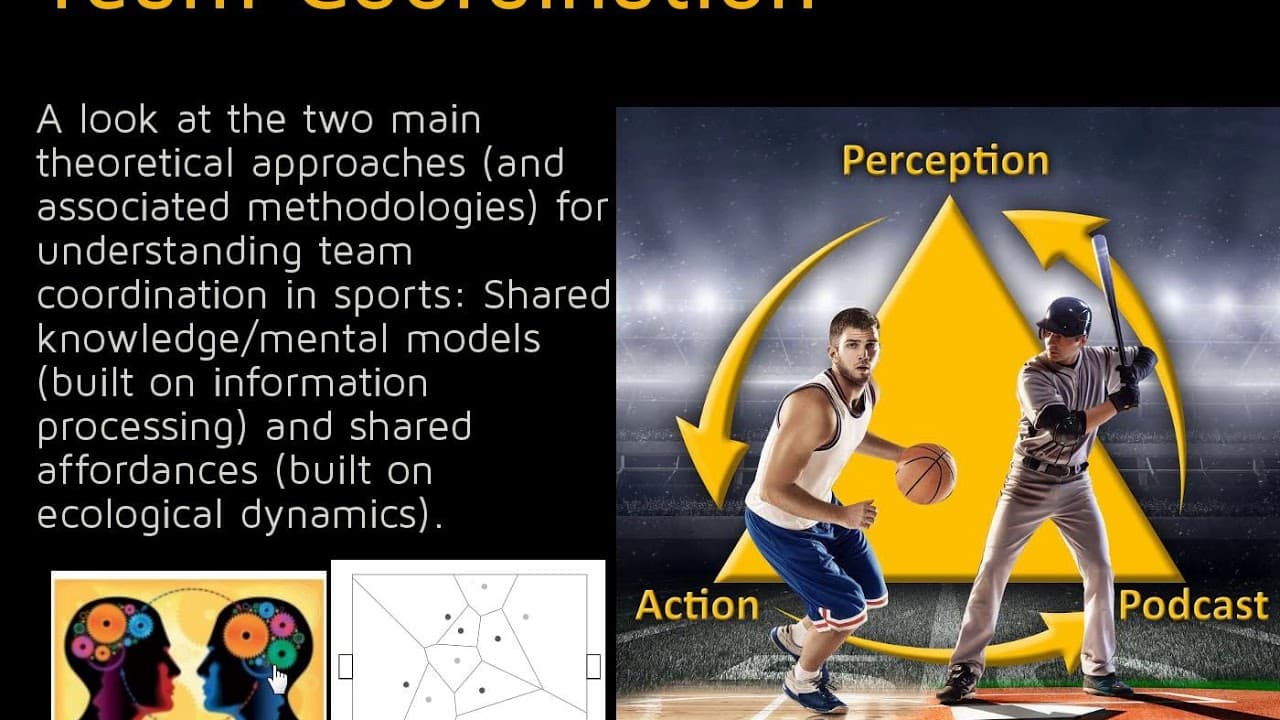
Team coordination in sports can be viewed through two main theoretical lenses: shared mental models and shared affordances. Shared mental models focus on stored knowledge and schemas, while shared affordances emphasize real-time perception and interaction. Each approach offers unique insights and methodologies for studying how teammates synchronize actions in dynamic environments.
Transcript
today on the perception and action podcast a look at the two main theoretical approaches and associated methodologies for understanding team coordination and sports shared knowledge / mental models built on information processing theory versus shared affordances built on ecological dynamics theory so it's time for a call to action hi everyone this ... Read More
Key Insights
- Shared mental models are based on stored information and schemas that team members use to coordinate actions.
- Shared affordances emphasize real-time perception and interaction, focusing on how teammates pick up the same cues simultaneously.
- Team cognition can be studied through retrospective knowledge elicitation or real-time ecological dynamics.
- Shared mental models involve offline analysis of stored knowledge, while shared affordances require online, interactive study.
- Ecological dynamics argue for the importance of shared attunement to perceptual information for coordination.
- Practice is crucial in both approaches, though it serves different purposes in developing team coordination.
- Macro and micro-level methodologies are used to study team coordination, each with its own strengths and limitations.
- A balance between shared knowledge and shared affordances may offer a more comprehensive understanding of team dynamics.
Install to Summarize YouTube Videos and Get Transcripts
Explore YouTube Video Summarizer or Get YouTube Transcript Extractor
Questions & Answers
Q: How do shared mental models facilitate team coordination?
Shared mental models facilitate team coordination by providing a common framework of stored knowledge and schemas that team members use to anticipate and coordinate actions. This approach relies on the idea that players have internalized rules, strategies, and expectations, allowing them to synchronize their actions without explicit communication. It is often studied through offline methods like interviews and surveys.
Q: What is the role of shared affordances in team sports?
Shared affordances play a crucial role in team sports by emphasizing the real-time perception and interaction of teammates. This approach, rooted in ecological dynamics, suggests that players coordinate actions by attuning to the same perceptual cues simultaneously. It underscores the importance of online, interactive study of team dynamics, focusing on how players detect opportunities for action as they emerge during gameplay.
Q: Why is practice important in developing team coordination?
Practice is important in developing team coordination as it helps players internalize shared knowledge and attune to perceptual cues. In the shared mental models approach, practice reinforces stored schemas and strategies, enabling players to anticipate and coordinate actions. In the shared affordances approach, practice allows players to become attuned to higher-order perceptual variables, enhancing their ability to detect and respond to opportunities in real time.
Q: How do researchers study team coordination in sports?
Researchers study team coordination in sports using a variety of methodologies. Shared mental models are often examined through retrospective knowledge elicitation methods like interviews and rating scales. Shared affordances are studied through real-time analysis of gameplay, using video or simulations to identify perceptual cues and interactive dynamics. Both approaches offer unique insights into how teams synchronize actions in dynamic environments.
Q: What are the limitations of the shared mental models approach?
The shared mental models approach has limitations, including its reliance on offline analysis and stored knowledge. It may not fully capture the real-time dynamics of team coordination, as it assumes players rely on pre-stored schemas for every possible scenario. Additionally, it may not account for novel or creative plays that arise spontaneously during gameplay, limiting its applicability to dynamic sports environments.
Q: How does the ecological dynamics approach differ from traditional models?
The ecological dynamics approach differs from traditional models by emphasizing real-time perception and interaction rather than stored knowledge. It argues that team coordination arises from shared attunement to perceptual cues, allowing players to respond to opportunities as they emerge. This approach focuses on online, interactive study of team dynamics, offering a richer and more parsimonious account of how teammates synchronize actions in dynamic environments.
Q: What methodologies are used to study shared affordances?
Methodologies used to study shared affordances include both micro and macro-level analyses. Micro-level research identifies perceptual information sources used for coordinated behavior, often through video or simulation analysis. Macro-level studies involve GPS data collection to assess group-based metrics like centroids and synchrony. These methodologies offer insights into the real-time dynamics of team coordination, focusing on how players attune to perceptual cues.
Q: How can shared knowledge and shared affordances be integrated?
Shared knowledge and shared affordances can be integrated by recognizing the complementary roles they play in team coordination. Shared knowledge provides a foundation of rules and strategies, while shared affordances emphasize real-time perception and interaction. By combining elements of both approaches, researchers can gain a more holistic understanding of how teams synchronize actions, accounting for both stored schemas and dynamic perceptual cues in sports environments.
Summary & Key Takeaways
-
Shared mental models involve players using stored knowledge and schemas to coordinate actions during games. This approach focuses on offline analysis of team cognition, utilizing methods like interviews and rating scales to assess shared knowledge. While it provides insights into team preparation, it may not fully capture real-time dynamics.
-
Shared affordances emphasize the real-time interaction and perception of teammates. This approach, grounded in ecological dynamics, argues that team coordination arises from shared attunement to perceptual cues, allowing players to respond to opportunities as they arise. It highlights the importance of online, interactive study of team dynamics.
-
Both theoretical approaches offer valuable insights into team coordination. Shared mental models focus on stored schemas and offline analysis, while shared affordances prioritize real-time perception and interaction. Combining elements of both may provide a more holistic understanding of how teams synchronize actions in sports.
Read in Other Languages (beta)
Share This Summary 📚
Summarize YouTube Videos and Get Video Transcripts with 1-Click
Try YouTube Summary with ChatGPT & Claude or YouTube Transcript Generator
Explore More Summaries from Rob Gray 📚
Summarize YouTube Videos and Get Video Transcripts with 1-Click
Try YouTube Summary with ChatGPT & Claude or YouTube Transcript Generator