Problem 3 on DPDA
TL;DR
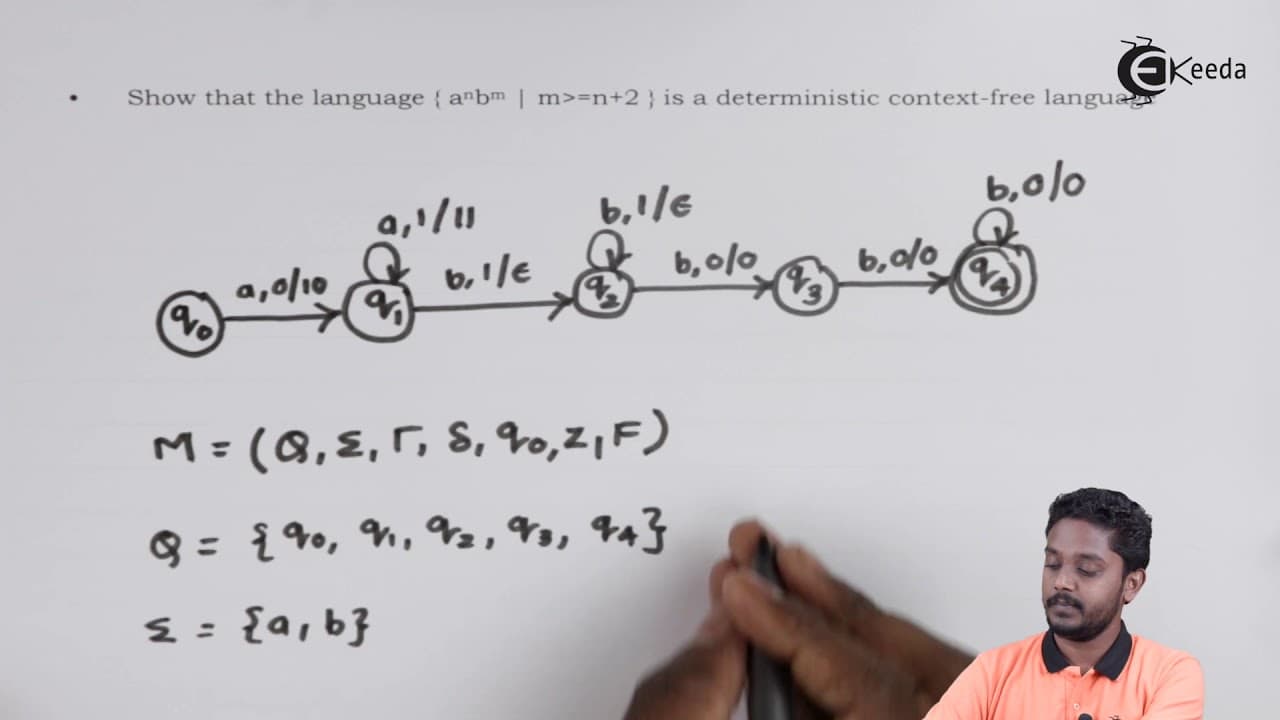
Learn how to construct a DPDA for the language A^N B^M, where M >= N/2.
Transcript
click the bell icon to get latest videos from equator hello friends let's start with the next question over here we are asked to draw a DP D for the language a raise to n B raised to M such that M is greater than or equal to n by 2 over here there are no restriction on n let us say n is greater than or equal to 1 that means at least one is required... Read More
Key Insights
- 🤬 The DPDA construction for the language A^N B^M, M >= N/2, involves systematically pushing and popping symbols onto the stack.
- 😆 The initial state is q0, and a final state q4 is reached when all conditions are satisfied.
- 🔣 The transition function Delta is defined based on the current state, input symbol, and top of the stack.
Install to Summarize YouTube Videos and Get Transcripts
Explore YouTube Video Summarizer or Get YouTube Transcript Extractor
Questions & Answers
Q: How do you construct a DPDA for the language A^N B^M, where M >= N/2?
To construct a DPDA, start by pushing '1' onto the stack for every 'A' encountered. Transition to the next state on encountering 'E'. Pop one '1' for each 'B'. Have at least two additional 'B's after equal numbers of 'A's and 'B's.
Q: What components are needed for the DPDA construction?
The DPDA components include: states (Q), alphabet (Sigma), stack symbols (Toggle), transition function (Delta), initial state (q0), initial stack symbol (0), final state (q4), and the stack (Z).
Q: How do you perform transitions in the DPDA?
The DPDA transitions depend on the current state, input symbol, and top of the stack. Each transition specifies the next state, the symbol to push onto the stack, and whether to pop a symbol.
Q: Can you provide an example run of a string on the constructed DPDA?
Let's take the string 'ABB'. The DPDA starts in state q0 with 'ABB' and '0' on the stack. Upon transitioning, it moves to state q1 with 'BB' and '10' on the stack. The next transition leads to state q2 with 'B' and '0' on the stack. Finally, the DPDA reaches a non-final state q3, indicating the string is rejected.
Summary & Key Takeaways
-
This video explains how to draw a DPDA for the language A^N B^M, with M >= N/2.
-
The construction starts by pushing a '1' onto the stack for every 'A' encountered and transitioning to the next state.
-
For every 'B', one '1' is popped from the stack. The DPDA requires at least two extra 'B's after encountering an equal number of 'A's and 'B's.
Read in Other Languages (beta)
Share This Summary 📚
Summarize YouTube Videos and Get Video Transcripts with 1-Click
Try YouTube Summary with ChatGPT & Claude or YouTube Transcript Generator
Explore More Summaries from Ekeeda 📚

Summarize YouTube Videos and Get Video Transcripts with 1-Click
Try YouTube Summary with ChatGPT & Claude or YouTube Transcript Generator