Leetcode 5712. Maximum Number of Consecutive Values You Can Make
TL;DR
The video explains an efficient way to find the maximum consecutive integers that can be formed from a given set of coin values.
Transcript
hi everyone welcome back to lead coding i'm your host faraz so in this video we are solving the question number three of the lead code by weekly contest 48 this problem was a tricky one so let us read the problem statement first you are given an integer array coins of length n which represents n coins that you own the value of the 8th coin is coin ... Read More
Key Insights
- 👻 Starting from zero is a fundamental aspect, as the empty subset allows for this base case.
- 🍹 Counting frequencies of the coin values enables a more manageable means of assessing possible consecutive sums.
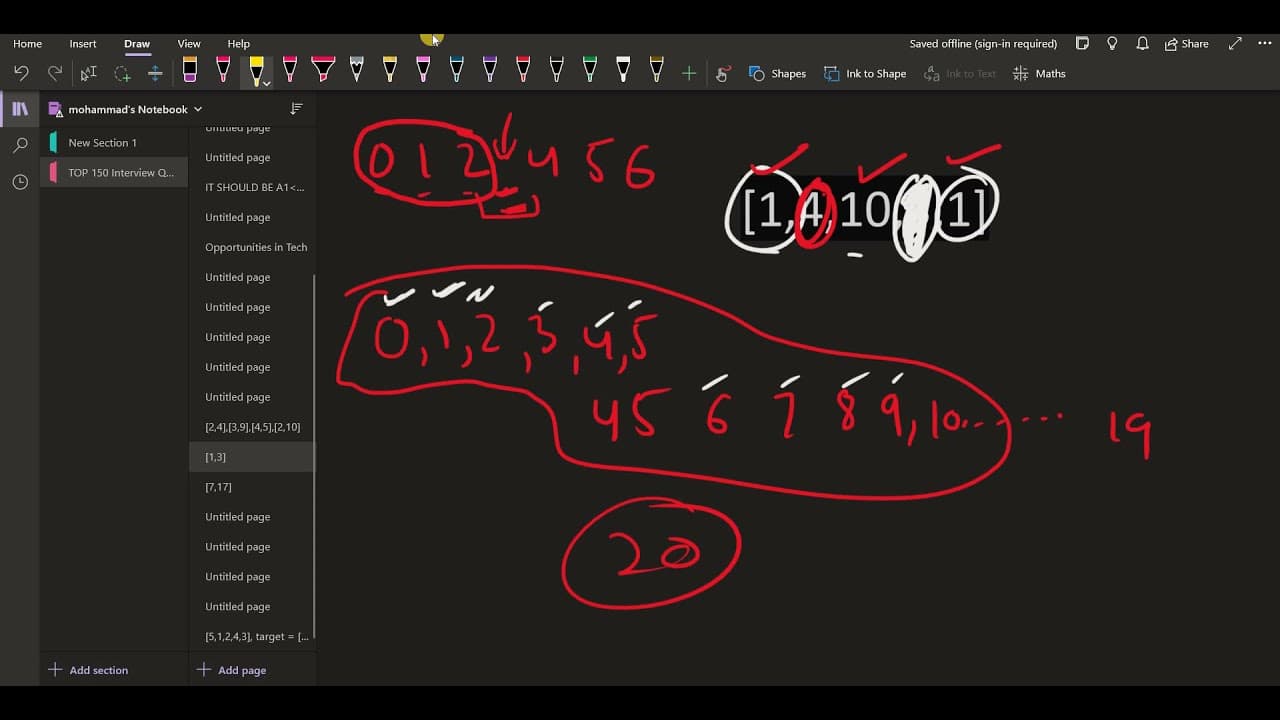
- ❤️🩹 If a gap is identified when iterating through sorted values, the current range ends, indicating how many consecutive integers can be formed.
- 🧡 The range of integers that can be formed is continuously updated based on combinations of available coin values and their frequencies.
- ❓ Efficiently managing subsets through frequency rather than brute-force enumeration significantly reduces computational load.
- 👣 Keeping track of gaps necessitates a strategic understanding of the involved coin values and their combinations.
- ❓ Dynamic programming concepts can be aligned with this problem, enhancing preparation for similar algorithmic challenges.
Install to Summarize YouTube Videos and Get Transcripts
Explore YouTube Video Summarizer or Get YouTube Transcript Extractor
Questions & Answers
Q: What is the main problem discussed in the video?
The main problem discussed is finding the maximum number of consecutive integers that can be formed using a given array of coin values, starting from zero. The challenge lies in how the coin values combine to produce new integers, especially when there are gaps in the sequence where certain values are missing.
Q: How does the presenter initially consider solving the problem?
The presenter initially considers generating all possible subsets of the coin values to determine the sums, which is computationally expensive with an exponential complexity of 2^n. This method is impractical for larger inputs, prompting a search for an optimized approach based on the frequency of specific coin values.
Q: Can you explain the significance of gaps in this problem?
Gaps in the sequence of sums are significant because they indicate missing integers that cannot be formed with the current coin values. If a gap exists, it limits the ability to generate further consecutive integers, necessitating the inclusion of necessary values to ensure that sequences can be extended.
Q: What is the approach taken to optimize the solution?
The optimization approach involves creating a frequency map of the coin values and maintaining a running range of consecutively formable integers. By iterating through the map, checking for gaps, and updating the range based on frequencies, the maximum integer range that can be formed is determined efficiently without exhaustive subset generation.
Q: How does the solution handle frequency counts of coin values?
The solution maintains a frequency map to count occurrences of each coin value. As the algorithm iterates through sorted coin values, it adjusts the current range of possible sums using the frequency of each coin, effectively calculating how many new integers can be obtained until a gap is identified.
Q: What time complexity does the solution achieve?
The solution achieves a time complexity of O(n) for processing the coin values, where n is the number of unique coin values. This accounts for counting frequencies and iterating through the sorted list. An additional space complexity of O(n) is used for storing the unique coin counts.
Summary & Key Takeaways
-
The problem involves determining the maximum number of consecutive integers that can be formed using subsets of given coin values, starting from zero.
-
Initial exploration used generating all possible subsets, which is computationally expensive; a more efficient solution counts coin frequencies to deduce possible sums.
-
Understanding gaps in the sequence is crucial, as missing elements limit the ability to form higher consecutive integers, necessitating careful frequency management within the solution.
Read in Other Languages (beta)
Share This Summary 📚
Summarize YouTube Videos and Get Video Transcripts with 1-Click
Try YouTube Summary with ChatGPT & Claude or YouTube Transcript Generator
Explore More Summaries from Fraz 📚


Summarize YouTube Videos and Get Video Transcripts with 1-Click
Try YouTube Summary with ChatGPT & Claude or YouTube Transcript Generator