Rulings on majority and minority rights by the Supreme Court | Khan Academy
TL;DR
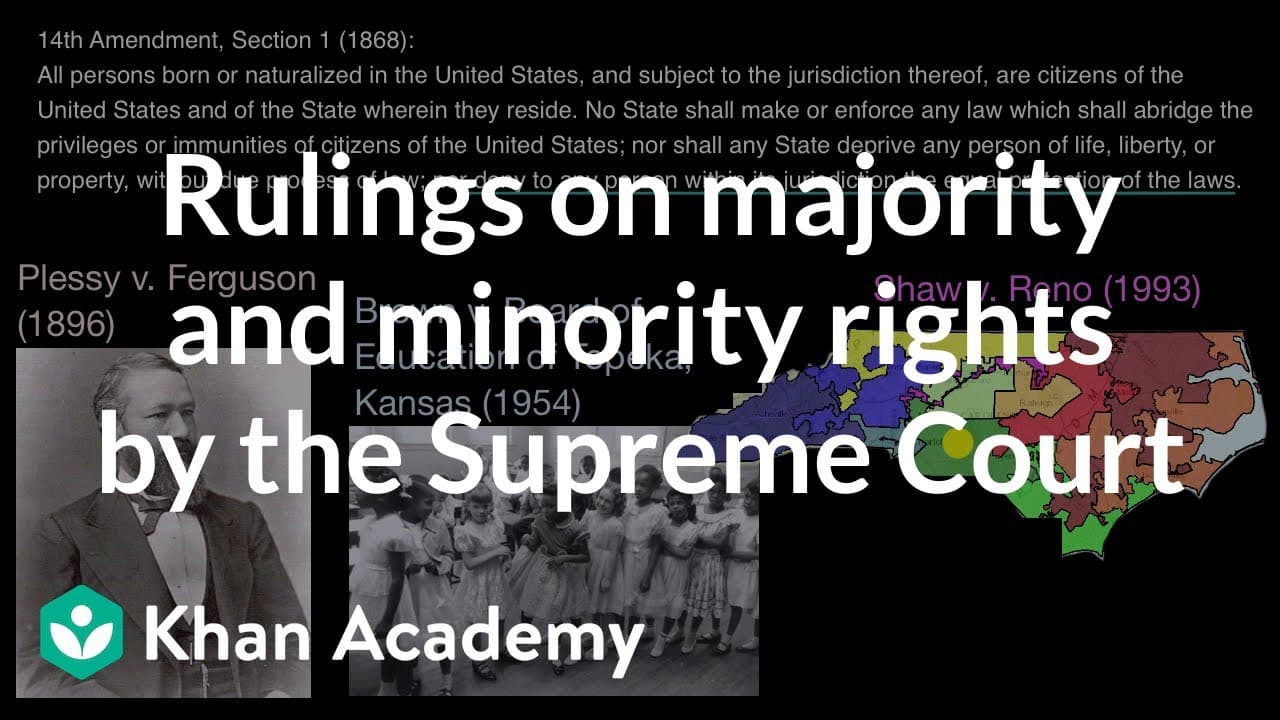
Supreme Court rulings on minority rights have evolved over time, as seen through cases like Plessy v. Ferguson, Brown v. Board of Education, and Shaw v. Reno.
Transcript
- We've already talked about the 14th Amendment in previous videos, but just as a reminder, Section 1 of the 14th Amendment says, "All persons born or naturalized in the United States, "and subject to the jurisdiction thereof, "are citizens of the United States "and of the State wherein they reside. "No State shall make or enforce any law "which sh... Read More
Key Insights
- 🗯️ The Equal Protection Clause of the 14th Amendment has been cited in many Supreme Court cases related to minority rights.
- 🗯️ Supreme Court rulings on minority rights can both reflect continuity and change over time.
- ❓ Plessy v. Ferguson reinforced segregation, while Brown v. Board of Education challenged it.
- 🛀 Shaw v. Reno showed that redistricting based on race violates the 14th Amendment.
- ❓ The intent behind an action, even if meant to benefit minorities, does not justify constitutional violations.
Install to Summarize YouTube Videos and Get Transcripts
Explore YouTube Video Summarizer or Get YouTube Transcript Extractor
Questions & Answers
Q: What did the 14th Amendment of the United States Constitution guarantee?
The 14th Amendment guarantees equal protection under the law, citizenship rights, and due process to all persons born or naturalized in the United States.
Q: What was the significance of Plessy v. Ferguson?
Plessy v. Ferguson upheld racial segregation as constitutional, establishing the "separate but equal" doctrine that allowed for legalized discrimination against African Americans.
Q: What did the Brown v. Board of Education ruling establish?
Brown v. Board of Education overturned Plessy v. Ferguson, ruling that segregation in public schools was inherently unequal and violated the 14th Amendment's Equal Protection Clause.
Q: Why was Shaw v. Reno a landmark case?
Shaw v. Reno addressed racial gerrymandering, ruling that redistricting based solely on race was unconstitutional as it violated the 14th Amendment's Equal Protection Clause.
Summary & Key Takeaways
-
The 14th Amendment of the United States Constitution guarantees equal protection under the law for all citizens, but its interpretation has changed over time.
-
In Plessy v. Ferguson (1896), the Supreme Court ruled that segregated railcars were constitutional as long as they were "separate but equal."
-
In Brown v. Board of Education (1954), the Court overturned the "separate but equal" doctrine, stating that segregation was inherently unequal.
-
Shaw v. Reno (1993) involved redistricting in North Carolina based on race, which the Court deemed unconstitutional under the 14th Amendment's Equal Protection Clause.
Read in Other Languages (beta)
Share This Summary 📚
Summarize YouTube Videos and Get Video Transcripts with 1-Click
Try YouTube Summary with ChatGPT & Claude or YouTube Transcript Generator
Explore More Summaries from Khan Academy 📚



Summarize YouTube Videos and Get Video Transcripts with 1-Click
Try YouTube Summary with ChatGPT & Claude or YouTube Transcript Generator