Trigonometry: Standard Position, Quadrantal Angles, and Coterminal Angles
TL;DR
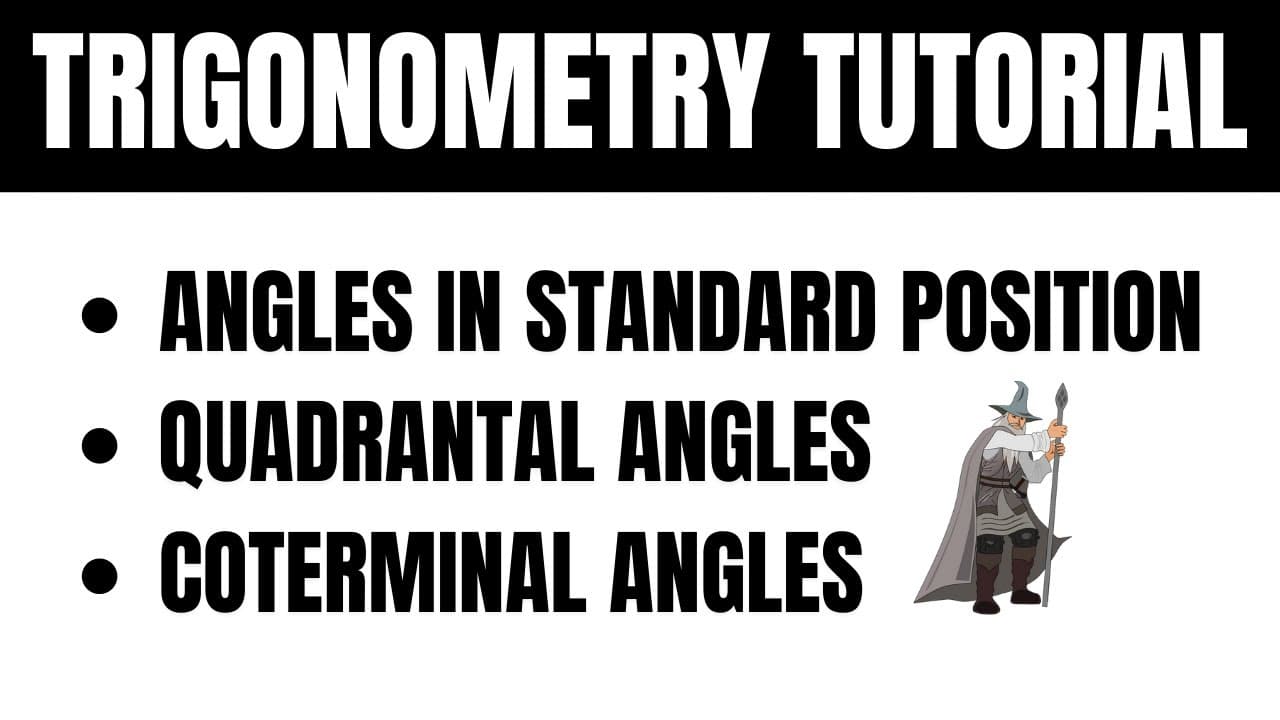
This video explains the concept of angles in standard position, including acute, obtuse, and quadrantal angles, as well as how to find coterminal angles.
Transcript
hello in this video we're going to talk about more special angles so the first type of angle we're going to discuss is an angle in standard position standard position this is actually a simple concept but it's very very important to know so we say an angle is in standard position if its vertex is at the origin so at the origin okay and its initial ... Read More
Key Insights
- 🧘 Understanding angles in standard position is fundamental in geometry and trigonometry.
- 🔺 Acute angles measure less than 90 degrees, while obtuse angles measure between 90 and 180 degrees.
- 🔺 Quadrantal angles are particularly useful for calculating trigonometric function values.
- 🔺 Coterminal angles are angles that differ in rotation but have the same initial and terminal sides.
Install to Summarize YouTube Videos and Get Transcripts
Explore YouTube Video Summarizer or Get YouTube Transcript Extractor
Questions & Answers
Q: What does it mean for an angle to be in standard position?
An angle is in standard position when its vertex is at the origin and its initial side is along the x-axis.
Q: What are acute angles?
Acute angles are angles that measure less than 90 degrees. In the video, the examples shown have their terminal sides in different quadrants.
Q: What are obtuse angles?
Obtuse angles are angles that measure between 90 and 180 degrees. The video demonstrates an example of an obtuse angle with its initial side along the x-axis.
Q: What are quadrantal angles?
Quadrantal angles are angles that have their terminal sides along either the x-axis or the y-axis. Examples given in the video include 90 degrees and 180 degrees.
Q: What are coterminal angles?
Coterminal angles are angles that have the same initial and terminal sides but different amounts of rotation. They can be found by adding or subtracting multiples of 360 degrees.
Q: How do you find coterminal angles?
To find coterminal angles, add or subtract 360 degrees as necessary to the given angle. This will give you angles that have the same initial and terminal sides but different amounts of rotation.
Summary & Key Takeaways
-
The video introduces the concept of angles in standard position, where the vertex is at the origin and the initial side is along the x-axis.
-
It provides examples of acute angles (measuring less than 90 degrees) and obtuse angles (measuring between 90 and 180 degrees) in standard position.
-
The video also discusses quadrantal angles (90, 180, 270, and 360 degrees) and explains how they are useful for calculating trigonometric function values.
-
Lastly, it explains coterminal angles, which are angles that have the same initial and terminal sides but different amounts of rotation, and provides examples on how to find them.
Read in Other Languages (beta)
Share This Summary 📚
Summarize YouTube Videos and Get Video Transcripts with 1-Click
Try YouTube Summary with ChatGPT & Claude or YouTube Transcript Generator
Explore More Summaries from The Math Sorcerer 📚




Summarize YouTube Videos and Get Video Transcripts with 1-Click
Try YouTube Summary with ChatGPT & Claude or YouTube Transcript Generator