Henderson–Hasselbalch equation | Acids and bases | AP Chemistry | Khan Academy
TL;DR
The Henderson-Hasselbalch equation is used to calculate the pH of buffer solutions by considering the concentrations of weak acids and their conjugate bases.
Transcript
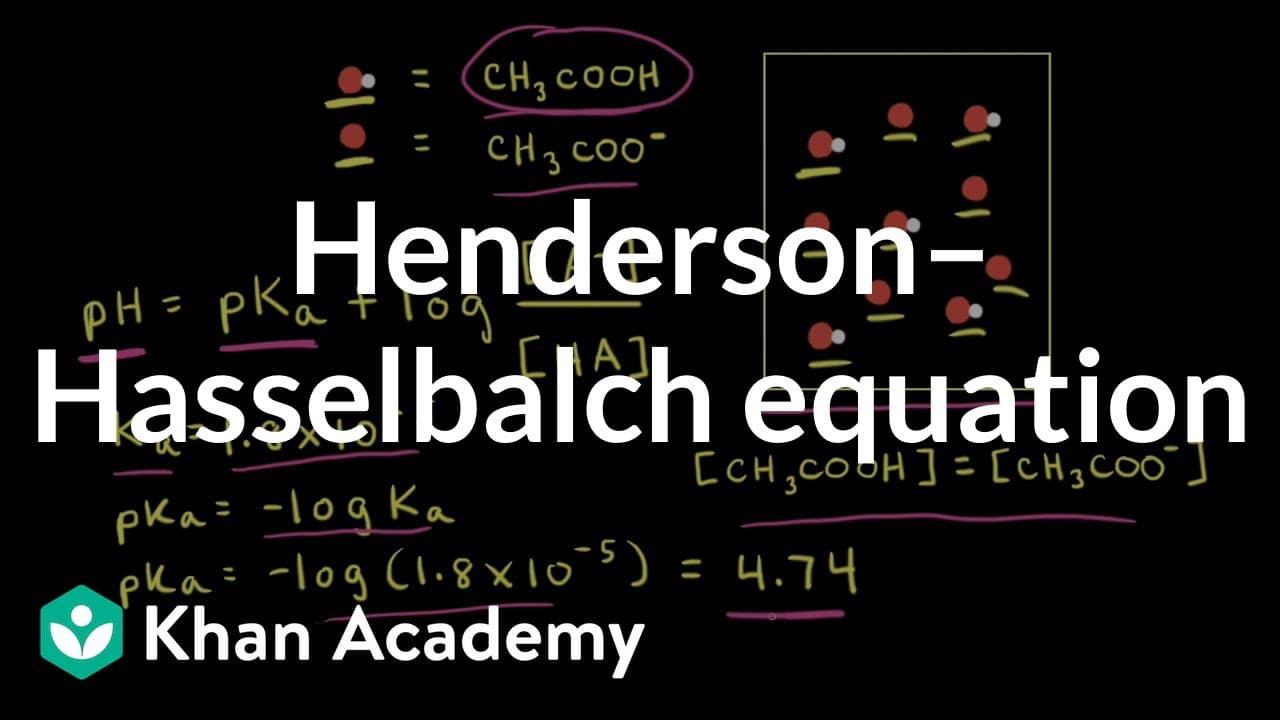
- [Instructor] The Henderson-Hasselbalch equation is an equation that's often used to calculate the pH of buffer solutions. Buffers consists of a weak acid and its conjugate base. So for a generic weak acid, we could call that HA, and therefore, its conjugate base would be A-. To calculate the pH of the buffer solution, we would find the pKa of the... Read More
Key Insights
- 😥 The Henderson-Hasselbalch equation is a useful tool in calculating the pH of buffer solutions.
- ❓ The pKa value represents the acid dissociation constant and is necessary for the Henderson-Hasselbalch equation.
- ❓ Particulate diagrams provide a visual representation of the relative concentrations of particles in a buffer solution.
- 😥 The relationship between the concentrations of the weak acid and conjugate base determines the pH of the buffer solution.
- ⚾ The Henderson-Hasselbalch equation can be used to predict the relative concentrations of the weak acid and conjugate base based on the known pH of a buffer solution.
- 😘 The pH of a buffer solution can be higher or lower than the pKa value of the weak acid, depending on the relative concentrations of the weak acid and conjugate base.
- ❓ The Henderson-Hasselbalch equation is applicable to various buffer solutions.
Install to Summarize YouTube Videos and Get Transcripts
Explore YouTube Video Summarizer or Get YouTube Transcript Extractor
Questions & Answers
Q: What is the Henderson-Hasselbalch equation used for?
The Henderson-Hasselbalch equation is used to calculate the pH of buffer solutions by considering the concentrations of a weak acid and its conjugate base.
Q: How is the pKa of a weak acid determined?
The pKa of a weak acid can be found by taking the negative log of the Ka value, with the Ka value representing the acid dissociation constant.
Q: How does the concentration of the weak acid affect the pH of a buffer solution?
If the concentration of the weak acid is equal to the concentration of the conjugate base, the pH of the buffer solution will be equal to the pKa of the weak acid.
Q: What information can be obtained from particulate diagrams?
Particulate diagrams help visualize the relative concentrations of particles, allowing for the determination of the relative concentrations of the weak acid and conjugate base in a buffer solution.
Summary & Key Takeaways
-
The Henderson-Hasselbalch equation is used to calculate the pH of buffer solutions, which are made up of weak acids and their conjugate bases.
-
The equation involves finding the pKa of the weak acid and using the log of the concentration of the conjugate base divided by the concentration of the weak acid.
-
By analyzing particulate diagrams, the relative concentrations of the weak acid and conjugate base can be determined, allowing for predictions about the pH of the buffer solution.
Read in Other Languages (beta)
Share This Summary 📚
Summarize YouTube Videos and Get Video Transcripts with 1-Click
Try YouTube Summary with ChatGPT & Claude or YouTube Transcript Generator
Explore More Summaries from Khan Academy 📚



Summarize YouTube Videos and Get Video Transcripts with 1-Click
Try YouTube Summary with ChatGPT & Claude or YouTube Transcript Generator