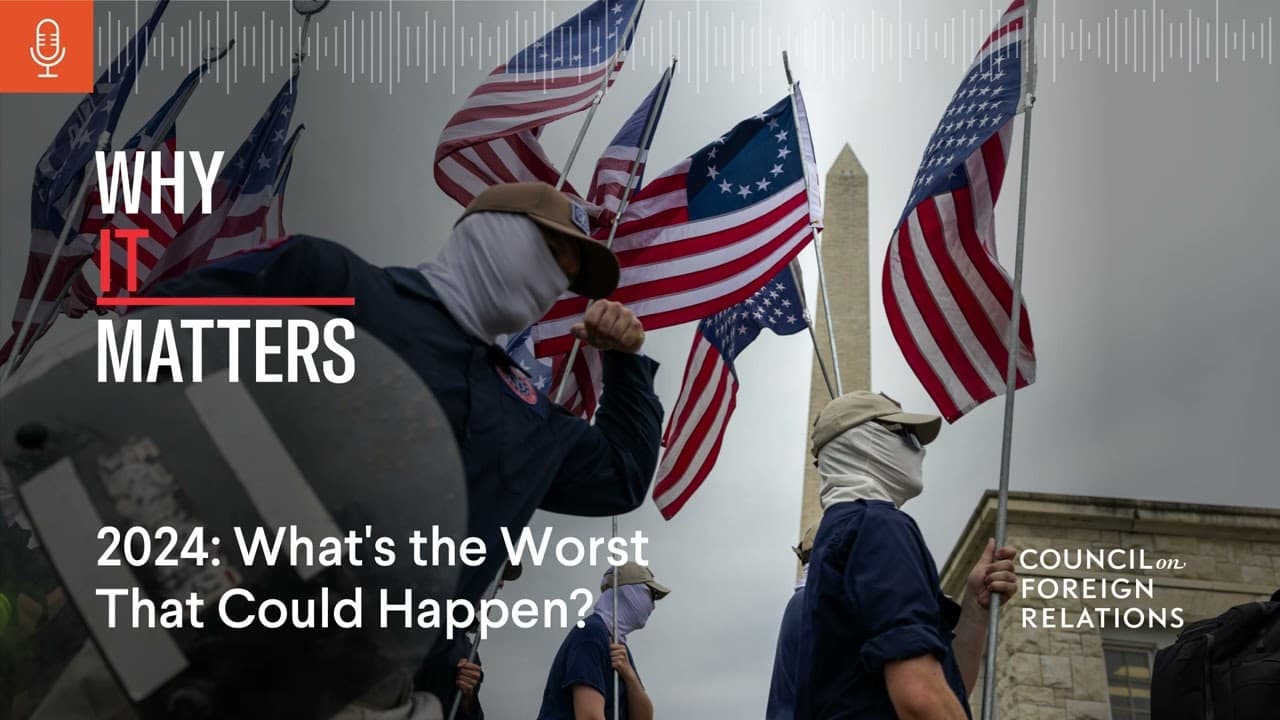
2024: What's the Worst That Could Happen?
TL;DR
2024 poses unprecedented global threats, including political violence, Middle East escalation, and U.S. border crisis.
Transcript
DW News: A global battle of political systems is underway. DW News: 2024's election bonanza kicked off in January in Taiwan. Channel 4 News: Outside of Israel and Gaza, we've seen attacks in Lebanon, Syria, Iraq and Yemen just over the course of this weekend. DW News: 2023 was the hottest year on record. Scientists warned that this year could very ... Read More
Key Insights
- The U.S. is facing unprecedented political polarization, increasing the risk of domestic terrorism and political violence around the 2024 presidential election.
- The conflict in Gaza between Israel and Hamas has the potential to escalate into a wider regional conflict involving multiple countries in the Middle East.
- A surge in migration at the southwest U.S. border is creating political tensions and could lead to a national security threat if not managed properly.
- Foreign policy experts are concerned about the implications of U.S. domestic issues on global diplomacy and the country's ability to promote democracy.
- The U.S. is distracted by multiple international and domestic issues, potentially allowing adversaries to exploit vulnerabilities.
- Climate change is indirectly contributing to global conflicts, acting as an accelerant in regions already facing instability.
- Despite the challenges, there have been some positive developments in international relations, such as improved U.S.-China dialogue and peace efforts in Armenia and Azerbaijan.
- The level of anxiety about global conflict trends is at an all-time high, with experts expressing unprecedented concerns for 2024.
Install to Summarize YouTube Videos and Get Transcripts
Explore YouTube Video Summarizer or Get YouTube Transcript Extractor
Questions & Answers
Q: What are the top concerns for 2024 according to the CFR survey?
The top concerns for 2024 include growing political polarization in the United States, which could lead to domestic terrorism and political violence, the escalation of conflict in Gaza between Israel and Hamas, and a surge in migration at the southwest U.S. border. These threats are considered high impact and high probability, marking an unprecedented level of concern.
Q: How could political polarization in the U.S. affect foreign policy?
Political polarization in the U.S. could have several foreign policy implications. It may distract the U.S. from international commitments, allow adversaries to exploit divisions through disinformation, and undermine the country's credibility in promoting democracy and human rights globally. The U.S. could struggle to advocate for peaceful elections abroad if it cannot maintain peace at home.
Q: What are the potential consequences of escalating conflict in the Middle East?
An escalating conflict in the Middle East could lead to a wider regional war involving multiple countries. This could distract the U.S. from other international commitments, strain relationships with allies, and lead to domestic political tensions. The U.S. has been deploying military resources to deter escalation and is engaging in diplomatic efforts to stabilize the situation.
Q: Why is the surge in migration at the U.S. southwest border a concern?
The surge in migration at the U.S. southwest border is a concern due to its potential to overwhelm border security, strain social services, and increase political tensions. The influx is driven by factors such as economic hardship, political corruption, and violence in source countries. Efforts are being made to improve conditions in these countries and enhance border security.
Q: How is climate change related to global conflicts?
Climate change acts as an accelerant for global conflicts by exacerbating existing tensions over resources such as water and land. Severe weather events and environmental degradation can lead to displacement and competition for resources, contributing to instability in regions like the Horn of Africa and the Sahel. While not explicitly mentioned, climate change is a factor in many global threats.
Q: What positive developments occurred in international relations in 2023?
In 2023, there were some positive developments in international relations, including improved dialogue between the U.S. and China, peace efforts between Armenia and Azerbaijan, and improved relations between Greece and Turkey. These developments suggest potential for progress in global diplomacy, despite the numerous challenges faced.
Q: Why are experts more anxious about global threats in 2024?
Experts are more anxious about global threats in 2024 due to the unprecedented level of high-impact, high-probability contingencies identified in the CFR survey. Three of the top threats, including domestic political violence, Middle East conflict escalation, and migration surges, are considered high likelihood and high impact, a situation not seen in previous years.
Q: What are some of the overlooked humanitarian threats mentioned?
Some overlooked humanitarian threats include the ongoing conflict and humanitarian crisis in Sudan, instability and violence in Myanmar, and instability in the Sahel region of Africa. These areas face significant challenges, but they receive less attention compared to more immediate geopolitical threats, potentially leading to insufficient responses to humanitarian needs.
Summary & Key Takeaways
-
The United States is experiencing unprecedented political polarization, raising concerns about potential domestic terrorism and political violence during the 2024 presidential election. This domestic issue is seen as a significant threat by foreign policy experts, who worry about its implications for global diplomacy.
-
The conflict between Israel and Hamas could escalate into a broader regional conflict in the Middle East, involving multiple countries. This potential escalation poses a significant threat to U.S. interests and could distract the U.S. from other international commitments.
-
A surge in migration at the southwest U.S. border is creating political tensions and could lead to a national security threat. Efforts are being made to address the root causes of migration and improve border security, but political divisiveness complicates the situation.
Read in Other Languages (beta)
Share This Summary 📚
Summarize YouTube Videos and Get Video Transcripts with 1-Click
Try YouTube Summary with ChatGPT & Claude or YouTube Transcript Generator
Explore More Summaries from Council on Foreign Relations 📚


Summarize YouTube Videos and Get Video Transcripts with 1-Click
Try YouTube Summary with ChatGPT & Claude or YouTube Transcript Generator