Problem 2 on Shear Force Diagram and Bending Moment Diagram for Beam - Strength of Materials
TL;DR
This analysis demonstrates the calculation and plotting of shear force and bending moment diagrams for a given beam, including locating the point of contraflexure.
Transcript
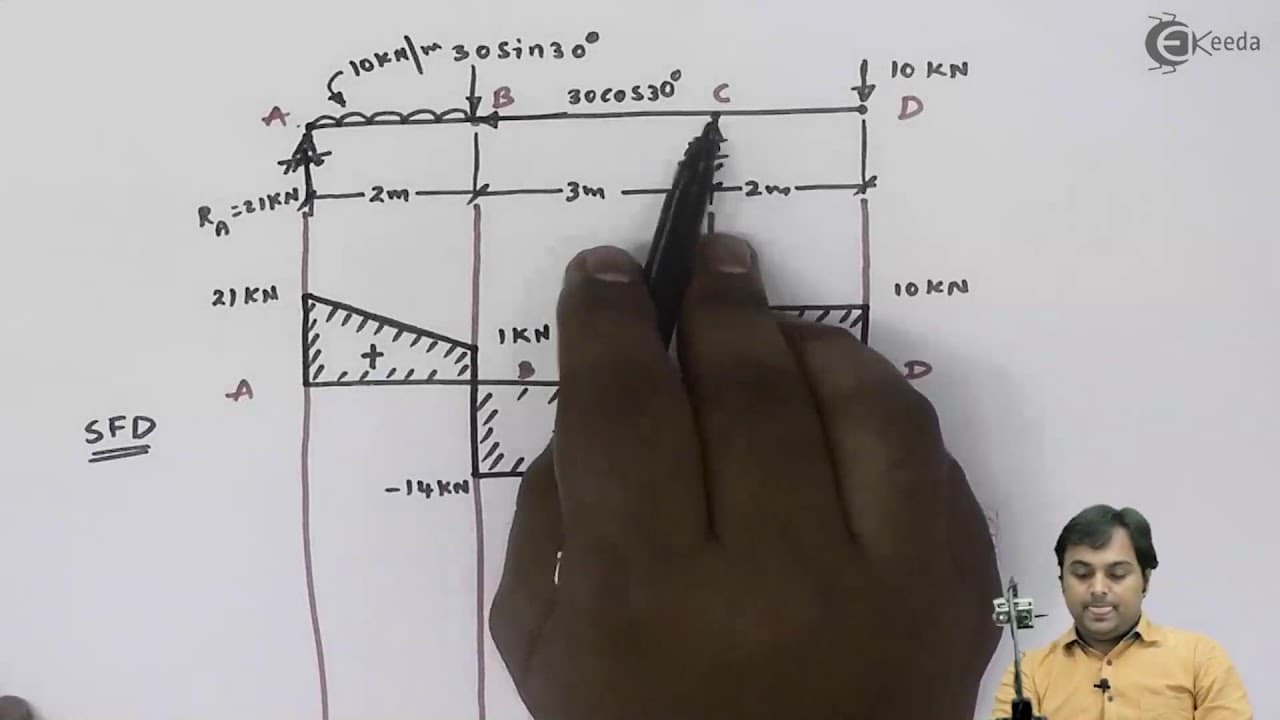
now sf at point a was 21 kilo newton positive except at point b we were having two values the first is one kilo newton positive and the second one is minus 14 kilo newton a negative value now the values which i have plotted above the line they are positive the values which are below the line they are negative so here i have drawn the sfd shear forc... Read More
Key Insights
- 🫥 Shear force values on the diagram above the line indicate positive values, while those below indicate negative values.
- 😥 Bending moment calculations involve considering reaction forces, UDL intensity, and distances from critical points.
- 😁 The bending moment diagram shows different curves for different sections of the beam, corresponding to the nature of the shear force in those sections.
- 😥 The point of contraflexure is the location where the bending moment changes sign from positive to negative.
- 🔺 The distance to the point of contraflexure can be calculated using the principle of similarity of triangles.
- 0️⃣ The bending moment at hinge supports is always zero due to the absence of rotational resistance.
- 😁 The bending moment at overhanging endpoints of the beam is also zero.
Install to Summarize YouTube Videos and Get Transcripts
Explore YouTube Video Summarizer or Get YouTube Transcript Extractor
Questions & Answers
Q: What does it mean when values on the shear force diagram (SFD) are plotted above or below the line?
Values above the line on the SFD represent positive shear forces, while values below the line represent negative shear forces. The line separates positive and negative values.
Q: How is the bending moment at hinge support calculated?
The bending moment at a hinge support is always zero, making it easy to calculate. This is due to the rotational freedom at the hinge, resulting in no moment acting on it.
Q: How is the bending moment at point B calculated?
To calculate the bending moment at point B, you consider the reaction force at A and the intensity of the uniformly distributed load (UDL). By taking the moments of these forces about point B, you can determine the bending moment at B.
Q: What is the significance of the point of contraflexure?
The point of contraflexure is where the bending moment changes sign from positive to negative, meaning it becomes zero at that location. The distance to the point of contraflexure can be calculated using the principle of similarity of triangles.
Summary & Key Takeaways
-
The content explains the process of drawing the shear force diagram (SFD) for a beam, followed by calculating and plotting the bending moment diagram (BMD).
-
Bending moment calculations involve determining the bending moment at critical points, such as hinges and supports.
-
The content concludes by discussing the concept of the point of contraflexure, which is the location where bending moment changes sign from positive to negative.
Read in Other Languages (beta)
Share This Summary 📚
Summarize YouTube Videos and Get Video Transcripts with 1-Click
Try YouTube Summary with ChatGPT & Claude or YouTube Transcript Generator
Explore More Summaries from Ekeeda 📚





Summarize YouTube Videos and Get Video Transcripts with 1-Click
Try YouTube Summary with ChatGPT & Claude or YouTube Transcript Generator