A Brief History of Everything, feat. Neil deGrasse Tyson
TL;DR
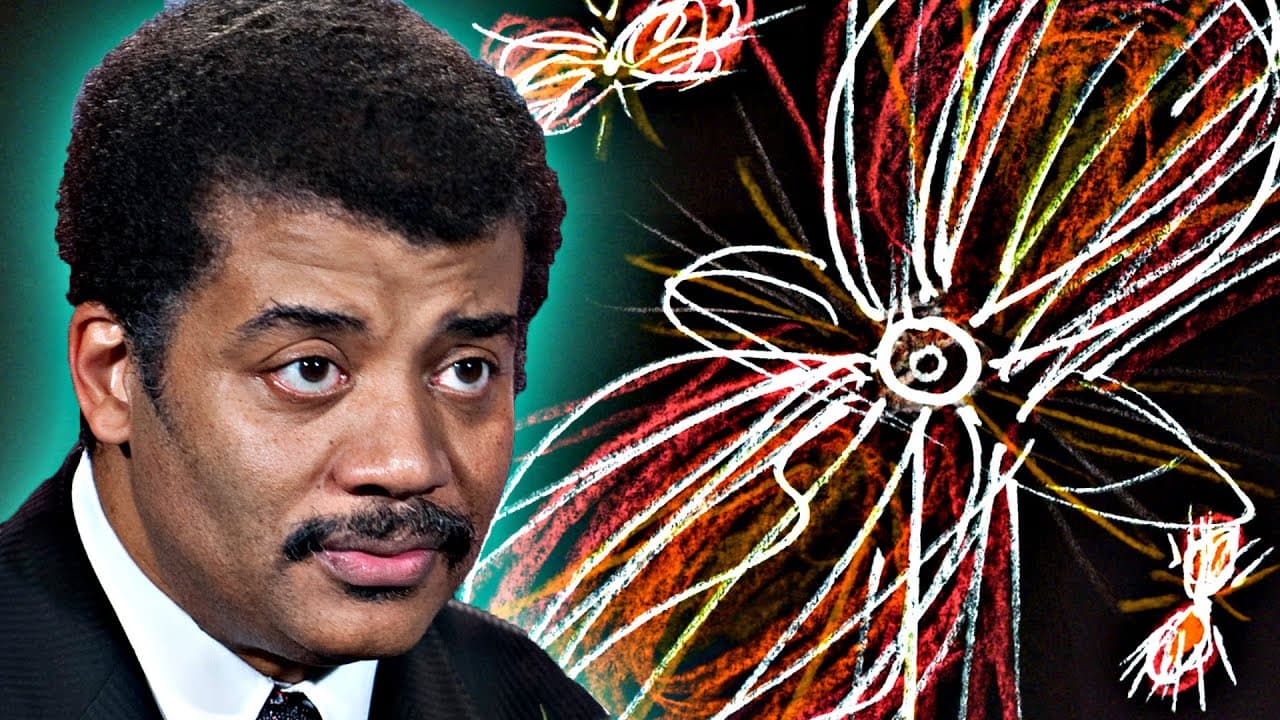
The universe began as a tiny, hot, and dense point and has been expanding for about 13.7 billion years. Through various processes, matter formed, stars were born and died, and eventually, life emerged.
Transcript
"The world has persisted many a long year, having once been set going in the appropriate motions. From these, everything else follows." Lucretius. In the beginning, about 13.7 billion years ago, all the space, and all the matter, and all the energy of the known universe was contained in a volume less than one trillionth the size of the point of a p... Read More
Key Insights
- 😅 The universe began as a tiny, hot, and dense point.
- ❓ Forces and particles were unified in the early stages of the universe.
- 🖐️ Matter-energy conversions and symmetries breaking played significant roles.
- 🤩 The expansion of the universe led to the formation of galaxies and stars.
- 🤩 High mass stars enriched the universe with heavier elements through explosions.
- 💁 The Earth formed in a habitable zone around the Sun.
- 🚨 Life emerged and thrived on Earth due to the existence of carbon-based molecules.
Install to Summarize YouTube Videos and Get Transcripts
Explore YouTube Video Summarizer or Get YouTube Transcript Extractor
Questions & Answers
Q: How did the universe begin?
The universe began as a tiny, hot, and dense point less than one trillionth the size of a pin. It then started to expand for unknown reasons.
Q: What forces split from each other as the universe expanded?
Gravity split from other forces, followed by the strong nuclear force and the electroweak force. This led to the rapid growth of the universe.
Q: Why is there more matter than antimatter in the universe?
The symmetry between matter and antimatter was broken for reasons unknown, resulting in a slight excess of matter over antimatter. This asymmetry was crucial for the evolution of the universe.
Q: How did stars and elements form?
Stars formed as matter gravitated and concentrated into galaxies. The fusion processes within high mass stars produced elements heavier than hydrogen, which were then scattered throughout the galaxy when the stars exploded.
Summary & Key Takeaways
-
The universe started in a small, hot, and dense state before rapidly expanding and cooling.
-
Forces like gravity and electromagnetism separated from each other as the universe expanded.
-
Particles and atoms formed, leading to the creation of stars, galaxies, and eventually, life.
Read in Other Languages (beta)
Share This Summary 📚
Summarize YouTube Videos and Get Video Transcripts with 1-Click
Try YouTube Summary with ChatGPT & Claude or YouTube Transcript Generator
Explore More Summaries from minutephysics 📚




Summarize YouTube Videos and Get Video Transcripts with 1-Click
Try YouTube Summary with ChatGPT & Claude or YouTube Transcript Generator