Regression Notation Clarification
TL;DR
This video clarifies the difference between sample regression and population regression in the context of regressions, using notation and formulas to explain the concepts.
Transcript
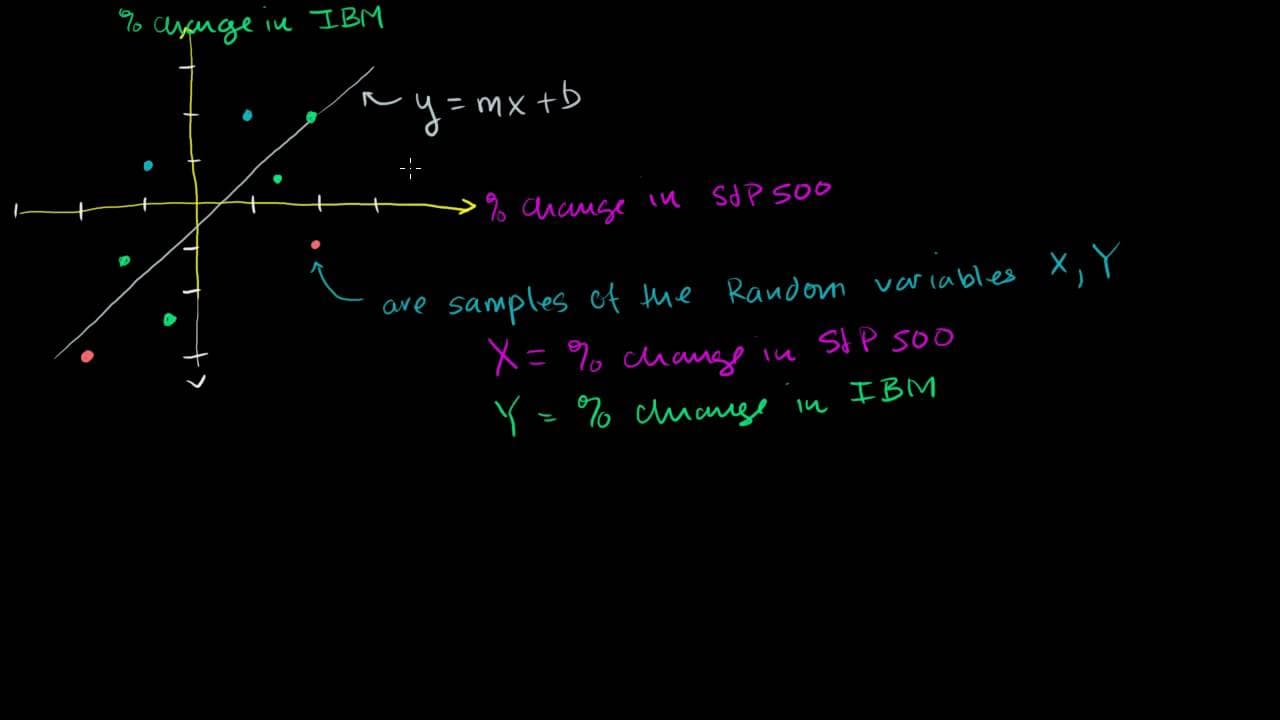
what i want to do in this video is clarify some of the notation that i've been using in regards to regressions and in particular we're going to focus on the difference between the sample regression and a population regression just to think about that so let me draw let me draw a some data points and just for fun let's make it a little bit more real... Read More
Key Insights
- 🫥 Sample regression is an estimate of the true regression line, based on a limited number of data points.
- 🫥 Population regression considers an infinite number of samples and represents the true regression line.
- 🤠 The notation "hat" denotes that a parameter is an estimate in sample regression.
- 😀 Formulas for calculating the slope and y-intercept differ between sample regression and population regression.
- 😃 The slope (m) represents the relationship between the variables, while the y-intercept (b) indicates the starting point of the regression line.
- 😒 Sample regression uses sample means, while population regression uses expected values (or means).
- ❣️ In sample regression, the slope and y-intercept are estimated using formulas involving product means, x means, y means, and x squared means.
Install to Summarize YouTube Videos and Get Transcripts
Explore YouTube Video Summarizer or Get YouTube Transcript Extractor
Questions & Answers
Q: What is the difference between sample regression and population regression?
Sample regression is based on a limited number of data points and provides an estimate of the true regression line. Population regression considers an infinite number of samples and represents the true regression line.
Q: What does the notation "hat" (e.g., "m hat") mean in sample regression?
The notation "hat" represents that the parameter is an estimate based on the sample data points. It indicates that the value is not the true parameter but an approximation.
Q: How are the slope and y-intercept calculated in sample regression?
In sample regression, the slope (m) is calculated as the mean of the products of each x-y coordinate minus the mean of x times the mean of y, divided by the mean of x squared minus the mean of x squared. The y-intercept (b) is calculated as the mean of y minus the slope times the mean of x.
Q: How are the slope and y-intercept calculated in population regression?
In population regression, the slope (m) is calculated as the expected value (or mean) of the product of x and y minus the expected value of x times the expected value of y, divided by the expected value of x squared minus the expected value of x squared. The y-intercept (b) is calculated as the expected value of y minus the slope times the expected value of x.
Summary & Key Takeaways
-
The video discusses the difference between sample regression and population regression using a real-world example of percent changes in the S&P 500 and IBM stock prices.
-
It explains that sample regression is based on a limited number of data points, while population regression considers an infinite number of samples and represents the true regression line.
-
The video provides formulas for calculating the slope and y-intercept in both sample and population regression, emphasizing that sample regression is an estimate of the true regression.
Read in Other Languages (beta)
Share This Summary 📚
Summarize YouTube Videos and Get Video Transcripts with 1-Click
Try YouTube Summary with ChatGPT & Claude or YouTube Transcript Generator
Explore More Summaries from Khan Academy 📚



Summarize YouTube Videos and Get Video Transcripts with 1-Click
Try YouTube Summary with ChatGPT & Claude or YouTube Transcript Generator