Partial fraction expansion to evaluate integral | AP Calculus BC | Khan Academy
TL;DR
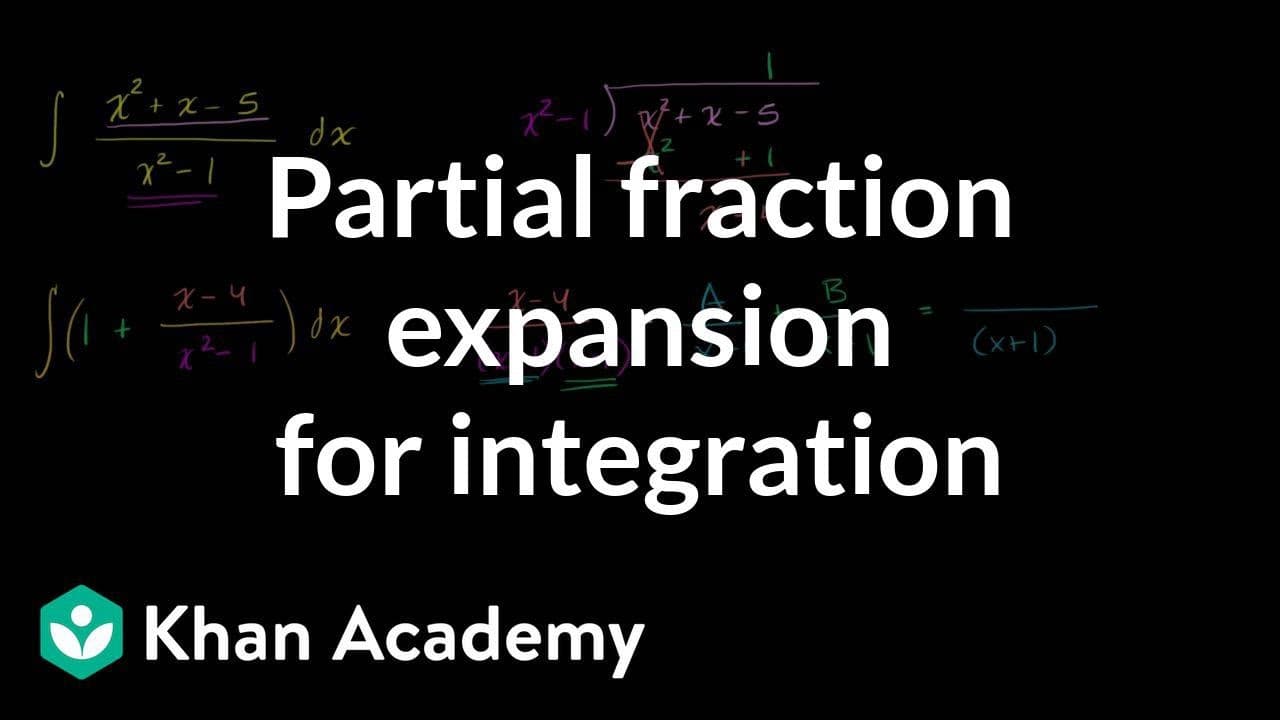
The video explains the process of simplifying a rational expression and evaluating its integral using algebraic long division and partial fraction expansion.
Transcript
- [Voiceover] Try to evaluate the following integral. So assuming you've had a go at it, so let's work through this together. And if at any point you get inspired, always feel free to pause the video and continue on with it on your own. So the first thing that might have jumped out at you we have a rational expression. The degree in the numerator i... Read More
Key Insights
- ➗ Algebraic long division is a useful technique for simplifying rational expressions by dividing the numerator by the denominator.
- 😑 Partial fraction expansion allows us to express a rational expression as the sum of simpler fractions, which facilitates integration.
- 🆘 Solving a system of equations helps to determine the coefficients in the partial fraction expansion.
Install to Summarize YouTube Videos and Get Transcripts
Explore YouTube Video Summarizer or Get YouTube Transcript Extractor
Questions & Answers
Q: Why is algebraic long division used in the video?
Algebraic long division is used because the rational expression has the same degree in the numerator and denominator. This technique helps simplify the expression and determine how many times the numerator goes into the denominator.
Q: What is the purpose of partial fraction expansion?
Partial fraction expansion is used to express a rational expression as the sum of two or more simpler fractions with lower degrees in the denominator. This makes it easier to evaluate the integral.
Q: How are the coefficients in the partial fraction expansion determined?
The coefficients are determined by setting up a system of equations using the terms in the expanded form and equating them to the original rational expression. Solving this system yields the values of the coefficients.
Q: What is the significance of the constant term in the final expression?
The constant term represents the constant of integration, which is added to the antiderivatives of the fraction terms. It accounts for the fact that the indefinite integral has infinitely many possible values.
Summary & Key Takeaways
-
The video starts by recognizing a rational expression with the same degree in the numerator and denominator, prompting the use of algebraic long division.
-
After performing the division, the rational expression is rewritten in a simplified form with a lower degree in the numerator.
-
The video then introduces the concept of partial fraction expansion as a tool to further simplify the expression by writing it as a sum of two rational expressions with lower degrees in the denominator.
-
The coefficients of the rational expressions in the partial fraction expansion are determined by setting up and solving a system of equations.
-
The final step involves taking the antiderivative of each term in the partial fraction expansion to evaluate the integral.
Read in Other Languages (beta)
Share This Summary 📚
Summarize YouTube Videos and Get Video Transcripts with 1-Click
Try YouTube Summary with ChatGPT & Claude or YouTube Transcript Generator
Explore More Summaries from Khan Academy 📚



Summarize YouTube Videos and Get Video Transcripts with 1-Click
Try YouTube Summary with ChatGPT & Claude or YouTube Transcript Generator