Momentum (6 of 16) Inelastic Collisions, An Explanation
TL;DR
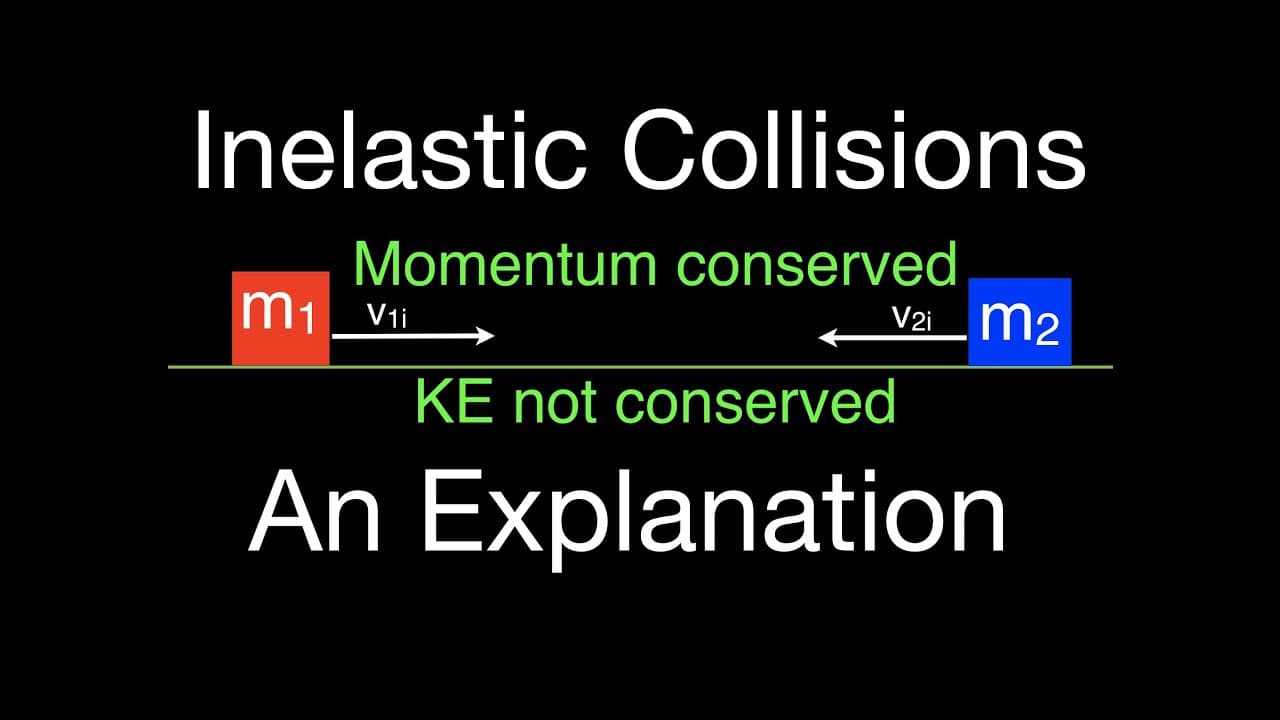
Inelastic collisions involve collisions where kinetic energy is not conserved, but momentum is. There are two types of inelastic collisions: perfectly inelastic (objects stick together) and partially inelastic (objects do not stick together).
Transcript
Okay in today's video. I am going to go over an explanation of momentum and specifically inelastic collisions and this is what any list inelastic collision is its kind of definition of an inelastic collision is a Collision where the kinetic energy, the total kinetic energy of the system, of let's say that two objects is not conserved so kinetic ene... Read More
Key Insights
- 💥 Inelastic collisions do not conserve kinetic energy, but momentum is conserved.
- 💥 There are two types of inelastic collisions: perfectly inelastic and partially inelastic.
- 💥 The final velocity after an inelastic collision can be calculated using the equation mentioned earlier.
Install to Summarize YouTube Videos and Get Transcripts
Explore YouTube Video Summarizer or Get YouTube Transcript Extractor
Questions & Answers
Q: What is the difference between an inelastic and an elastic collision?
In elastic collisions, kinetic energy is conserved, while in inelastic collisions, kinetic energy is not conserved. The energy is converted into other forms, such as heat energy or deformation of the objects.
Q: How is momentum conserved in all collisions?
Momentum is a vector quantity that is conserved in all collisions, whether they are elastic or inelastic. The total momentum of a system before a collision is equal to the total momentum after the collision.
Q: What is the difference between a perfectly inelastic and a partially inelastic collision?
In a perfectly inelastic collision, the two objects stick together after the collision. In a partially inelastic collision, the two objects do not stick together, but some kinetic energy is still lost during the collision.
Q: How can we calculate the final velocity after an inelastic collision?
The final velocity can be calculated using the equation: final velocity = (mass of object 1 * initial velocity of object 1) / (mass of object 1 + mass of object 2).
Summary & Key Takeaways
-
Inelastic collisions do not conserve kinetic energy, but they do conserve momentum.
-
Perfectly inelastic collisions involve objects sticking together, while partially inelastic collisions involve objects not sticking together.
-
The final velocity after an inelastic collision can be calculated using the equation: final velocity = (mass of object 1 * initial velocity of object 1) / (mass of object 1 + mass of object 2).
Read in Other Languages (beta)
Share This Summary 📚
Summarize YouTube Videos and Get Video Transcripts with 1-Click
Try YouTube Summary with ChatGPT & Claude or YouTube Transcript Generator
Explore More Summaries from Step by Step Science 📚
Summarize YouTube Videos and Get Video Transcripts with 1-Click
Try YouTube Summary with ChatGPT & Claude or YouTube Transcript Generator