Resolution and composition of forces Example 3 - Engineering Mechanics
TL;DR
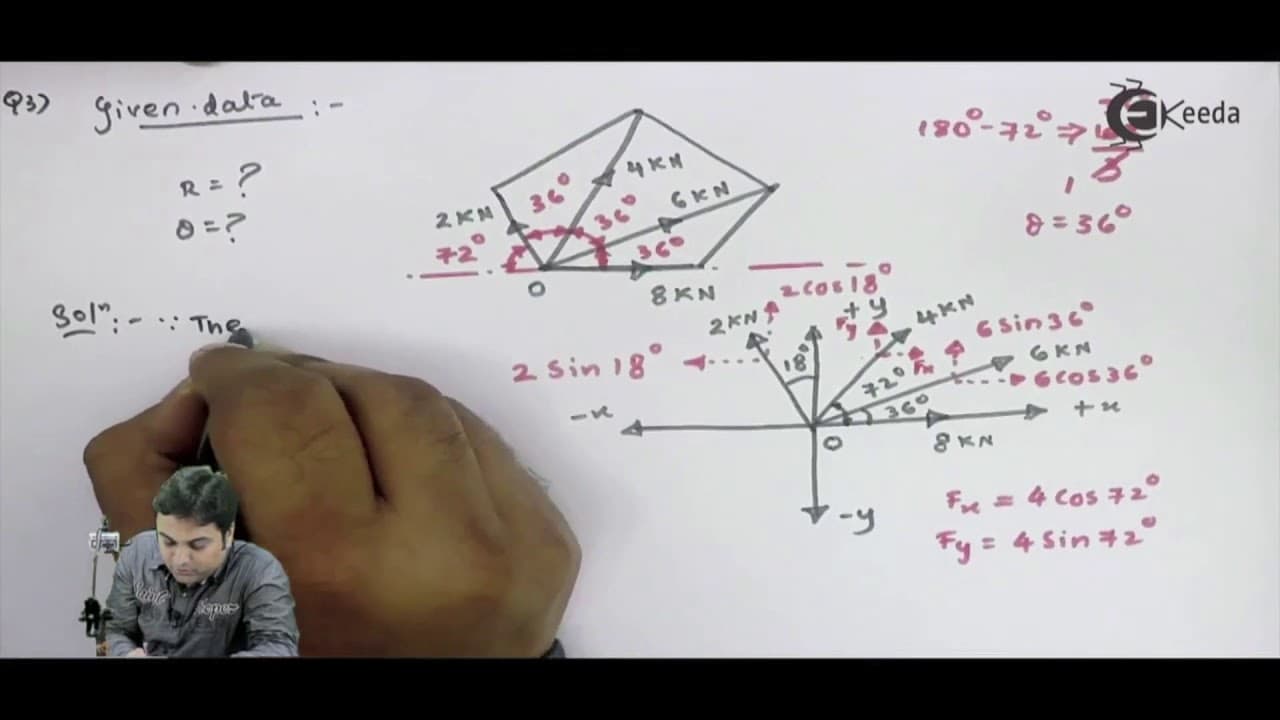
Calculate the resultant force in magnitude and direction for forces acting on a regular pentagon.
Transcript
let us solve the next question question number three i'll read the question forces of 2 comma 4 comma 6 and 8 kilo newton respectively acts on a regular pentagon as shown in figure the figure is given and here we have to find find the resultant find the resultant in magnitude and direction in magnitude and direction so this is the first problem whi... Read More
Key Insights
- ❓ The problem involves finding the resultant force on a regular pentagon.
- 🫥 The regular pentagon can be converted into a concurrent forces problem by extending the lines of the pentagon.
- 🚥 By resolving each force into its horizontal and vertical components, the problem can be solved.
- 🍹 The sum of all horizontal forces is 13.47 newton, while the sum of all vertical forces is 9.23 newton.
- 🫡 The resultant force is 16.33 newton at an angle of 34.41 degrees with respect to the horizontal line.
Install to Summarize YouTube Videos and Get Transcripts
Explore YouTube Video Summarizer or Get YouTube Transcript Extractor
Questions & Answers
Q: How do you convert a problem involving a regular pentagon into a concurrent forces problem?
To convert the problem, extend the lines of the pentagon and determine the angle of inclination for each edge. In this case, each angle is 36 degrees.
Q: How do you resolve the forces in this problem?
The horizontal component for each force can be found using cosine, and the vertical component can be found using sine. For example, the horizontal component of 6 kilo newton force is 6*cos(36).
Q: What is the sum of all the horizontal forces in this problem?
The sum of all the horizontal forces is found by adding the individual horizontal components. In this case, the sum is 13.47 newton.
Q: How can you find the resultant force and its location?
The resultant force can be found using the formula r = sqrt(sum of squares of horizontal and vertical forces). The location of the resultant can be found using the formula theta = tan inverse (sum of vertical forces / sum of horizontal forces). In this problem, the resultant is 16.33 newton at an angle of 34.41 degrees.
Summary & Key Takeaways
-
Given a regular pentagon, find the resultant force in magnitude and direction.
-
Convert the pentagon problem into a concurrent forces problem.
-
Resolve each force into its horizontal and vertical components.
Read in Other Languages (beta)
Share This Summary 📚
Summarize YouTube Videos and Get Video Transcripts with 1-Click
Try YouTube Summary with ChatGPT & Claude or YouTube Transcript Generator
Explore More Summaries from Ekeeda 📚






Summarize YouTube Videos and Get Video Transcripts with 1-Click
Try YouTube Summary with ChatGPT & Claude or YouTube Transcript Generator