What Is Bernoulli's Inequality and How Is It Proven?
TL;DR
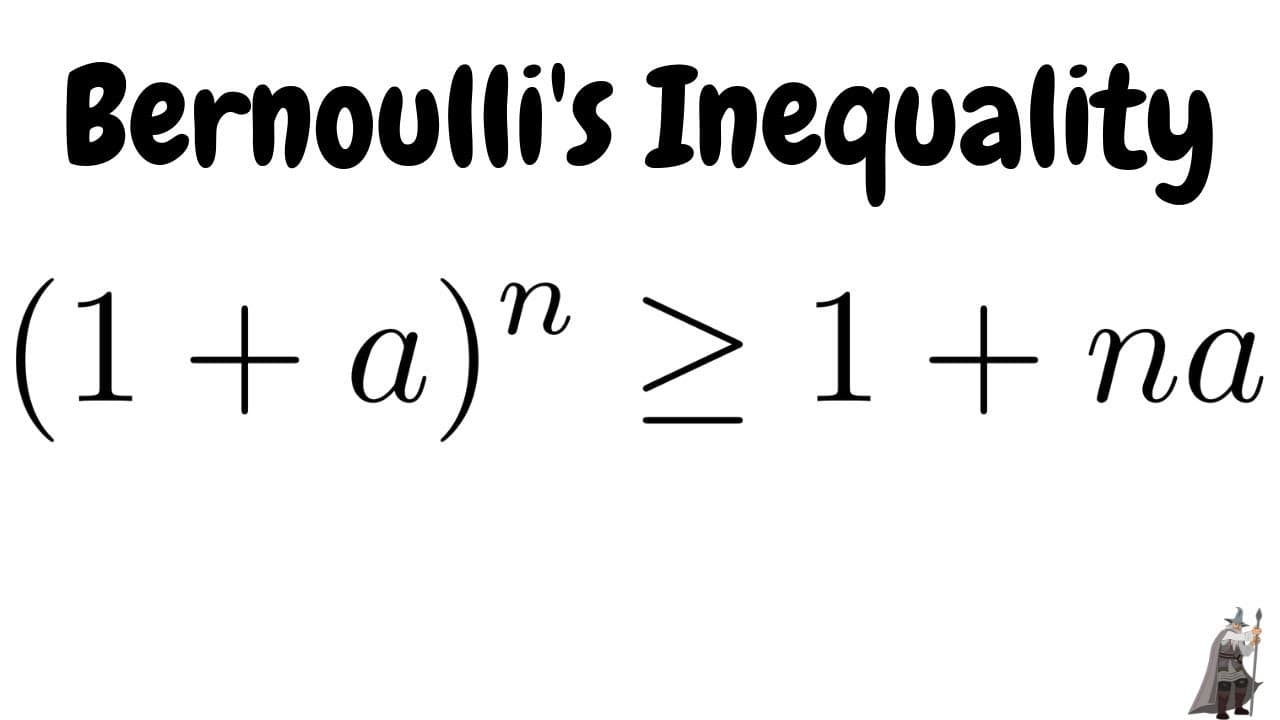
Bernoulli's inequality states that for all real numbers a ≥ -1 and positive integers n, the expression 1 + a^n ≥ 1 + na holds true. This is proven using mathematical induction, starting from the base case and showing that if it holds for n=k, it also holds for n=k+1, confirming the inequality for all positive integers.
Transcript
being asked to prove this inequality is true for all real numbers a greater than or equal to -1 and for all positive integers n this is called bari's inequality let's go ahead and prove it to prove this we'll use induction so this has to hold for all a greater than or equal to1 so we'll start by supposing a is greater than or equal to Nega 1 and no... Read More
Key Insights
- 👍 Bari's inequality needs to be proven true for all real numbers greater than or equal to -1 and for all positive integers.
- 👍 Mathematical induction is used to prove Bari's inequality.
- 🫱 The base case is established by showing that the left and right-hand sides of the inequality are equal for n=1.
- ❓ The induction hypothesis assumes the truth of the inequality for some positive integer K.
- 🥹 The induction step shows that the inequality holds for n=k+1 by using the induction hypothesis and properties of exponents.
- 🥹 By the principle of mathematical induction, it is concluded that Bari's inequality holds true for all positive integers.
- 🟰 The proof relies on the fact that a is greater than or equal to 1, which ensures that 1+a and a^2 are greater than or equal to zero.
Install to Summarize YouTube Videos and Get Transcripts
Explore YouTube Video Summarizer or Get YouTube Transcript Extractor
Questions & Answers
Q: What is Bari's inequality?
Bari's inequality is an inequality that needs to be proven true for all real numbers greater than or equal to -1 and for all positive integers.
Q: How is Bari's inequality proven?
Bari's inequality is proven using mathematical induction. The base case is shown to hold, and then the induction hypothesis and induction step are used to prove that it holds for n=k+1.
Q: Why is the base case important in the proof?
The base case is important because it establishes the truth of the inequality for the smallest positive integer, n=1. It forms the foundation for the induction step.
Q: What is the induction hypothesis in the proof?
The induction hypothesis assumes that the inequality holds true for some positive integer K. This assumption is used in the induction step to prove it for n=k+1.
Q: How is the induction step carried out?
The induction step starts with the left-hand side of the inequality for n=k+1 and shows that it is greater than or equal to the right-hand side by using the induction hypothesis and properties of exponents.
Summary & Key Takeaways
-
Bari's inequality is being proved true for all real numbers greater than or equal to -1 and for all positive integers using mathematical induction.
-
The proof starts with the base case of n=1 and shows that the left and right-hand sides of the inequality are equal.
-
The induction hypothesis is then stated and the induction step is carried out to show that the inequality holds for n=k+1.
-
By the principle of mathematical induction, it is concluded that Bari's inequality holds true for all positive integers.
Read in Other Languages (beta)
Share This Summary 📚
Summarize YouTube Videos and Get Video Transcripts with 1-Click
Try YouTube Summary with ChatGPT & Claude or YouTube Transcript Generator
Explore More Summaries from The Math Sorcerer 📚



Summarize YouTube Videos and Get Video Transcripts with 1-Click
Try YouTube Summary with ChatGPT & Claude or YouTube Transcript Generator