Schlieffen Plan and the First Battle of the Marne | The 20th century | World history | Khan Academy
TL;DR
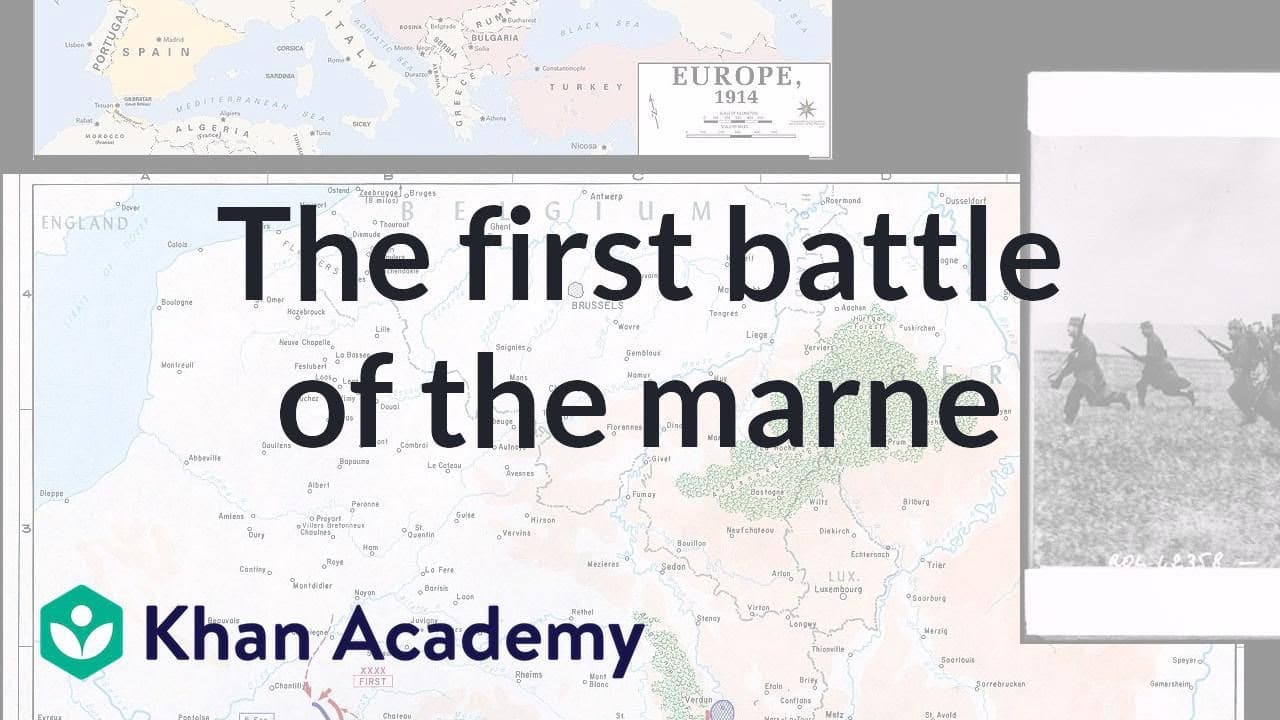
The Schlieffen Plan was Germany's strategy to avoid a two-front war by quickly defeating France, but it failed during the Battle of the Marne.
Transcript
Ever since the Franco-Prussian War in 1870 to 1871, the Germans recognized that they were likely to face another war with France. That was the war that allowed Germany to unify. They humiliated France. They were able to capture some very valuable territory from France, in particular Alsace and Lorraine, which is very mineral rich. And so the German... Read More
Key Insights
- 🎖️ Germany's experience in the Franco-Prussian War influenced their military strategy for World War I.
- 🫱 The Schlieffen Plan was designed to avoid a two-front war by defeating France first.
- ✋ The Battle of the Marne stopped the German advance and initiated a long period of trench warfare on the Western Front.
- ❓ The Schlieffen Plan's failure had significant consequences for the outcome of World War I.
- ❣️ Both the Germans and the French suffered heavy casualties during the Battle of the Marne.
- 😮 The Schlieffen Plan's reliance on speed and surprise was hindered by logistical challenges and unexpected resistance.
- 🥺 The establishment of trenches on the Western Front led to a stalemate and a war of attrition.
Install to Summarize YouTube Videos and Get Transcripts
Explore YouTube Video Summarizer or Get YouTube Transcript Extractor
Questions & Answers
Q: What inspired Germany to create the Schlieffen Plan?
Germany's victory over France in the Franco-Prussian War and the acquisition of valuable territory motivated them to plan for another potential war with France.
Q: Why did Germany want to avoid a two-front war?
Germany recognized the difficulty of fighting both France and Russia simultaneously, as each country had large armies and could potentially overwhelm Germany's forces.
Q: What was the main objective of the Schlieffen Plan?
The plan aimed to defeat France quickly by rolling through Belgium, thus avoiding the heavily fortified border with France and dealing a significant blow to the French army.
Q: How did the Battle of the Marne affect the Schlieffen Plan?
The Battle of the Marne stopped the German advance and prevented them from achieving a quick victory in France, forcing the war into a prolonged period of trench warfare.
Summary & Key Takeaways
-
Germany's humiliation of France in the Franco-Prussian War led them to plan for another war and the potential of a two-front conflict.
-
The Schlieffen Plan aimed to prevent a two-front war by defeating France first and then turning to face Russia.
-
The Battle of the Marne halted the German advance and led to the establishment of trenches and a three-year stalemate on the Western Front.
Read in Other Languages (beta)
Share This Summary 📚
Summarize YouTube Videos and Get Video Transcripts with 1-Click
Try YouTube Summary with ChatGPT & Claude or YouTube Transcript Generator
Explore More Summaries from Khan Academy 📚



Summarize YouTube Videos and Get Video Transcripts with 1-Click
Try YouTube Summary with ChatGPT & Claude or YouTube Transcript Generator