What Roles Do Proteins and Amino Acids Play?
TL;DR
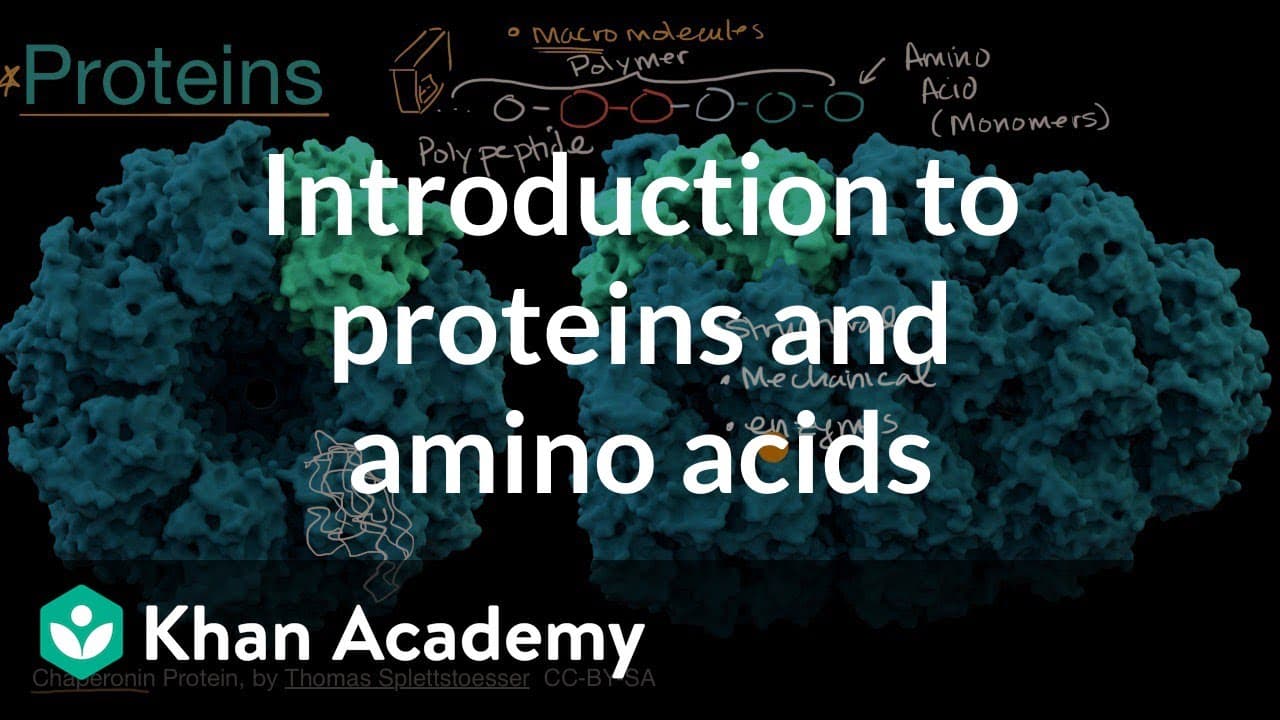
Proteins are vital biomolecules that perform numerous functions in living organisms, including structural support, enzymatic activity, and signaling. Comprised of amino acids, these large molecules can form long chains known as polypeptides, contributing to the vast diversity of biological processes.
Transcript
- [Instructor] What we're going to do in this video is talk about proteins, and some of you all might already be familiar with them, at least in some context. If you look at any type of packaging on food you'll oftentimes see a label that has protein listed and a certain number of grams per serving, and some of you who might be athletically incline... Read More
Key Insights
- 🫒 Proteins are essential biomolecules found in all living organisms and are involved in almost every biological process.
- 🫀 They are large molecules made up of many atoms and can be considered macro molecules.
- 🤙 Proteins are composed of amino acids, which form long chains called polypeptides.
- 📡 Proteins have diverse functions, including structural support, enzymatic reactions, immune response, and signaling.
- ❓ Muscle contraction relies on protein interactions, specifically actin and myosin proteins.
- 🧑🏭 Proteins can also act as enzymes, catalyzing biochemical reactions.
- ❓ Protein diversity is achieved through different sequences of amino acids.
Install to Summarize YouTube Videos and Get Transcripts
Explore YouTube Video Summarizer or Get YouTube Transcript Extractor
Questions & Answers
Q: What are proteins and why are they important?
Proteins are biomolecules found in all living organisms and are involved in various biological processes. They play a crucial role in structural support, enzymatic reactions, immune response, signaling, and more. Without proteins, life as we know it would not be possible.
Q: How are proteins formed?
Proteins are formed from amino acids, which are connected together through chemical bonds. Amino acids can form long chains called polypeptides, which can then fold and take on specific shapes to become functional proteins.
Q: What are the different types of proteins?
There are numerous types of proteins, each with a specific function. Some examples include structural proteins (providing support to cells and tissues), enzymes (catalyzing chemical reactions), transport proteins (moving molecules across cell membranes), and receptor proteins (receiving signals from other cells).
Q: How do proteins contribute to muscle building?
Proteins play a crucial role in muscle building as they are involved in muscle contraction. Actin and myosin proteins interact with each other, leading to muscle contractions. Additionally, proteins are needed for muscle repair and growth.
Summary & Key Takeaways
-
Proteins are biomolecules found in all living organisms, and they play a crucial role in various biological processes.
-
They are large molecules made up of many atoms and come in different shapes and sizes.
-
Proteins are composed of amino acids, which are the building blocks of proteins and can form long chains called polypeptides.
Read in Other Languages (beta)
Share This Summary 📚
Summarize YouTube Videos and Get Video Transcripts with 1-Click
Try YouTube Summary with ChatGPT & Claude or YouTube Transcript Generator
Explore More Summaries from Khan Academy 📚



Summarize YouTube Videos and Get Video Transcripts with 1-Click
Try YouTube Summary with ChatGPT & Claude or YouTube Transcript Generator