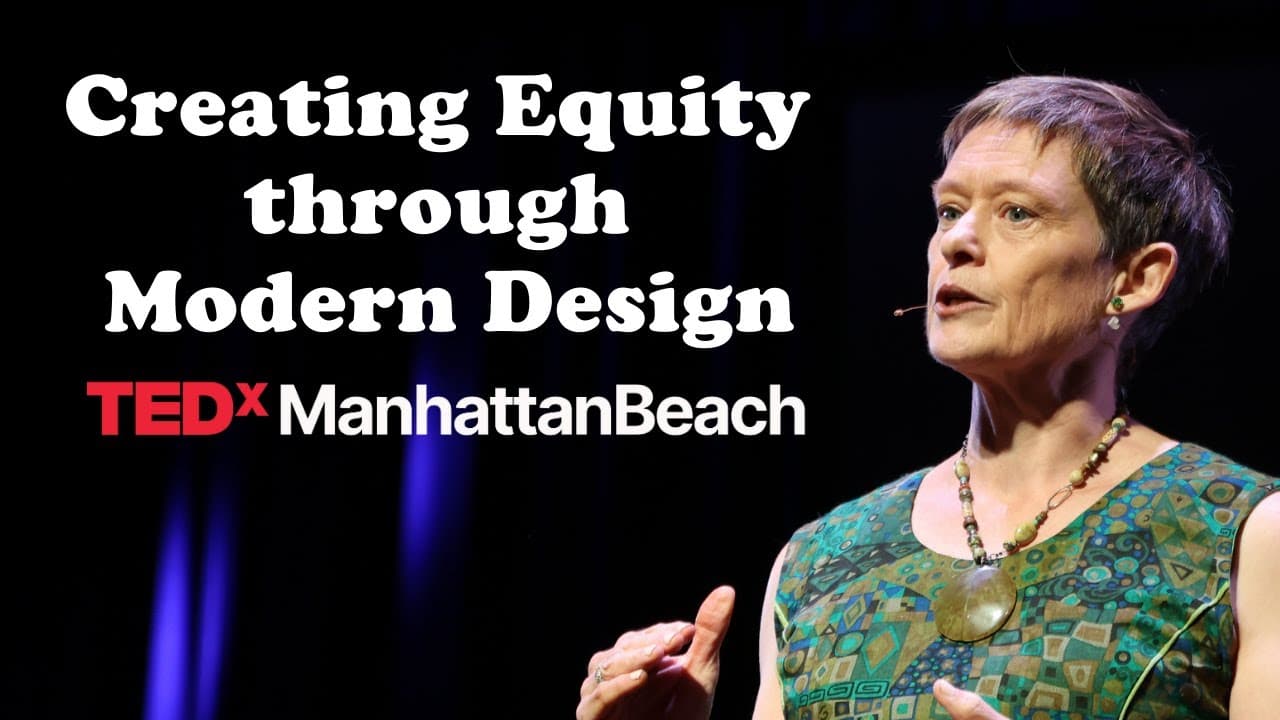
Driving climate action through design and hope | Fiona Cousins | TEDxManhattanBeach
TL;DR
The content discusses the interconnected challenges of climate change, social justice, and biodiversity and how design practice can be used to address them.
Transcript
the greatest challenges of our time are due to human impact on our world when I was born there were 3.45 billion people on the planet by the time I was 45 that number had doubled and now it's just about 8 billion happily far few of us are living in poverty and poor health we have made enormous progress in improving our per capita impact but we are ... Read More
Key Insights
- 🌸 Human impact on the planet, such as climate change and biodiversity loss, are among the greatest challenges of our time.
- 🎨 Design practice, with its focus on understanding problems and creating and testing solutions, can be a powerful tool to address these challenges.
- 📽️ Projects that consider the broader impacts and incorporate sustainability principles have demonstrated better outcomes.
- 🪛 Personal practices such as curiosity, generosity, and courage are important in driving change.
- ❓ Collaboration and embracing diverse perspectives are crucial in solving wicked problems.
- 🎨 Design practice requires deep knowledge, inclusive teamwork, creativity, and resilience.
- 🌍 The world needs innovative and responsible design solutions to keep the planet livable for everyone.
Install to Summarize YouTube Videos and Get Transcripts
Explore YouTube Video Summarizer or Get YouTube Transcript Extractor
Questions & Answers
Q: What are the three interconnected challenges identified as the greatest of our time?
The three challenges are climate change, impact on natural ecosystems, and the need to address issues of social, racial, and intergenerational equity and diversity. These challenges are interconnected and require collective action to solve.
Q: How can design practice help address these challenges?
Design practice involves understanding the problem and creating and testing solutions. By incorporating the challenges as constraints and considering their broader impacts, design practice can lead to better outcomes that address climate change, social justice, and biodiversity.
Q: Can you provide examples of projects that have successfully addressed these challenges?
Sure, for example, the Hunters Point South project in New York used blue-green infrastructure for stormwater management, benefiting both nature and the community. The building at 80m Street Southeast used timber construction for lower carbon emissions. The California High-Speed Rail project focused on carbon neutrality and habitat restoration.
Q: What personal practices can help address these challenges?
Three personal practices that can help are being curious, sharing knowledge, and being brave. Being curious about the big picture and practical details allows for innovation. Sharing knowledge and collaborating with diverse perspectives is crucial. Lastly, being brave in leading and thinking differently is essential to driving change.
Summary & Key Takeaways
-
The world is facing challenges such as climate change, social justice, and biodiversity loss due to human impact on the planet.
-
Design practice, which involves understanding the problem and creating and testing solutions, can help address these challenges.
-
Examples of projects that have taken a holistic approach and considered the broader impacts include a waterfront park using sustainable stormwater management, a building constructed with timber for lower carbon emissions, and a high-speed rail project focused on carbon neutrality.
Read in Other Languages (beta)
Share This Summary 📚
Summarize YouTube Videos and Get Video Transcripts with 1-Click
Try YouTube Summary with ChatGPT & Claude or YouTube Transcript Generator
Explore More Summaries from TEDx Talks 📚

Summarize YouTube Videos and Get Video Transcripts with 1-Click
Try YouTube Summary with ChatGPT & Claude or YouTube Transcript Generator