Greatest Common Factor
TL;DR
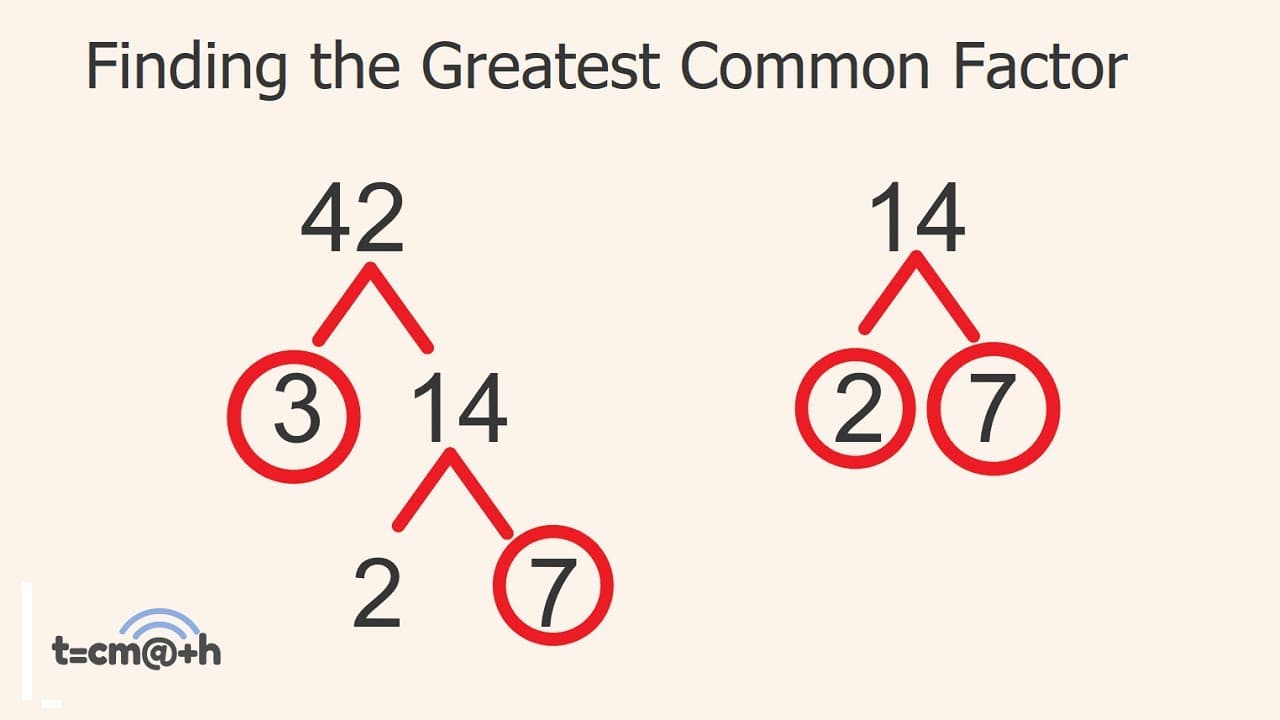
This video explains how to find the lowest common multiple and highest common factor using factor trees.
Transcript
good day in this video what we're going to be doing is we're going to be using factor trees to work at the lowest common multiple and the highest common factor of two numbers lowest common multiple is the lowest number that these guys will go into and the highest common factor is the highest common number that goes into them so let's have an exampl... Read More
Key Insights
- 🧑🏭 Factor trees are useful tools for finding the prime factors of composite numbers.
- 🧑🏭 The highest common factor is calculated by multiplying the common prime factors.
- 😘 The lowest common multiple is found by multiplying all the prime factors of the given numbers.
- 🧑🏭 The process of finding the highest common factor and lowest common multiple remains consistent for numbers with multiple prime factors.
- 🧑🏭 Factor trees can be used for larger numbers as well, following the same principles.
- #️⃣ The highest common factor is the largest number that divides both given numbers evenly.
- #️⃣ The lowest common multiple is the smallest number that both given numbers can divide into evenly.
Install to Summarize YouTube Videos and Get Transcripts
Explore YouTube Video Summarizer or Get YouTube Transcript Extractor
Questions & Answers
Q: What is a factor tree and how is it used in finding the lowest common multiple and highest common factor?
A factor tree is a diagram used to break down a number into its prime factors. By creating factor trees for two numbers, we can identify the common prime factors needed to find the lowest common multiple and highest common factor.
Q: How do you determine the highest common factor using factor trees?
To find the highest common factor, we look for the common prime factors in the factor trees of the given numbers. By multiplying these common factors, we obtain the highest common factor.
Q: What is the lowest common multiple and how is it calculated using factor trees?
The lowest common multiple is the smallest number that both given numbers can divide into. To calculate it, we multiply all the prime factors present in the factor trees of the given numbers.
Q: Can factor trees be used for larger numbers with multiple prime factors?
Yes, factor trees can be used for larger numbers with multiple prime factors. The process remains the same—break down the numbers into their prime factors and identify the common factors for finding the highest common factor and lowest common multiple.
Summary & Key Takeaways
-
The video demonstrates how to create factor trees for two given numbers (36 and 84) in order to find their lowest common multiple and highest common factor.
-
It explains the process of breaking down composite numbers into their prime factors using factor trees.
-
The highest common factor is found by multiplying the common prime factors, while the lowest common multiple is found by multiplying all the prime factors of both numbers.
Read in Other Languages (beta)
Share This Summary 📚
Summarize YouTube Videos and Get Video Transcripts with 1-Click
Try YouTube Summary with ChatGPT & Claude or YouTube Transcript Generator
Explore More Summaries from tecmath 📚


Summarize YouTube Videos and Get Video Transcripts with 1-Click
Try YouTube Summary with ChatGPT & Claude or YouTube Transcript Generator