Gradient Adaptive Lattice Filters - Adaptive Filters - Advanced Digital Signal Processing
TL;DR
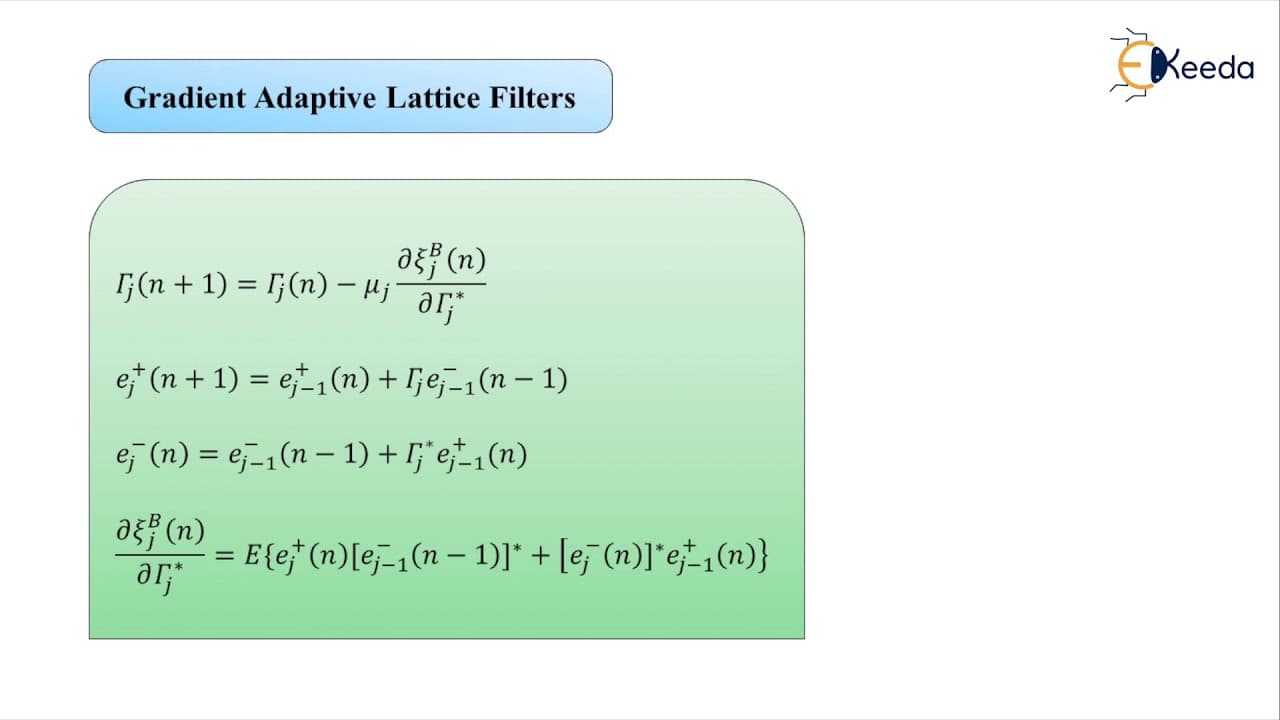
This video discusses the topic of gradient adaptive lattice filters, which are a more efficient form of implementing adaptive filters in digital signal processing.
Transcript
hello friends and welcome to this video we are with the sixth chapter of subject advanced digital signal processing and the chapter is adaptive filters so far learning the details of adoptive filters we started with the topics like adaptive filter system identification and then a fire adaptive filter design with the help of the algorithms like the ... Read More
Key Insights
- 📡 Adaptive filters are used in digital signal processing for adjusting their parameters based on input signals.
- 🍉 The lattice structure provides advantages in terms of computational complexity and simplicity in implementing adaptive filters.
- ❓ Reflection coefficients are used to represent the output of each stage of a lattice filter.
- 🎨 There are different approaches to designing lattice filters for linear prediction, including minimizing mean square prediction errors and the Burg's method.
- ❎ The steepest descent and least mean squares (LMS) methods are two approaches to updating the parameters of adaptive lattice filters.
Install to Summarize YouTube Videos and Get Transcripts
Explore YouTube Video Summarizer or Get YouTube Transcript Extractor
Questions & Answers
Q: What is the purpose of adaptive filters in digital signal processing?
Adaptive filters are used to adjust their parameters based on input signals to achieve specific filtering goals, such as noise cancellation or system identification.
Q: What advantages does the lattice structure offer in the implementation of adaptive filters?
The lattice structure provides advantages in terms of computational complexity and simplicity compared to the direct form structure.
Q: How are reflection coefficients used in the parameterization of lattice filters?
Reflection coefficients, denoted as gamma, are used to represent the output of each stage of the lattice filter and are related to forward and backward prediction errors.
Q: What are the two approaches to designing lattice filters for linear prediction?
The sequential minimization of mean square forward or backward prediction errors and the Burg's method are two common approaches to designing lattice filters.
Q: What is the update equation for the steepest descent adaptive lattice filter?
The update equation for the steepest descent adaptive lattice filter involves multiplying the step size by the expected values of the forward and backward prediction errors.
Q: What are the limitations of using the steepest descent approach for adaptive lattice filters?
The steepest descent approach requires knowing the second-order statistics of the forward and backward prediction errors, which may not always be practical.
Q: What is the alternative approach to the steepest descent method?
The alternative approach is the least mean squares (LMS) method, which replaces expected values with instantaneous values in the update equation.
Q: How can the convergence constraint be satisfied in the gradient adaptive lattice filter?
The step sizes in the gradient adaptive lattice filter can be determined by normalizing the algorithm using a time-varying step size and estimating the denominator using a recursion equation.
Summary & Key Takeaways
-
The video is part of a series on advanced digital signal processing, specifically focusing on adaptive filters.
-
It explains the concept of adaptive filters and their practical applications, including noise cancellation.
-
The video introduces the topic of gradient adaptive lattice filters as a more efficient implementation of adaptive filters using a lattice structure.
Read in Other Languages (beta)
Share This Summary 📚
Summarize YouTube Videos and Get Video Transcripts with 1-Click
Try YouTube Summary with ChatGPT & Claude or YouTube Transcript Generator
Explore More Summaries from Ekeeda 📚






Summarize YouTube Videos and Get Video Transcripts with 1-Click
Try YouTube Summary with ChatGPT & Claude or YouTube Transcript Generator