The pH scale | Acids and bases | AP Chemistry | Khan Academy
TL;DR
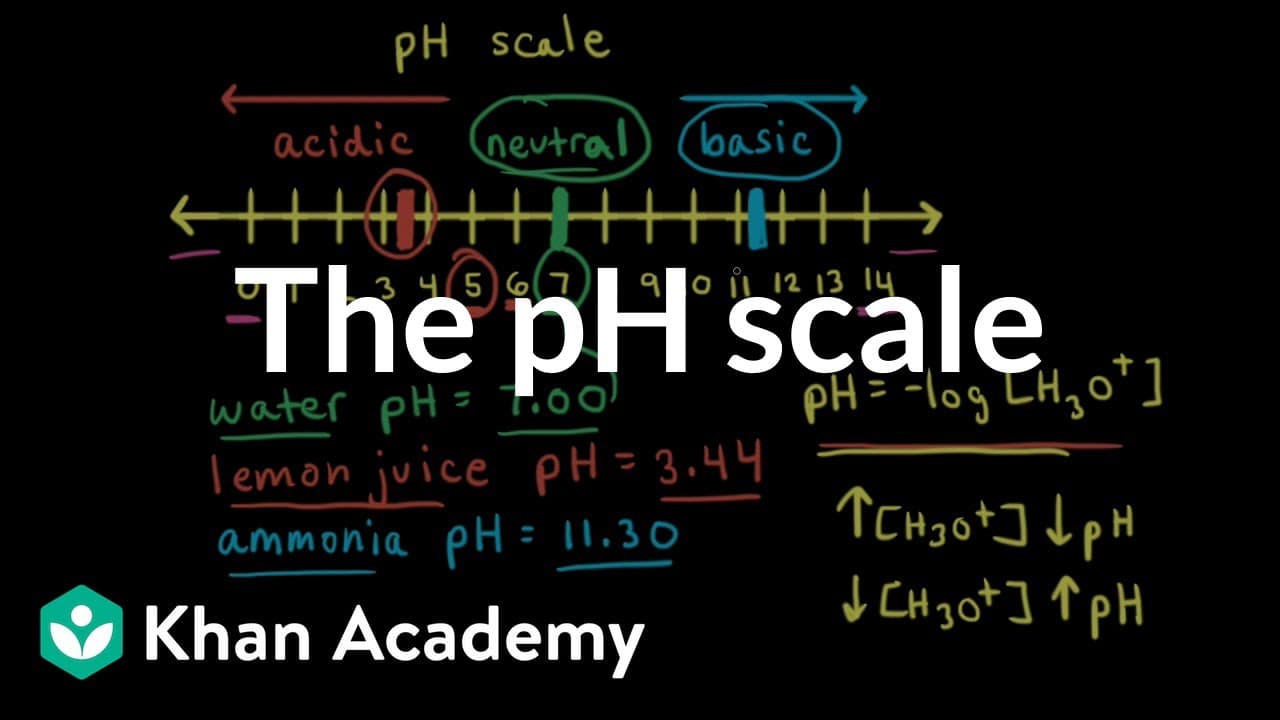
pH is a measure of the concentration of hydronium ions in a solution, with lower pH values indicating more acidic solutions and higher values representing basic solutions.
Transcript
- [Instructor] For a sample of pure water at 25 degrees Celsius, the concentration of hydronium ion is equal to 1.0 times 10 to the negative seventh molar. Because the concentrations are often very small, it's much more convenient to express the concentration of hydronium ion in terms of pH. And pH is defined as the negative log of the concentratio... Read More
Key Insights
- 😑 pH is a logarithmic measure of hydronium ion concentration, making it convenient for expressing values that span many orders of magnitude.
- 😐 The pH scale is used to classify solutions as acidic, neutral, or basic.
- 😑 Calculating pH can be done by using the negative logarithm of the concentration of hydronium ions.
- ❓ pH and pOH are related through the equation pH + pOH = 14.00 at 25 degrees Celsius.
- 😥 Logarithmic estimation allows for quick approximations of pH values without using a calculator.
- 😘 The higher the concentration of hydronium ions, the lower the pH value, indicating a more acidic solution.
- 😥 Pure water has a pH value of 7.00, making it neutral on the pH scale.
Install to Summarize YouTube Videos and Get Transcripts
Explore YouTube Video Summarizer or Get YouTube Transcript Extractor
Questions & Answers
Q: What is pH and how is it related to hydronium ion concentration?
pH is a measure of the concentration of hydronium ions in a solution, expressed as the negative log of this concentration. Lower pH values correspond to higher hydronium ion concentrations.
Q: How can pH be calculated without using a calculator?
By estimating the concentration of hydronium ions on a logarithmic scale, pH values can be approximated. For example, a concentration of 10^-3 corresponds to a pH of 3, while 10^-4 corresponds to a pH of 4.
Q: How does the pH scale work?
The pH scale ranges from 0 to 14, with solutions below 7 being acidic, those at 7 being neutral (such as pure water), and values above 7 indicating basic solutions.
Q: What is the relationship between pH and the concentration of hydronium ions?
As the concentration of hydronium ions increases, the pH value decreases, indicating a more acidic solution. Conversely, lower concentrations result in higher pH values, indicating a more basic solution.
Summary & Key Takeaways
-
pH is a convenient way to express the concentration of hydronium ions in a solution, defined as the negative log of the concentration.
-
Logarithms are used to determine pH values, where the numbers to the right of the decimal point indicate significant figures.
-
Solutions with pH values below 7 are acidic, while those above 7 are basic.
Read in Other Languages (beta)
Share This Summary 📚
Summarize YouTube Videos and Get Video Transcripts with 1-Click
Try YouTube Summary with ChatGPT & Claude or YouTube Transcript Generator
Explore More Summaries from Khan Academy 📚



Summarize YouTube Videos and Get Video Transcripts with 1-Click
Try YouTube Summary with ChatGPT & Claude or YouTube Transcript Generator