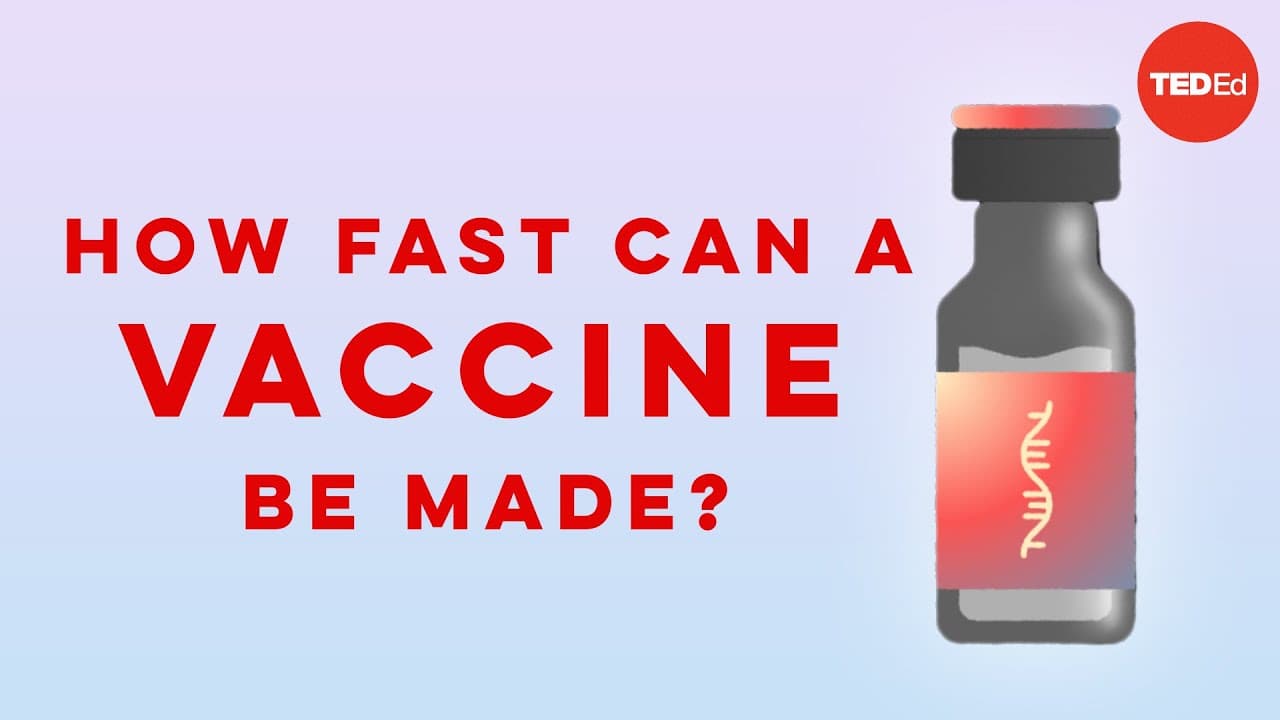
How fast can a vaccine be made? - Dan Kwartler
TL;DR
Vaccine development during a pandemic involves three phases: exploratory research, clinical testing, and manufacturing, with the need for collaboration and parallel work to expedite the process.
Transcript
When a new pathogen emerges, our bodies and healthcare systems are left vulnerable. In times like these, there’s an urgent need for a vaccine to create widespread immunity with minimal loss of life. So how quickly can we develop vaccines when we need them most? Vaccine development can generally be split into three phases. In exploratory research, ... Read More
Key Insights
- ❓ Vaccine development during a pandemic requires strategies to expedite the process.
- 🐎 Different vaccine designs have their own advantages and disadvantages in terms of resilience and speed of production.
- 🍉 Clinical testing is a lengthy and challenging phase due to the focus on safety and long-term effects.
- ⏮️ Leveraging previous treatments can help expedite clinical testing under certain circumstances.
- 👍 National regulatory authorities review and approve safe vaccines after successful Phase III trials.
- 💦 Collaboration and parallel work between labs worldwide is crucial for rapid vaccine development.
- 👍 Manufacturing plans must be designed in parallel to research and testing to start production as soon as vaccines are approved.
Install to Summarize YouTube Videos and Get Transcripts
Explore YouTube Video Summarizer or Get YouTube Transcript Extractor
Questions & Answers
Q: What are the three phases of vaccine development?
The three phases of vaccine development are exploratory research, clinical testing, and manufacturing. This process involves finding safe vaccine designs, testing for safety and efficacy, and producing vaccines for public use.
Q: What are the different vaccine designs used in exploratory research?
Exploratory research explores different vaccine designs, including traditional attenuated vaccines, inactivated vaccines, and sub-unit vaccines. Each design has its own pros and cons in terms of resilience and speed of production.
Q: How does clinical testing ensure vaccine safety and effectiveness?
Clinical testing consists of three phases. Phase I trials focus on immune response and safety. Phase II trials determine dosage and delivery. Phase III trials identify rare side effects, negative reactions, and establish safety in the vaccine's primary use population.
Q: How does collaboration between labs expedite vaccine development?
When dealing with a pandemic, various labs working simultaneously on different vaccine models can speed up the development process. Testable vaccines can move into clinical testing while alternative approaches are explored.
Summary & Key Takeaways
-
Vaccine development typically takes 15 to 20 years, but during a pandemic, researchers employ strategies to expedite the process.
-
Exploratory research aims to find safe ways to introduce the virus to the immune system, with different vaccine designs available.
-
Clinical testing involves multiple phases to establish safety, effectiveness, dosage, and identify potential side effects.
-
Manufacturing requires coordination between labs and manufacturers, with the need to adapt to changes in vaccine design.
Read in Other Languages (beta)
Share This Summary 📚
Summarize YouTube Videos and Get Video Transcripts with 1-Click
Try YouTube Summary with ChatGPT & Claude or YouTube Transcript Generator
Explore More Summaries from TED-Ed 📚





Summarize YouTube Videos and Get Video Transcripts with 1-Click
Try YouTube Summary with ChatGPT & Claude or YouTube Transcript Generator