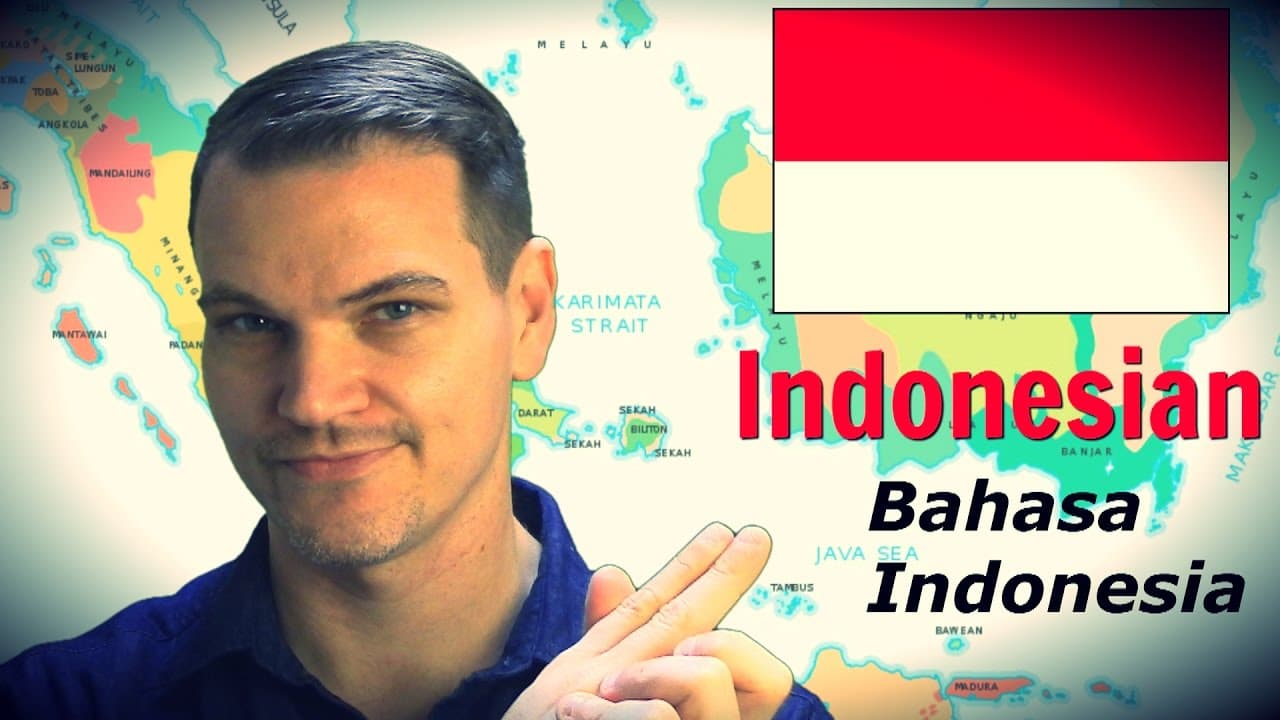
The Indonesian Language (Bahasa Indonesia)
TL;DR
Indonesian is a simple, widely spoken lingua franca in Indonesia.
Transcript
Follow Langfocus on Facebook, Twitter and Instagram. Hello everyone. Welcome to the Langfocus channel and my name is Paul. Today's topic is the Indonesian language, or Bahasa Indonesia as it's called in Indonesian. Indonesian is closely connected with Malay. So, if you haven't seen my video on the Malay language yet, I recommend that you watch that... Read More
Key Insights
- Indonesian, known as Bahasa Indonesia, is closely related to Malay but has evolved with unique features, including Dutch loanwords.
- Indonesian serves as a lingua franca in Indonesia, where hundreds of languages are spoken, making it essential for communication and education.
- The language emerged from Malay during the colonial period, with the Dutch promoting Malay for trade and administration rather than imposing Dutch.
- Indonesian was chosen as the national language at independence to ensure unity, despite being the native language of only 5% of the population.
- Standard Indonesian is known for its simplicity, including straightforward phonology, orthography, and lack of verb conjugations and grammatical gender.
- Colloquial varieties, known as Bahasa Gaul, differ from Standard Indonesian and are influenced by local languages, with Jakarta's version incorporating Betawi, Javanese, and Sundanese.
- Indonesian's affix system, while challenging, allows learners to expand vocabulary by understanding word roots and connections.
- The spread of Indonesian as a native language is increasing, especially in urban areas, due to intermarriage and migration.
Install to Summarize YouTube Videos and Get Transcripts
Explore YouTube Video Summarizer or Get YouTube Transcript Extractor
Questions & Answers
Q: Why is Indonesian considered a lingua franca in Indonesia?
Indonesian functions as a lingua franca in Indonesia due to the country's linguistic diversity, with hundreds of regional languages spoken across the archipelago. It facilitates communication between speakers of different native languages and is used in education, media, and government, making it essential for national cohesion.
Q: How did the Indonesian language evolve from Malay?
Indonesian evolved from Malay, which was a lingua franca for trade and administration in the Malay Archipelago. During the colonial period, the Dutch promoted Malay for practical reasons, and over time, it developed unique features, including Dutch loanwords. This evolution led to the distinct Indonesian variety of Malay.
Q: Why wasn't Javanese chosen as the national language of Indonesia?
Javanese, despite being the native language of over 40% of the population, wasn't chosen as the national language to avoid favoritism towards the largest ethnic group. Indonesian, already a widespread lingua franca, was more neutral and simpler, making it a better choice for unifying the diverse nation.
Q: What are some key features of Standard Indonesian?
Standard Indonesian is characterized by its simplicity, with straightforward phonology and orthography. It follows a simple SVO sentence structure, lacks case inflections and grammatical gender, and does not require verb conjugations. These features contribute to its accessibility for learners and its rapid adoption as a national language.
Q: How do colloquial varieties of Indonesian differ from Standard Indonesian?
Colloquial varieties, known as Bahasa Gaul, differ from Standard Indonesian by incorporating regional linguistic influences. For example, Jakarta's Bahasa Gaul includes elements from Betawi, Javanese, and Sundanese. These variations often involve changes in vocabulary, pronunciation, and grammar, reflecting the local linguistic environment.
Q: What role do affixes play in the Indonesian language?
Affixes in Indonesian are crucial for word formation, allowing speakers to create verbs and nouns from roots. Although challenging for learners, understanding affixes helps expand vocabulary by revealing connections between words. This system is a key feature distinguishing Indonesian from other languages, despite its overall simplicity.
Q: How is the Indonesian language spreading as a native language?
Indonesian is increasingly becoming a native language, especially in urban areas, due to migration and intermarriage. As people from diverse linguistic backgrounds move to cities and form families, they often adopt Indonesian as the primary language for communication and raising children, contributing to its growing status as a native language.
Q: What impact did Dutch colonial rule have on the Indonesian language?
Dutch colonial rule influenced the Indonesian language by introducing Dutch loanwords, especially in areas under Dutch control. However, the Dutch did not impose their language widely, instead promoting Malay for trade and administration. This approach allowed Malay to evolve into Indonesian, distinct from other Malay varieties, and facilitated its role as a national language.
Summary & Key Takeaways
-
The Indonesian language, or Bahasa Indonesia, is based on Malay but has evolved with unique features. It serves as a lingua franca in Indonesia, facilitating communication among speakers of hundreds of regional languages. Its simplicity and historical role in trade have contributed to its widespread adoption.
-
Indonesian became the national language at independence to foster unity, despite being the native language of only a small percentage of the population. Its simplicity, including straightforward phonology and grammar, has made it accessible for millions as a second language.
-
Colloquial varieties of Indonesian, known as Bahasa Gaul, differ from Standard Indonesian and are influenced by local languages. These variations reflect the diverse linguistic landscape of Indonesia and contribute to the distinctiveness of Indonesian compared to other Malay varieties.
Read in Other Languages (beta)
Share This Summary 📚
Summarize YouTube Videos and Get Video Transcripts with 1-Click
Try YouTube Summary with ChatGPT & Claude or YouTube Transcript Generator
Explore More Summaries from Langfocus 📚


Summarize YouTube Videos and Get Video Transcripts with 1-Click
Try YouTube Summary with ChatGPT & Claude or YouTube Transcript Generator