2011 Calculus BC free response #1 (b & c) | AP Calculus BC | Khan Academy
TL;DR
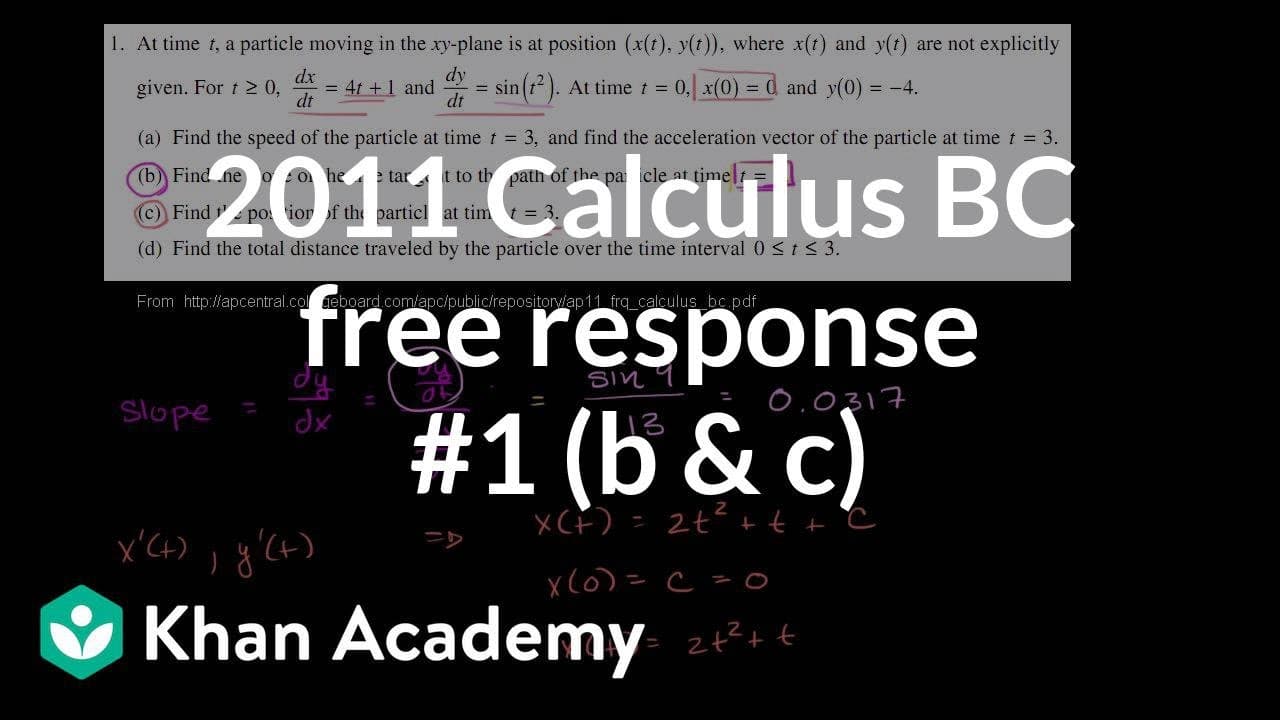
The video explains how to find the slope of the tangent line and the position of a particle at time t equals 3.
Transcript
Part b-- find the slope of the tangent line to the path of the particle at time t is equal to 3. So the slope of the tangent line is just going to be equal to the rate of change of y with respect to x at that point. And this is the same thing as dy/dt over dx/dt. And dealing with differentials is a little bit strange, especially when you want to de... Read More
Key Insights
- ⏳ The slope of the tangent line to the particle's path at time t equals 3 can be determined by finding the ratio of dy/dt to dx/dt.
- 🍞 Multiplying both the numerator and denominator by dt/dt cancels out the differentials and simplifies the calculation of the slope.
- ⏳ Finding dy/dt and dx/dt at time t equals 3 allows for the calculation of the slope of the tangent line.
- 🧘 The position of the particle at time t equals 3 can be found by evaluating the functions x(t) and y(t) at t equals 3.
- 🧘 The antiderivative of a function is used to find the position of the particle by integrating the given functions.
- ❓ The constant of integration in the antiderivative can be determined using an initial condition provided in the problem.
Install to Summarize YouTube Videos and Get Transcripts
Explore YouTube Video Summarizer or Get YouTube Transcript Extractor
Questions & Answers
Q: How is the slope of the tangent line related to the rate of change of y with respect to x?
The slope of the tangent line is equal to the ratio of dy/dt to dx/dt, as explained in the video. It represents the rate of change of y with respect to x at a specific point in time.
Q: Why does multiplying both the numerator and denominator by dt/dt cancel out the differentials?
Multiplying both the numerator and denominator by dt/dt is an algebraic manipulation to get rid of the differentials. When viewed as small changes in y, x, and t, the cancellation occurs because dt/dt represents the same small change in t for both numerator and denominator.
Q: How do you find dy/dt at time t equals 3?
Dy/dt at time t equals 3 is equal to the sine of 3 squared, or sine of 9. This value is given in the video and can be calculated as approximately 0.0317.
Q: What is the position of the particle at time t equals 3?
The position of the particle at time t equals 3 is (21, -3.226). This is obtained by evaluating the functions x(t) and y(t) at t equals 3, as shown in the video.
Summary & Key Takeaways
-
The slope of the tangent line to the path of the particle at time t equals 3 can be found by taking the derivative of y with respect to x.
-
To find the slope, the video demonstrates multiplying both the numerator and the denominator by dt/dt, canceling them out, and obtaining the ratio of dy/dt to dx/dt.
-
The video then explains how to find the position of the particle at time t equals 3 by integrating the given functions and evaluating them at that time.
Read in Other Languages (beta)
Share This Summary 📚
Summarize YouTube Videos and Get Video Transcripts with 1-Click
Try YouTube Summary with ChatGPT & Claude or YouTube Transcript Generator
Explore More Summaries from Khan Academy 📚



Summarize YouTube Videos and Get Video Transcripts with 1-Click
Try YouTube Summary with ChatGPT & Claude or YouTube Transcript Generator