How Does New Subsurface Scattering Improve Game Graphics?
TL;DR
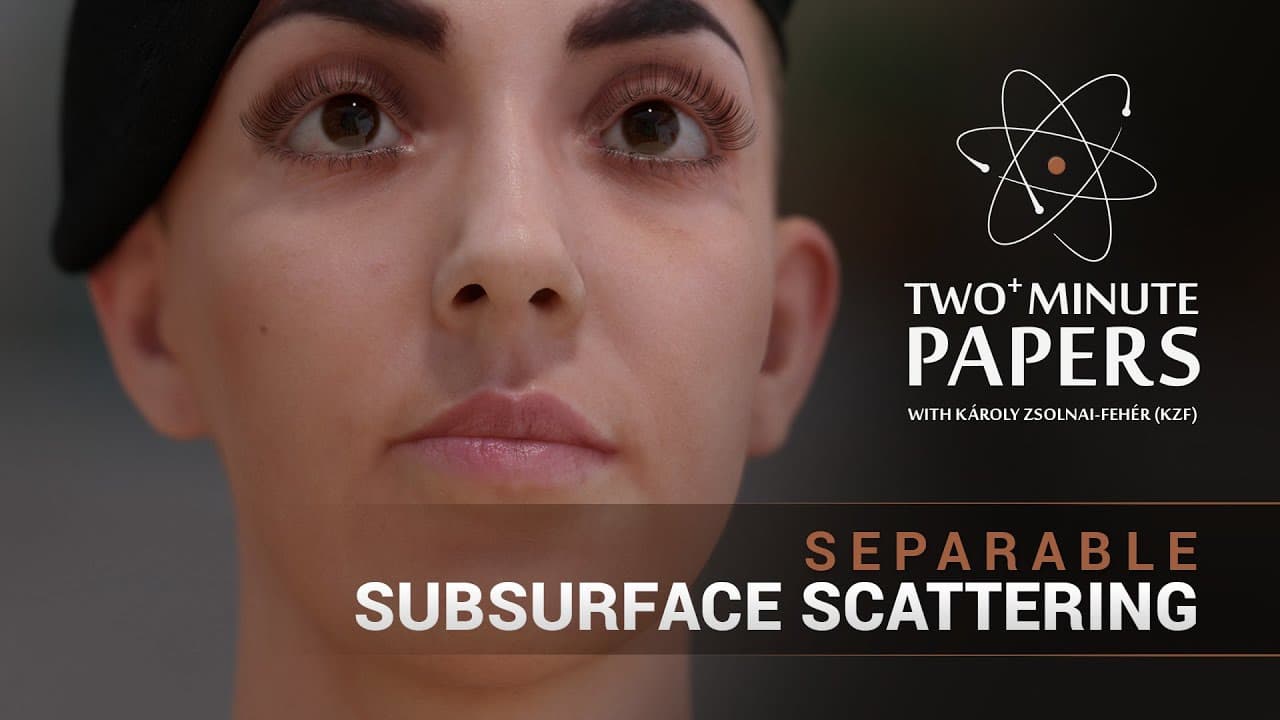
A new subsurface scattering technique enables real-time simulation of light transport in just half a millisecond per image, greatly enhancing video game realism. By using diffusion profiles and convolution methods, this innovation reduces computational costs while allowing for artistic manipulation, making it suitable for both high-end games and scientific applications.
Transcript
Dear Fellow Scholars, this is Two Minute Papers with Károly Zsolnai-Fehér. Subsurface scattering means that a portion of incoming light penetrates the surface of a material. Our skin is a little known, but nonetheless great example of that, but so are plant leaves, marble, milk, or snails, to have a wackier example. Subsurface scattering looks unbe... Read More
Key Insights
- ⌛ Activision Blizzard and two universities collaborate to develop a revolutionary subsurface scattering technique for real-time graphics.
- 😒 The technique uses diffusion profiles and convolution to mix optical properties and create highly realistic graphics.
- ⌛ It allows for real-time applications, eliminating the need for time-consuming simulations.
- ❓ The results are scientifically provable and offer possibilities for artistic manipulation and customization.
- 👻 The technique's simplicity allows it to fit on a business card and has potential for wide-ranging applications beyond gaming.
- 👨🔬 Collaboration between academia and companies can produce results beneficial to both the gaming industry and scientific research.
- ❓ The technique has been recognized and adopted by Intel, showcasing its significance and practicality.
Install to Summarize YouTube Videos and Get Transcripts
Explore YouTube Video Summarizer or Get YouTube Transcript Extractor
Questions & Answers
Q: What is subsurface scattering and why is it difficult to simulate?
Subsurface scattering refers to the penetration of light through surfaces, such as skin or leaves. It is challenging to simulate because it requires computing thousands of light scattering events for every ray of light, resulting in time-consuming and computationally expensive processes.
Q: How does the collaboration's technique differ from previous methods?
The technique involves recording light bounces off translucent materials, creating diffusion profiles that store the optical properties of the materials. By convoluting these profiles with target materials, the optical properties are mixed, resulting in realistic graphics.
Q: How does this technique improve graphics in video games?
With the ability to simulate subsurface scattering in just half a millisecond per image, the technique allows real-time applications, eliminating the lifeless, rubbery appearance of human characters in games. It enables photorealistic graphics by applying appropriate diffusion profiles and artistic manipulation.
Q: What are the potential applications of this technique outside of video games?
The technique's computational efficiency and realistic results have broader applications beyond gaming. It can be used for scientific research, artistic manipulation, and even tools like Blender, where it has recently appeared.
Summary & Key Takeaways
-
Subsurface scattering, the penetration of light through surfaces, is a complex and expensive process to simulate in computer graphics.
-
This collaboration has developed a new convolution-based technique that uses diffusion profiles to mix the optical properties of materials and generate photorealistic graphics.
-
The technique is computationally efficient, allowing real-time applications, and offers the potential for artistic manipulation.
Read in Other Languages (beta)
Share This Summary 📚
Summarize YouTube Videos and Get Video Transcripts with 1-Click
Try YouTube Summary with ChatGPT & Claude or YouTube Transcript Generator
Explore More Summaries from Two Minute Papers 📚




Summarize YouTube Videos and Get Video Transcripts with 1-Click
Try YouTube Summary with ChatGPT & Claude or YouTube Transcript Generator