Linear vs. exponential growth: from data | High School Math | Khan Academy
TL;DR
Linear and exponential functions are used to model the growth of oak and birch trees, with a linear model fitting the data for oak trees and an exponential model fitting the data for birch trees.
Transcript
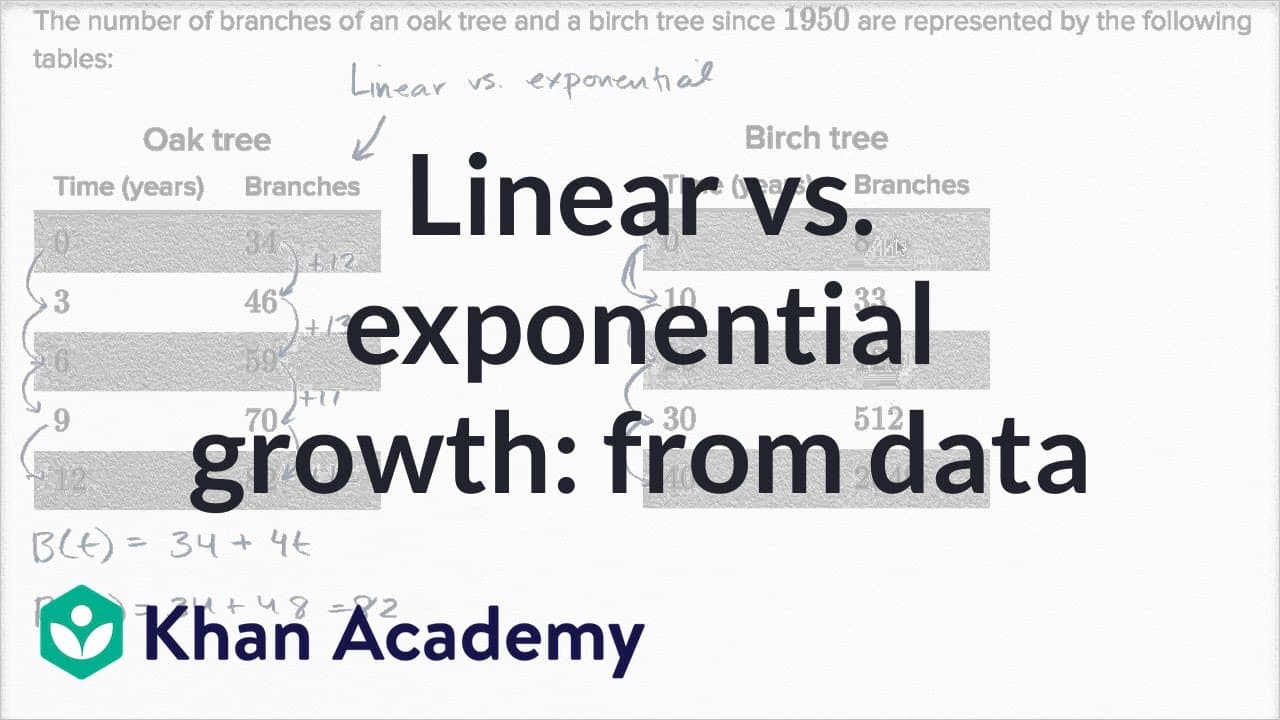
- [Voiceover] The number of branches of an oak tree and a birch tree since 1950 are represented by the following tables. So for the oak tree we see when time equals zero has 34 branches. After three years it has 46 branches, so on and so forth. And in the birch tree they give us similar data. At the beginning has eight branches. In 10 years has 33 ... Read More
Key Insights
- 🌍 Real-world data often requires approximations and models to understand and predict behavior accurately.
- 🌲 The growth of oak trees exhibits a roughly constant increase in branches every three years, making a linear model appropriate.
- 🧑🏭 The growth of birch trees shows an exponential pattern, with the number of branches multiplying by a factor of four every ten years.
- 🌱 Linear and exponential models can provide useful insights into the growth patterns of different plant species.
- 🙂 The models presented in the content provide good approximations for the growth of oak and birch trees, although there may be slight deviations from the actual data.
- 🌲 The linear model for oak trees and the exponential model for birch trees can be used to predict future growth based on current time values.
Install to Summarize YouTube Videos and Get Transcripts
Explore YouTube Video Summarizer or Get YouTube Transcript Extractor
Questions & Answers
Q: How can the growth of oak and birch trees be modeled using functions?
The growth of oak trees can be modeled using a linear function, with a fixed increase in the number of branches over a fixed period of time. The growth of birch trees, on the other hand, can be modeled using an exponential function, with the number of branches increasing by a constant factor every decade.
Q: Why is a linear model suitable for modeling the growth of oak trees?
A linear model is suitable for modeling the growth of oak trees because there is a fixed increase in the number of branches over a fixed period of time. The increase in branches averages around 12 every three years, allowing for a linear approximation of the data.
Q: Why is an exponential model suitable for modeling the growth of birch trees?
An exponential model is suitable for modeling the growth of birch trees because the number of branches increases by a constant factor every decade. The increase in branches is approximately four times the previous value, leading to an exponential growth pattern.
Q: How can the linear and exponential models be represented mathematically?
The linear model for the growth of oak trees can be represented as: branches = 34 + (4 * time/3), where time is the number of years. The exponential model for the growth of birch trees can be represented as: branches = 8 * (4^(time/10)), where time is the number of years.
Summary & Key Takeaways
-
The growth of oak and birch trees over time is analyzed using mathematical functions.
-
The growth of oak trees can be modeled using a linear function, with a fixed increase in the number of branches over a fixed period of time.
-
The growth of birch trees can be modeled using an exponential function, with the number of branches increasing by a constant factor every decade.
Read in Other Languages (beta)
Share This Summary 📚
Summarize YouTube Videos and Get Video Transcripts with 1-Click
Try YouTube Summary with ChatGPT & Claude or YouTube Transcript Generator
Explore More Summaries from Khan Academy 📚



Summarize YouTube Videos and Get Video Transcripts with 1-Click
Try YouTube Summary with ChatGPT & Claude or YouTube Transcript Generator