Extraneous solutions to radical equations | Algebra I | Khan Academy
TL;DR
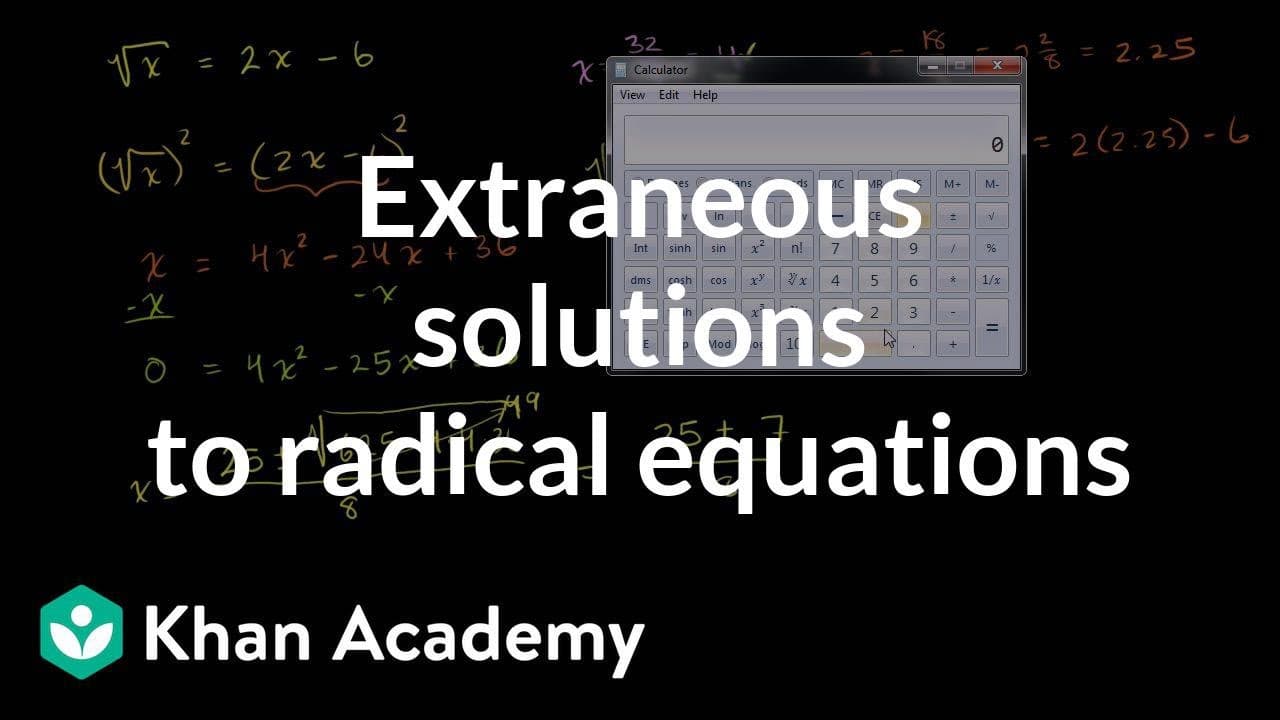
Learn how to solve radical equations and avoid extraneous solutions by isolating radicals, squaring both sides of the equation, and evaluating the solutions.
Transcript
In this video, we're going to start having some experience solving radical equations or equations that involve square roots or maybe even higher-power roots, but we're going to also try to understand an interesting phenomena that occurs when we do these equations. Let me show you what I'm talking about. Let's say I have the equation the square root... Read More
Key Insights
- 🫚 Radical equations involve square roots or higher-power roots.
- ❓ Isolate the radicals on one side of the equation to simplify solving.
- 🙃 Squaring both sides of the equation is a common step in solving radical equations.
- ❓ Extraneous solutions are solutions that do not satisfy the original equation.
- 🙃 Extraneous solutions may occur when squaring both sides introduces additional solutions.
- 🔌 Checking the validity of solutions by plugging them back into the original equation is crucial.
- 🥺 Multiple interpretations of the equation can lead to different valid solutions.
Install to Summarize YouTube Videos and Get Transcripts
Explore YouTube Video Summarizer or Get YouTube Transcript Extractor
Questions & Answers
Q: How do you solve radical equations involving square roots?
To solve radical equations involving square roots, isolate the square root on one side of the equation and then square both sides. This allows you to eliminate the radical and find the solution.
Q: What are extraneous solutions?
Extraneous solutions are solutions that appear during the solving process but do not actually satisfy the original equation. They occur when squaring both sides introduces additional solutions that are not valid.
Q: How can you determine if a solution is extraneous?
To determine if a solution is extraneous, plug the solution back into the original equation and check if it holds true. If the solution does not satisfy the original equation, it is an extraneous solution.
Q: Why do extraneous solutions occur in radical equations?
Extraneous solutions occur because when squaring both sides of the equation, additional solutions may emerge. However, these additional solutions might not be valid for the original equation, leading to extraneous solutions.
Summary & Key Takeaways
-
Radical equations involve square roots and other higher-power roots.
-
Isolate the radicals on one side of the equation and then square both sides.
-
Sometimes, extraneous solutions occur, which are solutions that do not actually satisfy the original equation.
Read in Other Languages (beta)
Share This Summary 📚
Summarize YouTube Videos and Get Video Transcripts with 1-Click
Try YouTube Summary with ChatGPT & Claude or YouTube Transcript Generator
Explore More Summaries from Khan Academy 📚



Summarize YouTube Videos and Get Video Transcripts with 1-Click
Try YouTube Summary with ChatGPT & Claude or YouTube Transcript Generator