Simple Baselines | Stanford CS224U Natural Language Understanding | Spring 2021
TL;DR
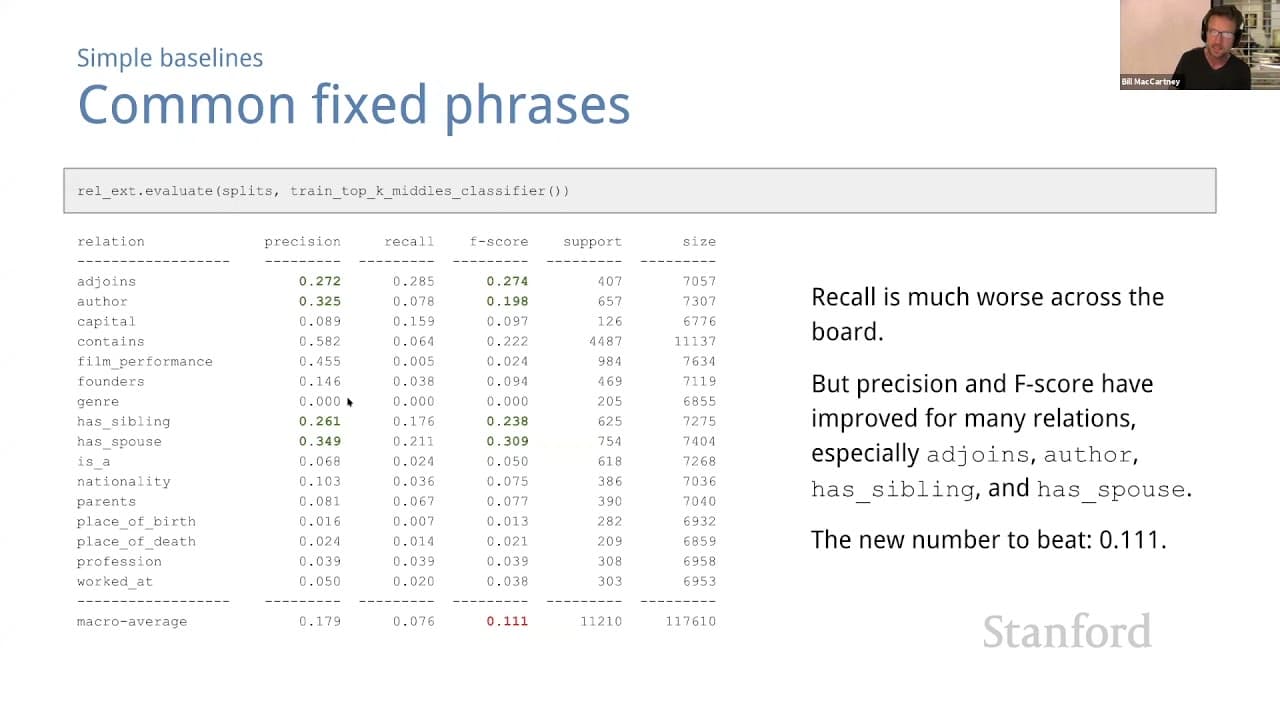
Starting with simple models (random guesser, phrase matching, bag of words classifier) helps establish baselines for more sophisticated models. The bag of words classifier showed significant improvement in precision and f-score compared to the random guesser and phrase matching approaches.
Transcript
it's good methodological practice whenever you're starting to build new models to start by evaluating very simple models which establish baselines to which you can then compare the more sophisticated models that you're going to build later on so to do that we're going to start by looking at three simple models a random guesser a very simple phrase ... Read More
Key Insights
- 🆘 Starting with simple models, such as a random guesser, helps establish baselines for evaluating more advanced models.
- 💯 The phrase matching strategy, which identifies common connecting phrases, can improve precision and f-score in natural language processing tasks.
- 💯 The bag of words classifier, using word counts as features, shows significant improvements in precision and f-score compared to simpler approaches, but there is still room for further improvement.
- 👻 Evaluating models allows for the identification of limitations, improvements, and the overall performance of the models.
- 📈 Precision and recall are important metrics to consider in model evaluation.
- ✋ Punctuation and stop words can carry useful information in natural language processing tasks.
- 💯 The chosen f-score metric gives more weight to precision than recall, which impacts the overall performance of the models.
Install to Summarize YouTube Videos and Get Transcripts
Explore YouTube Video Summarizer or Get YouTube Transcript Extractor
Questions & Answers
Q: Why is it important to start with simple models when building new models in natural language processing?
Starting with simple models helps establish baselines for more advanced models, allowing comparison and evaluation of their performance. It also helps identify any issues or limitations in the testing process.
Q: How did the random guesser model perform in terms of precision and recall?
The random guesser model achieved recall of around 0.5, as it predicts true about half the time. However, precision was generally poor because only a few of the randomly predicted true instances were actually true.
Q: What is the main advantage of the phrase matching strategy compared to the random guesser model?
The phrase matching strategy identifies common phrases connecting entities for each relation, leading to more informed predictions. It showed significant improvements in precision and f-score compared to the random guesser model.
Q: What insights can be gained from the evaluation of the bag of words classifier?
The bag of words classifier, using a simple feature function based on word counts, demonstrated significant improvements in precision and f-score compared to the previous approaches. However, there is still plenty of room for improvement, indicating further opportunities to enhance the model.
Summary & Key Takeaways
-
Evaluating simple models is important to establish baselines for more advanced models in natural language processing.
-
The random guesser model, which simply flips a coin to make predictions, is easy to implement but has poor precision.
-
The phrase matching strategy, which identifies common phrases connecting entities for each relation, showed improvements in precision and f-score.
-
The bag of words classifier, using a simple feature function based on word counts, improved precision and f-score significantly compared to the previous approaches.
Read in Other Languages (beta)
Share This Summary 📚
Summarize YouTube Videos and Get Video Transcripts with 1-Click
Try YouTube Summary with ChatGPT & Claude or YouTube Transcript Generator
Explore More Summaries from Stanford Online 📚

Summarize YouTube Videos and Get Video Transcripts with 1-Click
Try YouTube Summary with ChatGPT & Claude or YouTube Transcript Generator