Soaps and its Preparation - Chemistry In Everyday Life - Chemistry Class 12
TL;DR
This video explains the two methods of soap preparation - hydrolysis of fat and neutralization of fatty acid, and discusses the various uses of soap.
Transcript
click the bell icon to get latest videos from ekeeda and now in this topic we are going to talk about the soaps and its preparation so how it can be fried that is what i am going to talk about in this topic so friends talking about soap soap is now a daily usage of us and that's the reason that it's in this topic we are going to talk about the uses... Read More
Key Insights
- 👨 Soap is prepared through the hydrolysis of fat or the neutralization of fatty acids.
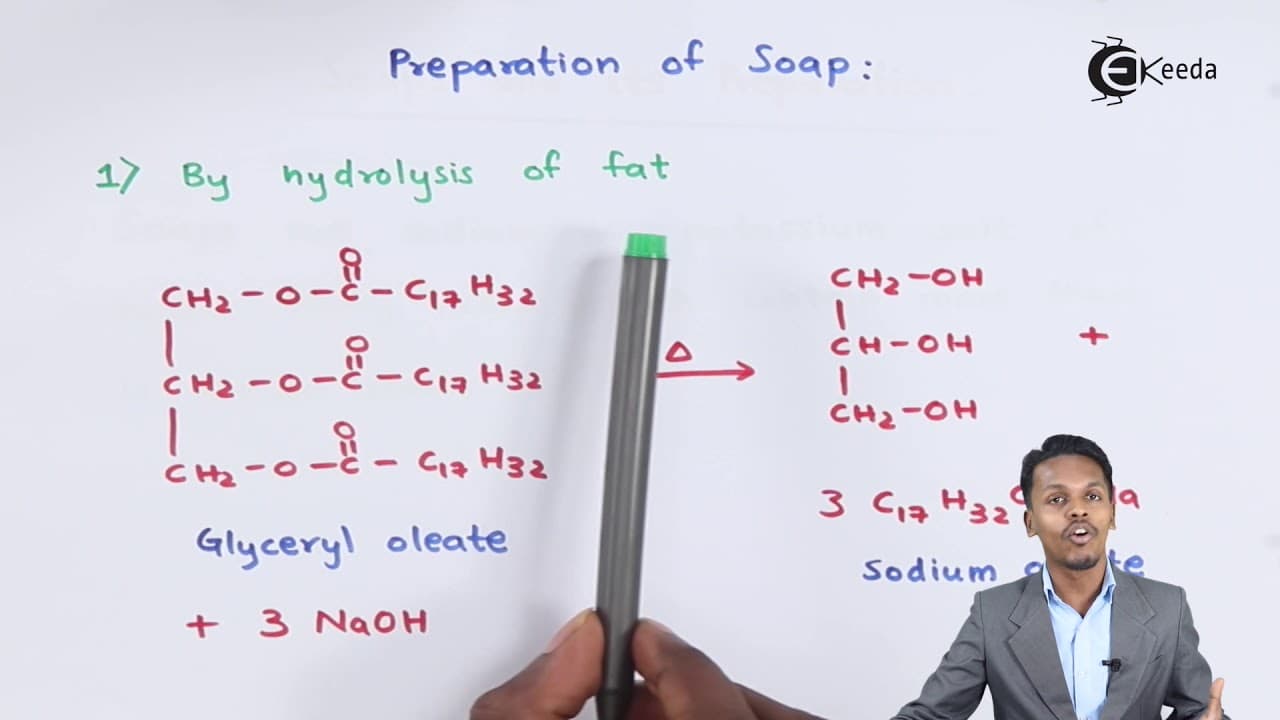
- 👨 The hydrolysis method involves reacting fats with sodium hydroxide to produce glycerol and sodium salts of fatty acids.
- 💦 The direct neutralization method involves treating fatty acids with a base to form soap and water.
- 👋 Soap acts as a good cleansing agent and is used for personal hygiene and cleaning purposes.
- 🧼 The glycerol obtained during soap preparation can be used for synthesizing other products.
- 💦 Soap is soluble in water and can be separated from the solution by adding salt.
- 🛟 Soap is widely used in daily life and has become a necessity.
Install to Summarize YouTube Videos and Get Transcripts
Explore YouTube Video Summarizer or Get YouTube Transcript Extractor
Questions & Answers
Q: What are the two methods of soap preparation?
The two methods are hydrolysis of fat (saponification) and direct neutralization of fatty acids.
Q: How does saponification occur?
Saponification occurs when a fat molecule reacts with sodium hydroxide (NaOH), resulting in the formation of glycerol and sodium salts of fatty acids.
Q: What is the byproduct of the direct neutralization method?
The byproduct of the direct neutralization method is water (H2O), which is released along with the formation of soap.
Q: What are some common uses of soap?
Soap is widely used as a cleansing agent for personal hygiene, washing clothes, and various household cleaning purposes.
Summary & Key Takeaways
-
Soap is a daily necessity and is made by reacting fats or oils with sodium or potassium salts of higher fatty acids.
-
The first method of soap preparation is the hydrolysis of fat, also known as saponification, where a fat molecule reacts with three moles of NaOH to produce glycerol and sodium ions.
-
The second method is the direct neutralization of fatty acids, where fatty acids are treated with a base to form soap and water as a byproduct.
Read in Other Languages (beta)
Share This Summary 📚
Summarize YouTube Videos and Get Video Transcripts with 1-Click
Try YouTube Summary with ChatGPT & Claude or YouTube Transcript Generator
Explore More Summaries from Ekeeda 📚






Summarize YouTube Videos and Get Video Transcripts with 1-Click
Try YouTube Summary with ChatGPT & Claude or YouTube Transcript Generator