Geometric series as a function | Series | AP Calculus BC | Khan Academy
TL;DR
The video explains how to express an infinite series in a more traditional form using geometric series properties.
Transcript
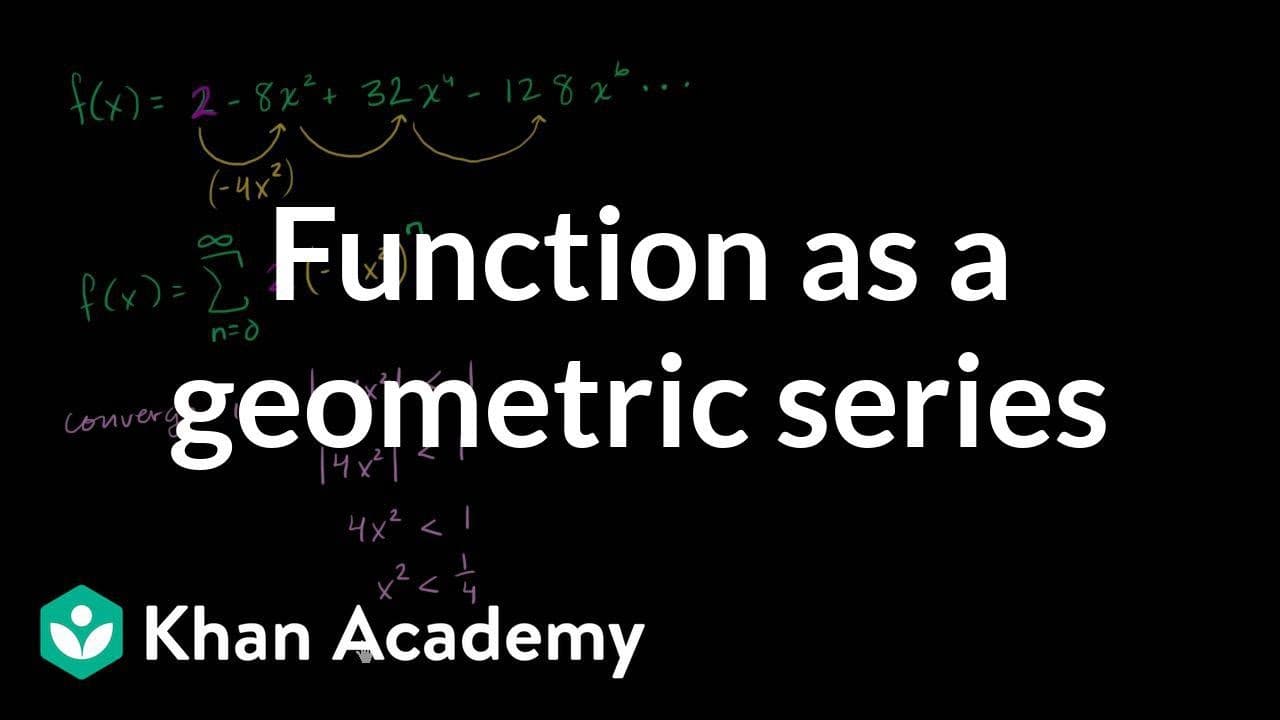
We have a function right over here defined as an infinite series. What I want to attempt to do in this video is to see if we can express it in a more traditional form. And so the thing that might jump out at you is, well, look, if this is a geometric series, we know how to take the sum of an infinite geometric series, at least over the x values whe... Read More
Key Insights
- 😑 The process of expressing an infinite series in a traditional form involves determining if it is a geometric series based on the pattern of ratios.
- 🥳 Convergence of a geometric series is determined by checking if the absolute value of the common ratio is less than 1.
- ☺️ The convergence interval represents the range of x values for which the series will converge.
Install to Summarize YouTube Videos and Get Transcripts
Explore YouTube Video Summarizer or Get YouTube Transcript Extractor
Questions & Answers
Q: How is the common ratio of the infinite series determined?
The common ratio of the infinite series is determined by looking at the pattern of ratios between consecutive terms. In this case, from 2 to -8x squared, the ratio is -4x squared, and the subsequent ratios also follow this pattern.
Q: What is the condition for a geometric series to converge?
A geometric series will converge if the absolute value of the common ratio is less than 1. In this case, the absolute value of -4x squared should be less than 1 for convergence.
Q: How is the convergence interval for the series determined?
To determine the convergence interval, we consider the absolute value of x squared (radius of convergence) to be less than 1/4. This means that the series will converge if x is within -1/4 to 1/4 distance from 0.
Q: What is the expression for the infinite series in a traditional form?
The expression for the infinite series is 2 over 1 plus 4x squared, which is found from the sum formula for geometric series by substituting the first term and the common ratio.
Summary & Key Takeaways
-
The video discusses the process of expressing an infinite series in a traditional form by determining if it is a geometric series based on the pattern of ratios.
-
The common ratio for the given series is determined to be -4x squared, which allows the series to be rewritten in geometric form.
-
The convergence of the series is determined by checking if the absolute value of the common ratio is less than 1, leading to an interval of convergence where the series converges.
-
The expression of the series is found by using the sum formula for geometric series, resulting in 2 over 1 plus 4x squared.
Read in Other Languages (beta)
Share This Summary 📚
Summarize YouTube Videos and Get Video Transcripts with 1-Click
Try YouTube Summary with ChatGPT & Claude or YouTube Transcript Generator
Explore More Summaries from Khan Academy 📚



Summarize YouTube Videos and Get Video Transcripts with 1-Click
Try YouTube Summary with ChatGPT & Claude or YouTube Transcript Generator