What Is the Friedel-Crafts Alkylation Mechanism?
TL;DR
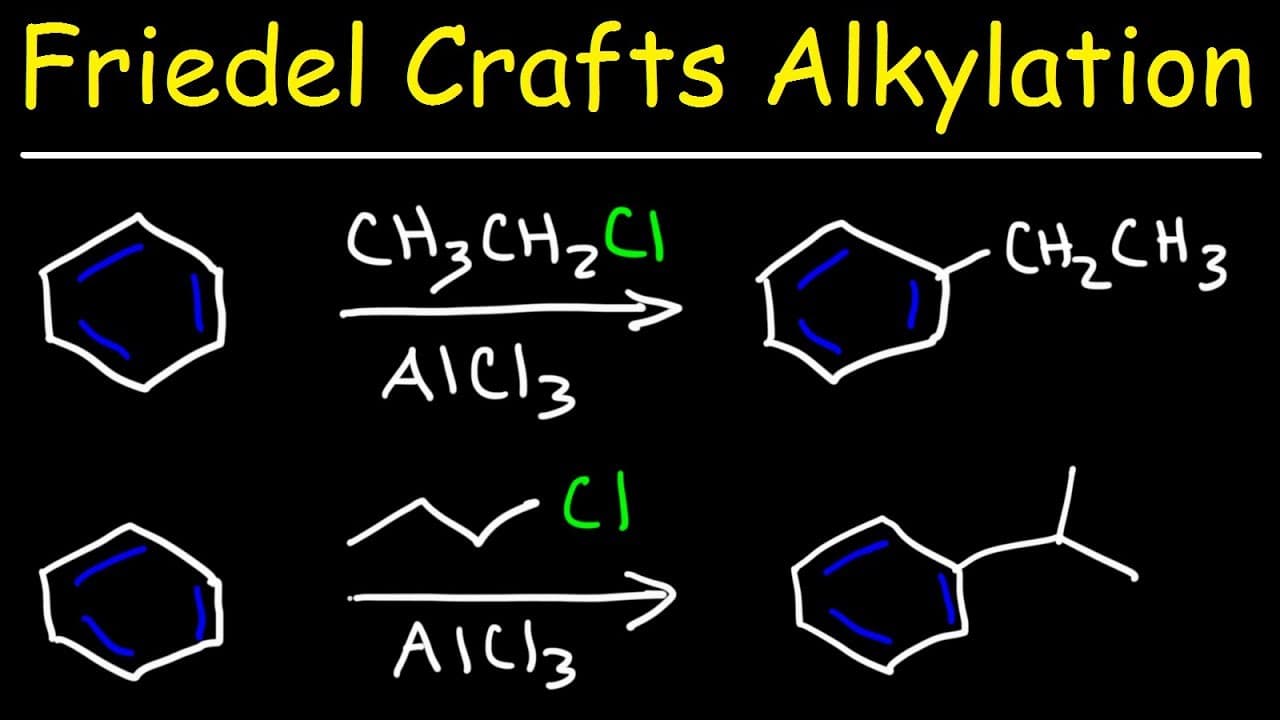
The Friedel-Crafts alkylation replaces a hydrogen atom in benzene with an alkyl group, using an alkyl chloride and aluminum chloride as a catalyst. However, it has limitations such as polyalkylation, carbocation rearrangements, and ineffectiveness with strongly deactivated rings like nitrobenzene. Alternative methods include using alkenes with hydrofluoric acid or alcohols with boron trifluoride.
Transcript
in this video we're going to go over the frito crafts alkylation reaction of benzene so here is the generic reaction so let's start with benzene and what we're going to do is we're going to react with an alkyl chloride using aluminum chloride as the catalyst and the net effect is that we're replacing a hydrogen atom with an alkyl group or with an r... Read More
Key Insights
- 🫀 The Friedel-Crafts alkylation reaction involves replacing a hydrogen atom in benzene with an alkyl group using aluminum chloride as the catalyst.
- 😋 Limitations of the reaction include polyalkylations, carbocation rearrangements, and its ineffectiveness with strongly deactivated rings like nitrobenzene.
- ❓ Alternative methods of benzene alkylation include using alkenes with hydrofluoric acid or alcohols with boron trifluoride.
Install to Summarize YouTube Videos and Get Transcripts
Explore YouTube Video Summarizer or Get YouTube Transcript Extractor
Questions & Answers
Q: What is the basic concept behind the Friedel-Crafts alkylation reaction?
The basic idea is to replace a hydrogen atom in benzene with an alkyl group, achieved by reacting an alkyl chloride with aluminum chloride as the catalyst. It results in the formation of an alkylated product.
Q: What are the limitations of the Friedel-Crafts alkylation reaction?
The limitations include the possible occurrence of polyalkylations, where more than one alkyl group is added to the benzene ring, carbocation rearrangements, and the failure of the reaction with strongly deactivated rings like nitrobenzene.
Q: Can the Friedel-Crafts alkylation reaction be performed without using an alkyl chloride?
Yes, it is possible to perform the reaction using other compounds such as alkenes or alcohols. For example, an alkene with hydrofluoric acid or an alcohol with boron trifluoride can be used as alternative methods.
Q: How can propyl benzene be obtained from benzene if the Friedel-Crafts alkylation reaction is not an effective method?
Propyl benzene can be synthesized by first alkylating benzene with an acid chloride containing three carbon atoms using the Friedel-Crafts alkylation reaction. The resulting ketone can then be reduced to an alkane using the Clemmensen or Wolff-Kishner reduction, yielding propyl benzene.
Summary & Key Takeaways
-
The Friedel-Crafts alkylation reaction involves replacing a hydrogen atom in benzene with an alkyl group using an alkyl chloride and aluminum chloride as the catalyst.
-
Limitations of the reaction include the possibility of polyalkylations, carbocation rearrangements, and the ineffectiveness with strongly deactivated rings such as nitrobenzene.
-
Alternative methods for alkylating benzene include using alkenes with hydrofluoric acid or alcohols with boron trifluoride.
Read in Other Languages (beta)
Share This Summary 📚
Summarize YouTube Videos and Get Video Transcripts with 1-Click
Try YouTube Summary with ChatGPT & Claude or YouTube Transcript Generator
Explore More Summaries from The Organic Chemistry Tutor 📚



Summarize YouTube Videos and Get Video Transcripts with 1-Click
Try YouTube Summary with ChatGPT & Claude or YouTube Transcript Generator