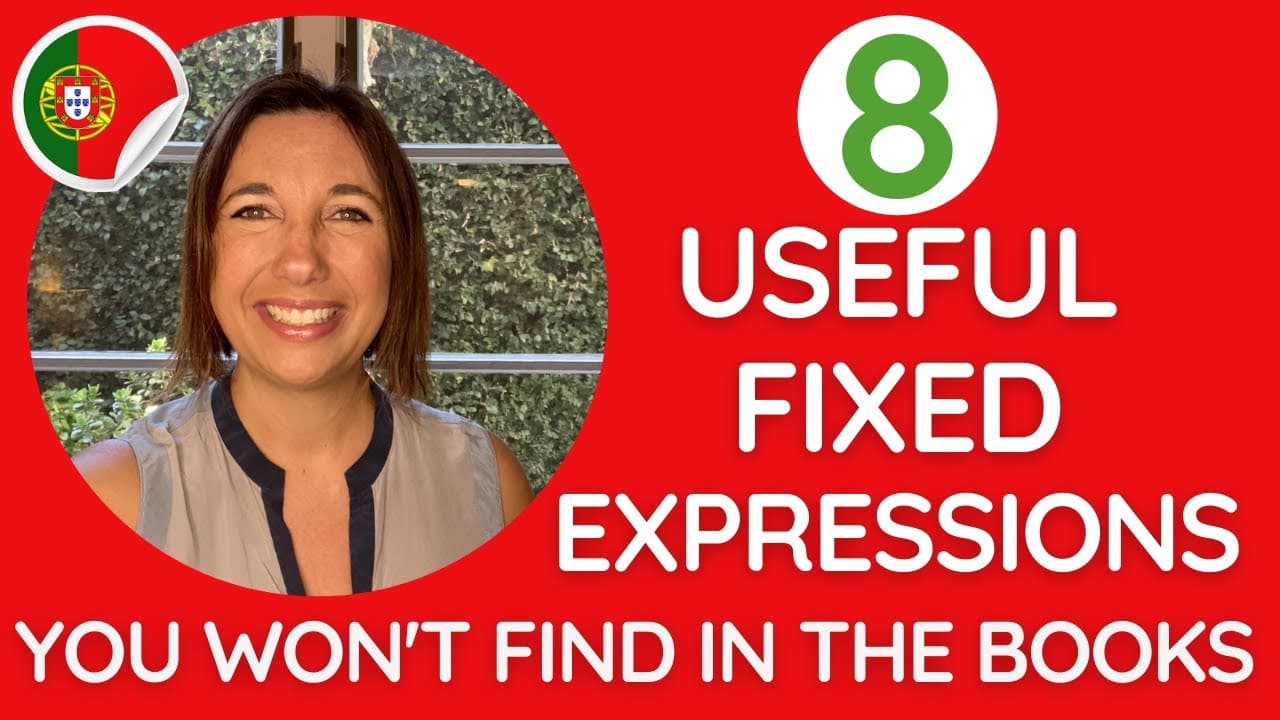
8 Fixed Expressions to Sound Like a Native in European Portuguese.
TL;DR
Learn 8 key Portuguese expressions starting with 'À'.
Transcript
Olá a todos! In this episode, I will be talking about fixed expressions. I love to teach these because they are used in everyday situations in Portugal and usually are very difficult for students to understand. Since these require memorization, to make it easier I decided to focus on the fixed expressions that begin with “À”, the contraction of the... Read More
Key Insights
- Fixed expressions in Portuguese often don't translate word-for-word and require memorization for proper usage.
- The expression 'À toa' is used to describe actions done randomly or without reason, often used in negative contexts.
- 'À borla' is a slang term for getting something for free, interchangeable with 'de graça'.
- 'À maneira' is a compliment indicating something done correctly or a person being good.
- 'À socapa' describes actions done secretly to avoid attention, similar to doing something on the sly.
- 'À tangente' is used when someone narrowly escapes or achieves something, akin to 'by the skin of my teeth'.
- 'À revelia' is often used in legal contexts to indicate actions done against someone's will.
- 'À vista desarmada' means perceiving something without additional help, similar to 'to the naked eye'.
Install to Summarize YouTube Videos and Get Transcripts
Explore YouTube Video Summarizer or Get YouTube Transcript Extractor
Questions & Answers
Q: What is the significance of using fixed expressions in Portuguese?
Fixed expressions in Portuguese are crucial for sounding more natural and fluent. They often don't translate directly into other languages, making them challenging for learners. By mastering these expressions, one can navigate everyday conversations more effectively and understand cultural nuances better.
Q: How does 'À toa' differ from other expressions?
'À toa' specifically refers to actions done without purpose or randomly. It's often used in negative contexts to describe behavior that lacks direction or intention. This distinguishes it from other expressions that might convey a sense of purpose or intention.
Q: What context is 'À borla' used in?
'À borla' is used when something is obtained for free. It's a slang expression, interchangeable with 'de graça', and is commonly used in informal settings. Understanding when to use 'À borla' can help in casual conversations where discussing free items or services is relevant.
Q: Can you explain the expression 'À socapa'?
'À socapa' refers to doing something secretly or quietly to avoid drawing attention. It's akin to doing something on the sly or under the radar. This expression is useful in contexts where discretion is necessary, and understanding its use can help in navigating conversations about secretive actions.
Q: What does 'À tangente' convey?
'À tangente' is used when someone narrowly escapes or achieves something. It derives from mathematical terminology, meaning tangent, and is similar to the English idiom 'by the skin of my teeth'. This expression is valuable in discussions about close calls or near misses.
Q: In what situations is 'À revelia' used?
'À revelia' is often used in legal contexts to describe actions taken against someone's will. It has been extended to other social contexts, indicating something done without consent. This expression is important for understanding discussions about authority and consent.
Q: How is 'À pala de' different from 'À borla'?
'À pala de' indicates getting or doing something because someone else is paying for it or sponsoring it. While both expressions involve getting something without personal cost, 'À pala de' emphasizes the involvement of a third party, making it distinct from 'À borla'.
Q: What does 'À vista desarmada' mean?
'À vista desarmada' means perceiving something without additional help, akin to 'to the naked eye'. It's used to describe observations made without tools or enhancements. This expression is useful in contexts where natural perception is emphasized, such as in scientific or observational discussions.
Summary & Key Takeaways
-
The video focuses on teaching eight fixed expressions in European Portuguese that start with the contraction 'À'. These expressions are commonly used in everyday situations in Portugal and can be challenging for learners to master.
-
Each expression has a unique meaning and context of use, such as 'À toa' for random actions, or 'À borla' for something free. Understanding these expressions can enhance conversational skills in Portuguese.
-
The video also promotes a book club and encourages viewers to subscribe for more content. The expressions are explained with examples, helping learners to incorporate them into daily conversations.
Read in Other Languages (beta)
Share This Summary 📚
Summarize YouTube Videos and Get Video Transcripts with 1-Click
Try YouTube Summary with ChatGPT & Claude or YouTube Transcript Generator
Explore More Summaries from Learn European Portuguese Online 📚


Summarize YouTube Videos and Get Video Transcripts with 1-Click
Try YouTube Summary with ChatGPT & Claude or YouTube Transcript Generator