Cell size | Structure of a cell | Biology | Khan Academy
TL;DR
Cells have a minimum size due to the complexity of their structure and a maximum size due to the volume-to-surface area ratio.
Transcript
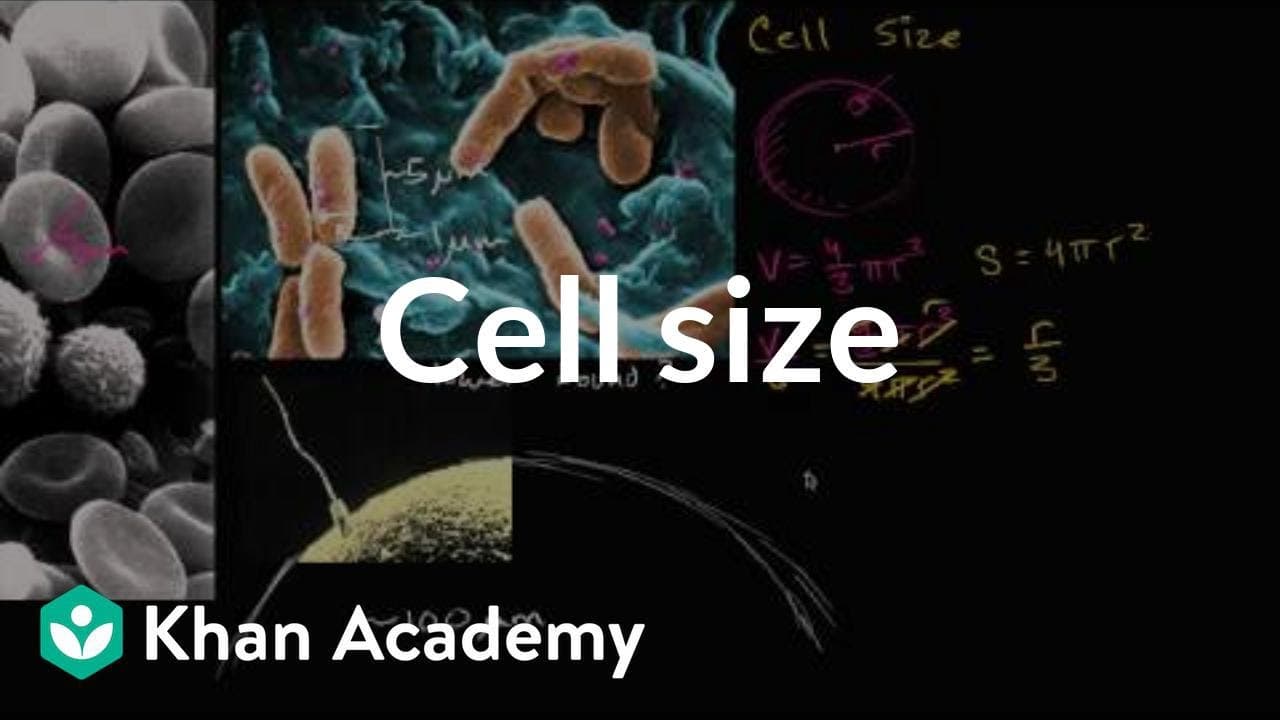
- What I want to think about in this video is cell size, and in particular how small cells can get, and then also what tends to be the limiting factors for how large a cell can get. And I have some pictures of cells here. This picture right over here, this picture of pseudomonas bacteria, each of these pill-shaped things, this is a bacterial cell. ... Read More
Key Insights
- 🧑🌾 The smallest observed cells are a few hundred nanometers in size, with bacteria being the smallest known so far.
- 🥳 The volume-to-surface area ratio is an important limiting factor for cell size.
- 💗 As cells grow larger, the volume increases faster than the surface area, affecting nutrient exchange and waste removal.
- 💠 Cells can have different shapes and structures to maximize their surface area.
- 💁 The complexity of cellular structures and the need for genetic information and cellular machinery limit how small cells can get.
- 🥳 The volume-to-surface area ratio is an important consideration in many biological processes, not just cell size.
- 🔶 Different types of cells have different size ranges, with human egg cells being some of the largest cells in terms of diameter.
Install to Summarize YouTube Videos and Get Transcripts
Explore YouTube Video Summarizer or Get YouTube Transcript Extractor
Questions & Answers
Q: How small can a cell get?
The smallest observed cells are a few hundred nanometers in size, with bacterial cells being the smallest known so far. These cells are highly complex and have genetic information and cellular machinery packed into their small size.
Q: What is the limiting factor for cell size?
The volume-to-surface area ratio is a critical limiting factor for cell size. As cells increase in volume, the surface area must be able to handle the processing of inputs and outputs. If the surface area cannot keep up, the cell cannot function effectively.
Q: Can cells grow indefinitely?
Cells cannot grow indefinitely due to the limitations imposed by the volume-to-surface area ratio. As cells grow larger, the volume increases faster than the surface area, making it difficult for the surface to handle nutrient exchange and waste removal.
Q: Do all cells have spherical shapes?
Not all cells have spherical shapes. Some cells, like nerve cells, are long and thin to maximize their surface area. Other cells have structures that stick out to increase surface area.
Summary & Key Takeaways
-
The smallest observed cells are a few hundred nanometers in size, with bacterial cells discovered at the smallest size so far.
-
The volume-to-surface area ratio is a limiting factor for cell size, as the surface area must be able to process inputs and outputs for the volume of the cell.
-
As cells grow larger, the volume increases faster than the surface area, making it difficult for the surface to handle nutrient exchange and waste removal.
Read in Other Languages (beta)
Share This Summary 📚
Summarize YouTube Videos and Get Video Transcripts with 1-Click
Try YouTube Summary with ChatGPT & Claude or YouTube Transcript Generator
Explore More Summaries from Khan Academy 📚



Summarize YouTube Videos and Get Video Transcripts with 1-Click
Try YouTube Summary with ChatGPT & Claude or YouTube Transcript Generator