How to Perform Implicit Differentiation with Trigonometric Functions
TL;DR
To perform implicit differentiation on the equation tan(x/y) = x + y, apply the derivative operator on both sides using the chain rule. After substituting and simplifying, the resulting expression for dy/dx is (1/y - cos^2(x/y))/(x/y^2 + cos^2(x/y)), allowing you to find the derivative effectively.
Transcript
I've been asked implicitly differentiate the equation tangent of x over y is equal to x plus y. And I've done several implicit differentiation videos, but this tends to be one of the biggest sources of pain for first year calculus students. So I thought I would give at least another example. It never hurts to see as many as possible. So let's do th... Read More
Key Insights
- ❓ Implicit differentiation is a technique used to differentiate equations when it is not possible or easy to solve explicitly for a variable.
- 👻 The chain rule allows us to differentiate composite functions by multiplying the derivative of the outer function with the derivative of the inner function.
- 🙃 The process of implicit differentiation involves applying the derivative operator to both sides of the equation and treating the variables as functions of the differentiating variable.
- 😑 After algebraic manipulation, the expression for dy/dx can be obtained and used for further analysis or calculations.
- 🤝 Implicit differentiation is an important tool in calculus, especially when dealing with equations involving trigonometric functions or complex variables.
- 📏 Understanding the chain rule and algebraic manipulation is crucial for effectively applying implicit differentiation.
- 🆘 Practice and exposure to multiple examples can help improve understanding and proficiency in implicit differentiation.
Install to Summarize YouTube Videos and Get Transcripts
Explore YouTube Video Summarizer or Get YouTube Transcript Extractor
Questions & Answers
Q: What is implicit differentiation?
Implicit differentiation involves differentiating both sides of an equation with respect to a variable, usually x, and treating the other variables as functions of that variable. It allows us to find derivatives for equations that cannot be solved explicitly for a given variable.
Q: How is implicit differentiation applied in this example?
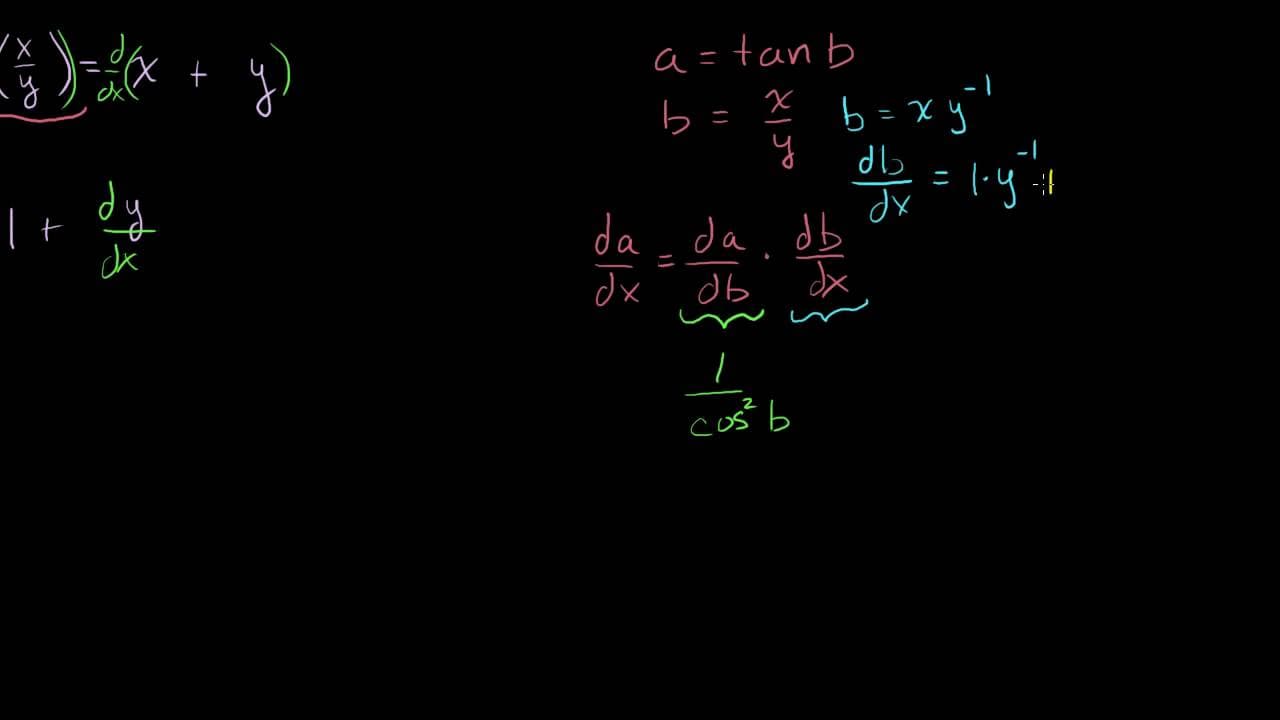
In this example, we apply the derivative with respect to x on both sides of the equation tangent(x/y) = x + y. We substitute a = tan(b) and b = x/y to differentiate the left side and solve for dy/dx.
Q: What is the chain rule used for in implicit differentiation?
The chain rule is applied when differentiating composite functions. In this example, we use the chain rule to differentiate the left side of the equation by treating a and b as functions of x, leading to the derivation of dy/dx.
Q: Why is it important to simplify the expression before solving for dy/dx?
Simplifying the expression helps isolate dy/dx and make it easier to solve for. By dividing both sides by a common factor, we can obtain a simplified expression for dy/dx that can be further manipulated if needed.
Summary & Key Takeaways
-
Implicit differentiation involves applying the derivative with respect to x on both sides of an equation.
-
To differentiate the left side of the equation, we substitute a = tan(b) and b = x/y.
-
By applying the chain rule and simplifying, we arrive at an expression for dy/dx.
-
After algebraic manipulation, the expression becomes (1/y - cos^2(x/y))/(x/y^2 + cos^2(x/y)).
Read in Other Languages (beta)
Share This Summary 📚
Summarize YouTube Videos and Get Video Transcripts with 1-Click
Try YouTube Summary with ChatGPT & Claude or YouTube Transcript Generator
Explore More Summaries from Khan Academy 📚



Summarize YouTube Videos and Get Video Transcripts with 1-Click
Try YouTube Summary with ChatGPT & Claude or YouTube Transcript Generator