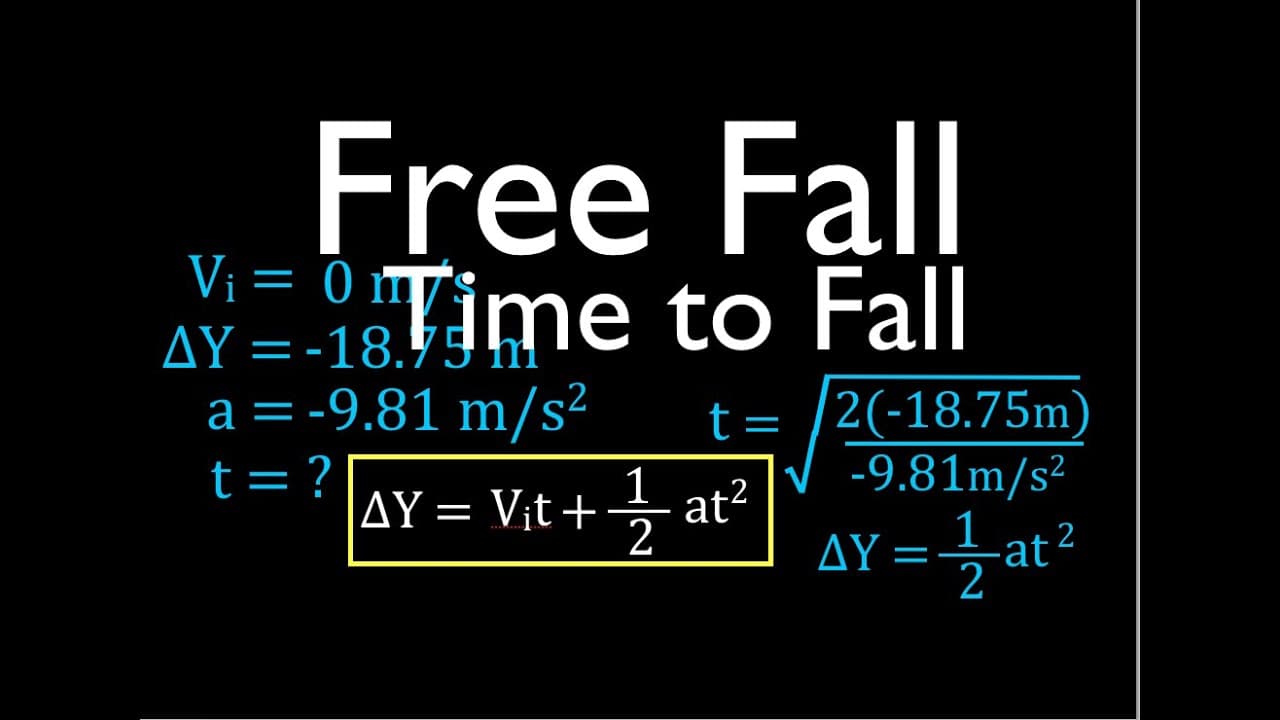
Physics, Kinematics, Free Fall (4 of 12) Solving for Time to Fall from Known Height
TL;DR
Calculate the time for an iPhone to fall from a 5-story balcony, given the distance of 18.75 meters.
Transcript
okay in today's video I'm going to go over a problem involving one-dimensional kinematics for freef fall and in this video we're going to calculate the time it takes something to fall if we know the distance so this is the problem we have Sam was mad at a sister Olivia so he took her iPhone and dropped it off the balcony of their fifth Story apartm... Read More
Key Insights
- 🆘 Drawing a diagram can help visualize the problem and understand the coordinate system being used.
- 👂 The variables involved in kinematic equations should be listed before attempting to solve the problem.
- 🥶 The acceleration due to gravity is always negative in free fall problems.
- ⌛ Kinematic equations can be used to find the time if the other variables are known.
- 🥶 The equation Δy = 1/2at^2 simplifies to Δy = 1/2gt^2 in free fall problems.
- 🍂 The time for an object to fall from a certain height is directly proportional to the square root of the distance.
- 🤔 The time and distance in free fall problems can be thought of as interchangeable measurements.
Install to Summarize YouTube Videos and Get Transcripts
Explore YouTube Video Summarizer or Get YouTube Transcript Extractor
Questions & Answers
Q: How is the initial velocity determined in free fall problems?
In free fall problems, the initial velocity is generally assumed to be zero because the object is dropped.
Q: What is the acceleration used in free fall problems?
The acceleration used in free fall problems is the acceleration due to gravity on Earth, which is approximately 9.81 m/s^2.
Q: How can the time be found in kinematic equations when the final velocity is not given?
When the final velocity is not given, a kinematic equation that includes time and the other known variables can be used. In this case, the equation that is used is Δy = 1/2at^2.
Q: How is the simplified equation Δy = 1/2at^2 derived?
The equation Δy = 1/2at^2 is derived by simplifying the equation ∆y = v_it + 1/2a*t^2, where the initial velocity v_i is assumed to be zero in free fall problems.
Summary & Key Takeaways
-
A problem involving one-dimensional kinematics for free fall is presented, where the goal is to calculate the time an object takes to fall a given distance.
-
A diagram is drawn to visualize the situation, with the object falling straight down from a 5-story balcony.
-
The variables involved in kinematic equations are listed, and the known variables for the problem are filled in.
Read in Other Languages (beta)
Share This Summary 📚
Summarize YouTube Videos and Get Video Transcripts with 1-Click
Try YouTube Summary with ChatGPT & Claude or YouTube Transcript Generator
Explore More Summaries from Step by Step Science 📚



Summarize YouTube Videos and Get Video Transcripts with 1-Click
Try YouTube Summary with ChatGPT & Claude or YouTube Transcript Generator