Expected profit from lottery ticket | Probability and Statistics | Khan Academy
TL;DR
Calculate the expected net profit of playing a specific lottery game, which surprisingly has a positive outcome.
Transcript
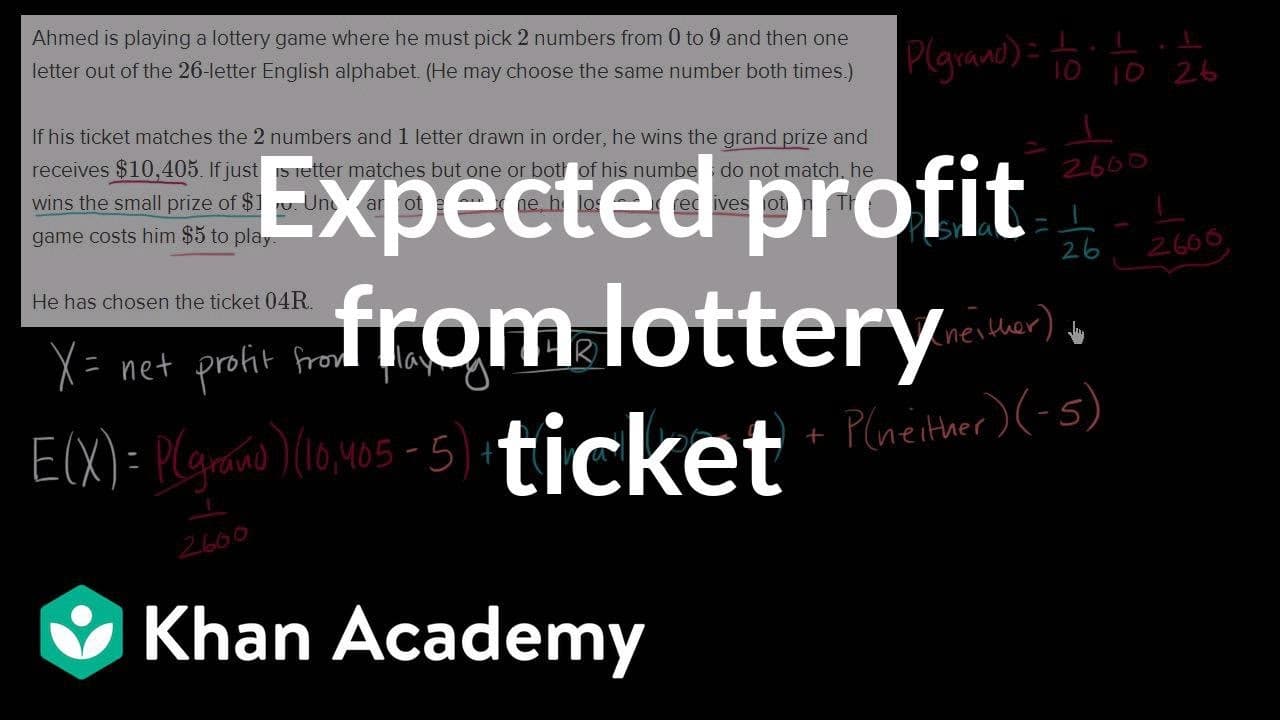
Voiceover:Ahmed is playing a lottery game where he must pick two numbers from zero to nine and then one letter out of the 26 letter English alphabet. He may choose the same number both times. If his ticket matches the two numbers and one letter drawn in order, he wins the grand prize and receives $10,405. If just his letter matches but one or both ... Read More
Key Insights
- 🎮 Expected net profit from playing this lottery game is positive, which is unusual and against the norm in lottery games.
- ❓ The specific probabilities and payoffs of each outcome determine the expected value.
- 🎮 Calculating the expected net profit can help individuals make informed decisions about playing or not playing this particular lottery game.
- 🎮 The game costs $5 to play, which factors into the calculations of net profit.
- 😘 The probability of winning the grand prize is extremely low at 1 in 2600.
- 😉 The probability of winning the small prize is higher at 1 in 26, but must be adjusted to exclude scenarios where the grand prize is won.
- 😉 The probability of not winning anything is 25/26, indicating a high likelihood of losing.
Install to Summarize YouTube Videos and Get Transcripts
Explore YouTube Video Summarizer or Get YouTube Transcript Extractor
Questions & Answers
Q: What are the payouts for winning this lottery game?
There are two potential payouts - $10,405 for matching both numbers and the letter, or $100 for only matching the letter.
Q: What is the probability of winning the grand prize?
The probability of winning the grand prize is 1 in 2600. This is derived from the individual probabilities of picking the correct numbers and letter.
Q: How is the probability of winning the small prize calculated?
The probability of winning the small prize is 1 in 26, which represents the chance of picking the correct letter only. However, this includes scenarios where the grand prize is won, so the probability of winning the grand prize (1 in 2600) must be subtracted to get the true probability of the small prize.
Q: Why is the probability of not winning calculated as 25/26?
The probability of not winning (getting nothing) is derived from the fact that there is a 1 in 26 chance of getting the letter wrong. Therefore, the probability of getting nothing is 1 minus the probability of winning the grand prize (1/26).
Summary & Key Takeaways
-
Ahmed plays a lottery game where he picks two numbers and one letter from 0-9 and A-Z respectively.
-
The game has specific payouts: $10,405 if both numbers and the letter match, $100 if only the letter matches, and nothing for any other outcome.
-
By calculating the probabilities and payoffs, the expected net profit of playing this specific ticket is $2.81.
Read in Other Languages (beta)
Share This Summary 📚
Summarize YouTube Videos and Get Video Transcripts with 1-Click
Try YouTube Summary with ChatGPT & Claude or YouTube Transcript Generator
Explore More Summaries from Khan Academy 📚



Summarize YouTube Videos and Get Video Transcripts with 1-Click
Try YouTube Summary with ChatGPT & Claude or YouTube Transcript Generator