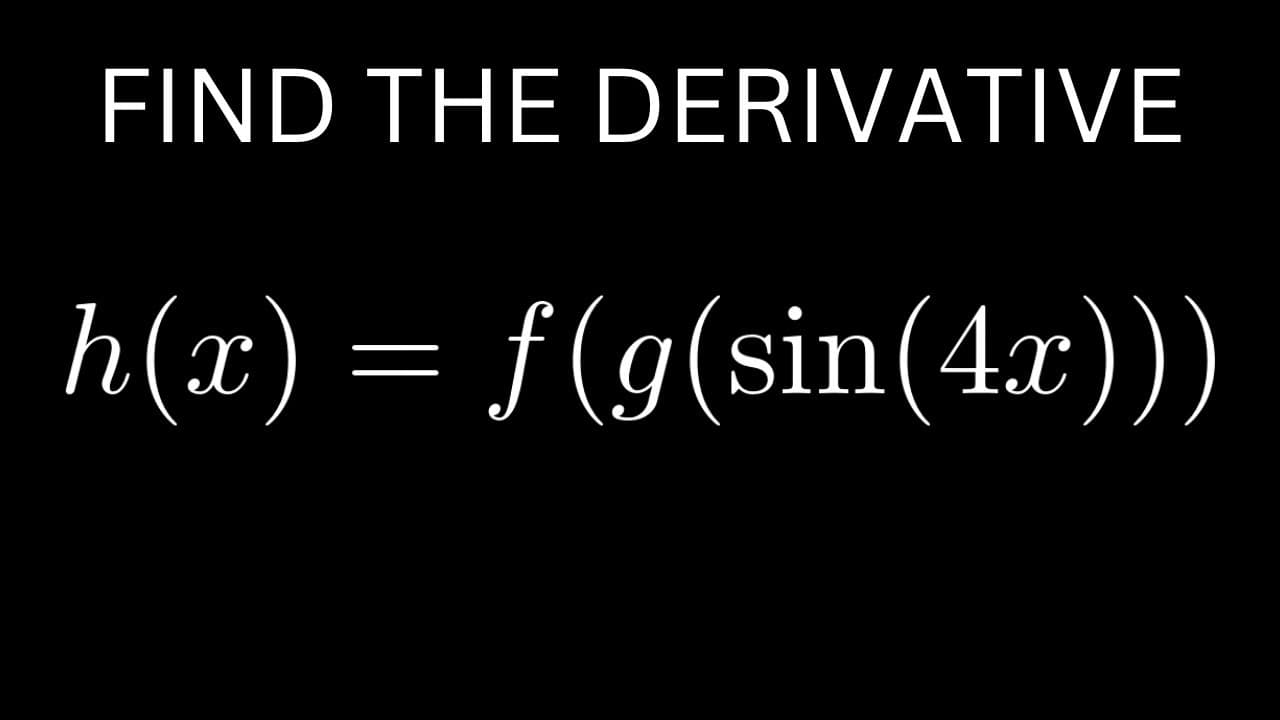
Derivative of h(x) = f(g(sin(4x)))
TL;DR
This video explains how to find the derivative of a function using the chain rule in calculus.
Transcript
hello in this problem we are going to find the derivative of this function we have H of x equals F of G of the sine of 4X and the question is to find the derivative of H so first recall the chain rule from calculus the chain rule so chain rule says that if you take the derivative with respect to X of a function say f of G of x you want to think of ... Read More
Key Insights
- 👻 The chain rule is a powerful tool in calculus that allows us to find the derivative of compositions of functions.
- 💠 It involves differentiating the outside function while leaving the inside function untouched, then multiplying it by the derivative of the inside function.
- 📏 The chain rule can be applied to functions with multiple layers of compositions, requiring multiple applications of the rule.
- 📏 Correct usage of parentheses is essential in ensuring the accuracy of the chain rule.
- 📏 The chain rule is not limited to single-variable functions and can be extended to functions with multiple variables.
- 🏑 Understanding the chain rule is crucial for solving complex calculus problems and applications in various fields.
- 🥳 The chain rule simplifies differentiation by breaking down complicated functions into smaller, manageable parts.
Install to Summarize YouTube Videos and Get Transcripts
Explore YouTube Video Summarizer or Get YouTube Transcript Extractor
Questions & Answers
Q: What is the chain rule in calculus?
The chain rule is a rule in calculus that allows us to find the derivative of a composition of functions. It involves taking the derivative of the outside function and multiplying it by the derivative of the inside function.
Q: How does the chain rule work in this specific example?
In this example, we have the function H(x) = F(G(sin(4x))). We first find the derivative of the outside function F, leaving the inside function G(sin(4x)) untouched. Then, we find the derivative of G, leaving sin(4x) untouched. Finally, we find the derivative of sin(4x) and multiply all the derivatives together.
Q: Why is it important to use parentheses correctly in the chain rule?
Using parentheses correctly is crucial in the chain rule to ensure that the composition of functions is properly calculated. Each set of parentheses represents the composition of an inside function with an outside function, and maintaining the correct number of parentheses ensures accurate differentiation.
Q: Are there applications of the chain rule in real-world scenarios?
Yes, the chain rule is widely used in various fields, such as physics, engineering, and economics. It allows us to find the rate of change of a dependent variable with respect to an independent variable in situations where multiple functions are combined.
Summary & Key Takeaways
-
The video teaches the chain rule in calculus, which involves finding the derivative of an outside function while leaving the inside function untouched and then multiplying it by the derivative of the inside function.
-
The example in the video involves finding the derivative of H, where H(x) = F(G(sin(4x))).
-
Multiple chain rules are used in this example, with the derivative of each function being calculated step by step.
Read in Other Languages (beta)
Share This Summary 📚
Summarize YouTube Videos and Get Video Transcripts with 1-Click
Try YouTube Summary with ChatGPT & Claude or YouTube Transcript Generator
Explore More Summaries from The Math Sorcerer 📚

Summarize YouTube Videos and Get Video Transcripts with 1-Click
Try YouTube Summary with ChatGPT & Claude or YouTube Transcript Generator